
On this page
- 01Key takeaways
- 02What is a creative brief?
- 03What are the nine fields?
- 04What does a completed brief look like?
- 05What are the common gaps?
- 06How does a brief save time?
- 07When is a full brief too much?
- 08What does this look like in practice?
- 09Creative brief checklist
- 10Next step
- 11Sources and further reading
- 12Frequently asked questions
Key takeaways
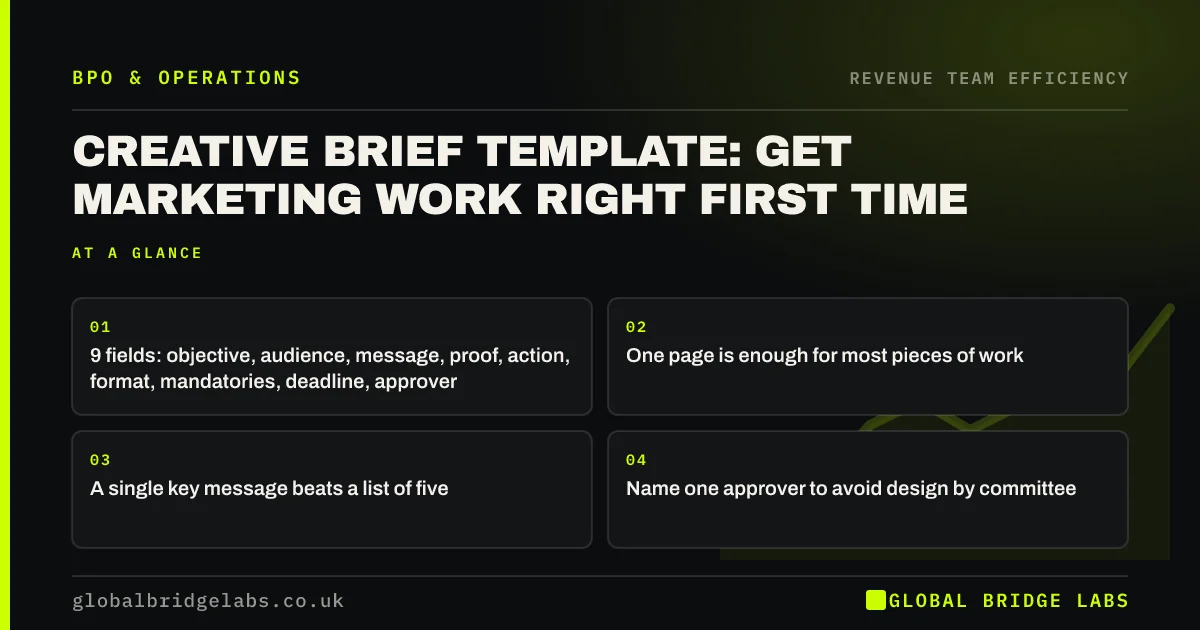
A creative brief template is a one-page form that tells a designer, writer or agency what to make and why. Nine fields cover most work: objective, audience, key message, proof, call to action, format, mandatories, deadline and approver. A complete brief usually halves the rounds of changes, because the first draft is aimed at the right target.
- 9 fields: objective, audience, message, proof, action, format, mandatories, deadline, approver.
- One page is enough for most pieces of work.
- A single key message beats a list of five.
- Name one approver to avoid design by committee.
Want this template adapted for your business? Message us on WhatsApp.
Chat on WhatsApp →What is a creative brief?
A creative brief is a short document that sets out what a piece of marketing must achieve, for whom and within what limits. It is written by the business and given to whoever produces the work, in-house or outsourced. It is the single most effective way to cut rework in design, copy and video.
What are the nine fields?
Each field answers a question a designer or writer would otherwise have to ask, or guess.
- Objective: what this piece must achieve.
- Audience: who it is for, in a sentence.
- Key message: the one thing they should remember.
- Proof: why they should believe it.
- Call to action: what they should do next.
- Format: size, channel, length and specs.
- Mandatories: logo, legal lines, brand rules.
- Deadline: with time for one round of changes.
- Approver: the one person who signs off.
What does a completed brief look like?
In an illustrative example for a trades firm: the objective is more boiler service bookings in September; the audience is homeowners within 15 miles with boilers over five years old; the key message is book before the winter rush; the proof is Gas Safe registration and reviews; the action is book online. Format: three social posts and one email. Approver: the operations manager. Example only.
- Marketing operations for small businesses: less chaos
- Acceptance criteria: define done for outsourced work
Want a second opinion on a brief before you send it? Share it on WhatsApp.
Chat on WhatsApp →What are the common gaps?
The common gaps are an objective that is really a task, such as make a post, several key messages competing for space, no proof, and no named approver. Missing mandatories, such as required legal lines, are a frequent cause of late changes. Each gap adds a round of revisions.
How does a brief save time?
A brief saves time because changes cost most when they come late. Settling the objective, message and mandatories before work starts means feedback is about execution, not direction. In an illustrative example, three rounds of changes at two hours each fall to one round after a full brief. Example figures only.
When is a full brief too much?
A full brief is too much for small repeat tasks, such as a weekly post in an established format. A two-line note referencing a standing brief is enough. Use the full template for new campaigns, new formats and anything that will be widely seen.
What does this look like in practice?
A pattern we see: a business blames its designer for slow work, but each job starts with a phone call and ends with three rounds of changes. A one-page brief turns most jobs into a single draft and a small round of edits.
Creative brief checklist
Check your brief against these.
- Objective is an outcome, not a task.
- One key message only.
- Proof is included.
- Call to action is clear.
- Mandatories are listed.
- One approver is named.
Next step
Send us a recent piece of marketing work that took several rounds. We will help you turn it into a template brief you can reuse.
Message us on WhatsApp for a brief template, or book a 30-minute consultation.
Chat on WhatsApp →Sources and further reading
Frequently asked questions
What should a creative brief include?
The objective, the audience, one key message, the proof behind it, the call to action, the format and specifications, any mandatory elements such as logos or legal lines, the deadline and one named approver. One page is enough for most work.
How long should a creative brief be?
Usually one page. Long briefs are skimmed and the important parts get missed. If you cannot fit the objective and key message into a sentence each, the thinking needs more work before the brief is written.
Who should write the creative brief?
The business commissioning the work, usually the person who owns the outcome. An agency or designer can help refine it, but the objective, audience and key message must come from the business.
Written by

Global Bridge Labs (GBL) is a UK–Sri Lanka partner for social media, websites and BPO. Everything here comes from client delivery, not theory.


