On this page
- 01Key takeaways
- 02What is the difference between the two motives?
- 03Why does the motive change the brief?
- 04Which motive pays back more for a small business?
- 05How do you write both into the contract?
- 06When should cost come first?
- 07What does this look like in practice?
- 08Motive checklist
- 09Next step
- 10Sources and further reading
- 11Frequently asked questions
Key takeaways
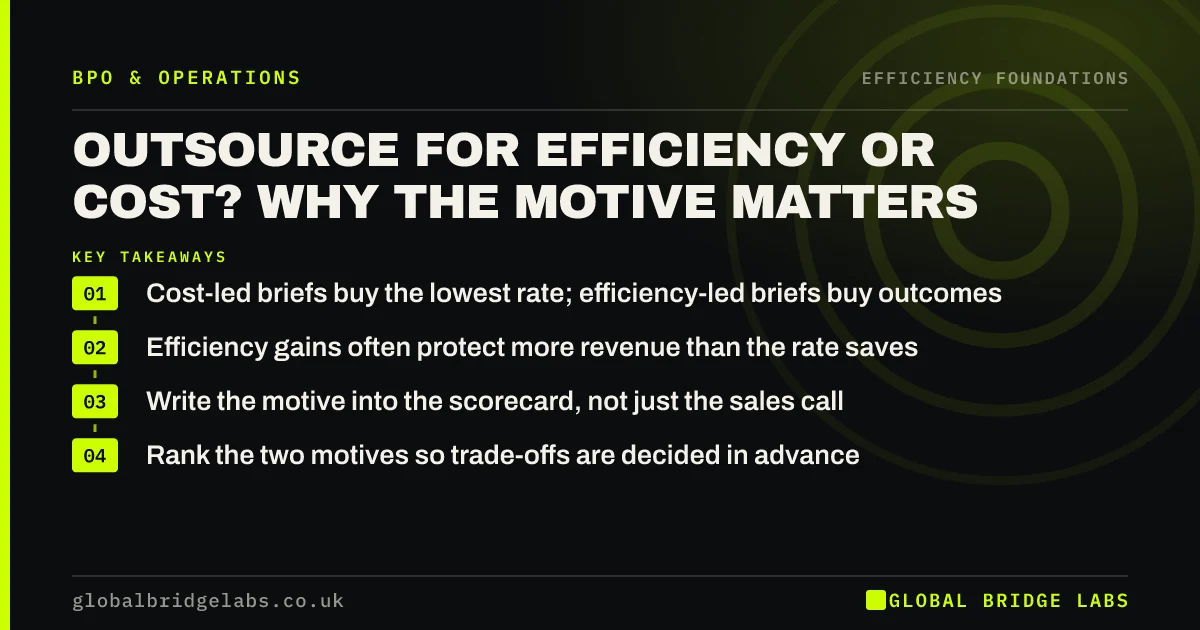
Outsourcing for efficiency judges success by lead time, accuracy and senior hours returned. Outsourcing for cost judges it by price per hour or per task. The motive shapes the brief, the provider you choose and the measures in the contract. Most small businesses gain more from efficiency, but the best briefs name both and rank them.
- Cost-led briefs buy the lowest rate; efficiency-led briefs buy outcomes.
- Efficiency gains often protect more revenue than the rate saves.
- Write the motive into the scorecard, not just the sales call.
- Rank the two motives so trade-offs are decided in advance.
Not sure which motive fits your business? Message us on WhatsApp with what is hurting most.
Chat on WhatsApp →What is the difference between the two motives?
A cost motive asks how cheaply the same work can be done. An efficiency motive asks how much faster, more accurate and less disruptive it can become. Both are legitimate. They pull in different directions when a choice comes up, such as paying a little more for UK-hours cover that halves response times.
Why does the motive change the brief?
The motive decides what you ask a provider to commit to. A cost brief specifies hours and rate. An efficiency brief specifies turnaround, right-first-time rate and backlog limits, and asks how the provider will improve them over time. Providers price and staff differently against each, so an unclear motive produces quotes that cannot be compared.
Which motive pays back more for a small business?
For most small businesses, efficiency pays back more because the largest losses are in senior time and slow service, not wages. In an illustrative example, saving £2 an hour on 40 hours a week is £4,160 a year. Returning 10 senior hours a week worth £60 each is about £31,200 a year of capacity. These are example figures to show scale.
Want both sides of this sum worked out with your numbers? Send them on WhatsApp.
Chat on WhatsApp →How do you write both into the contract?
Write cost terms as the price and the indexation clause, and efficiency terms as service levels with measures and a review cadence. Rank them: for example, turnaround first, accuracy second, price third. Then every trade-off in the first year has an agreed answer.
- Price: rate, minimums and annual review terms.
- Turnaround: a target per task type, measured weekly.
- Accuracy: right-first-time target with sampling.
- Improvement: one costed proposal each quarter.
When should cost come first?
Cost should come first when the business is under cash pressure, the process already runs well and customers do not notice its speed. Back-office work with fixed monthly deadlines, such as payroll inputs, often fits. Even then, keep an accuracy measure so a lower price does not create rework.
What does this look like in practice?
A pattern we see: a firm chooses the cheapest quote for customer email, then finds replies take two days because the provider staffs for the agreed hours, not the agreed turnaround. Rewriting the brief around response and resolution times fixes it, often for a modest change in price.
Motive checklist
Agree these points before you ask for quotes.
- Write down the one problem outsourcing must solve.
- Rank efficiency, quality and cost.
- Set a target for the top-ranked measure.
- Ask every provider to quote against it.
- Review the ranking after 90 days.
Next step
Tell us the problem you want outsourcing to fix. We will help you write a brief that names the right motive and the measures that prove it worked.
Message us on WhatsApp to shape your brief, or book a 30-minute consultation.
Chat on WhatsApp →Sources and further reading
- Rates and thresholds for employers 2026 to 2027 · HM Revenue & Customs
- The Sourcing and Consultancy Playbooks · Cabinet Office
Frequently asked questions
Is it better to outsource for efficiency or for cost?
For most small businesses efficiency pays back more, because slow service and senior time spent on admin cost more than the wage difference. Cost should lead when cash is tight and the process already runs well. The strongest briefs name both and rank them.
Can outsourcing improve efficiency and reduce cost at once?
Yes, often. A documented process run by a dedicated team usually costs less per task and moves faster. The two only conflict at the margin, for example when better cover or faster turnaround costs a little more. Deciding the ranking in advance settles those choices.
How do you measure efficiency in an outsourcing contract?
Use service levels for turnaround per task type, a right-first-time target checked by sampling, a backlog age limit and a weekly report. Add a review each quarter where the provider proposes at least one improvement with its expected effect.
Written by

Global Bridge Labs (GBL) is a UK–Sri Lanka partner for social media, websites and BPO. Everything here comes from client delivery, not theory.