
On this page
- 01Key takeaways
- 02What is a time and motion study?
- 03How do you run one in an office?
- 04What does a study usually find?
- 05What does it look like in numbers?
- 06How do the results help outsourcing?
- 07When does a time study backfire?
- 08What does this look like in practice?
- 09Time study checklist
- 10Next step
- 11Sources and further reading
- 12Frequently asked questions
Key takeaways
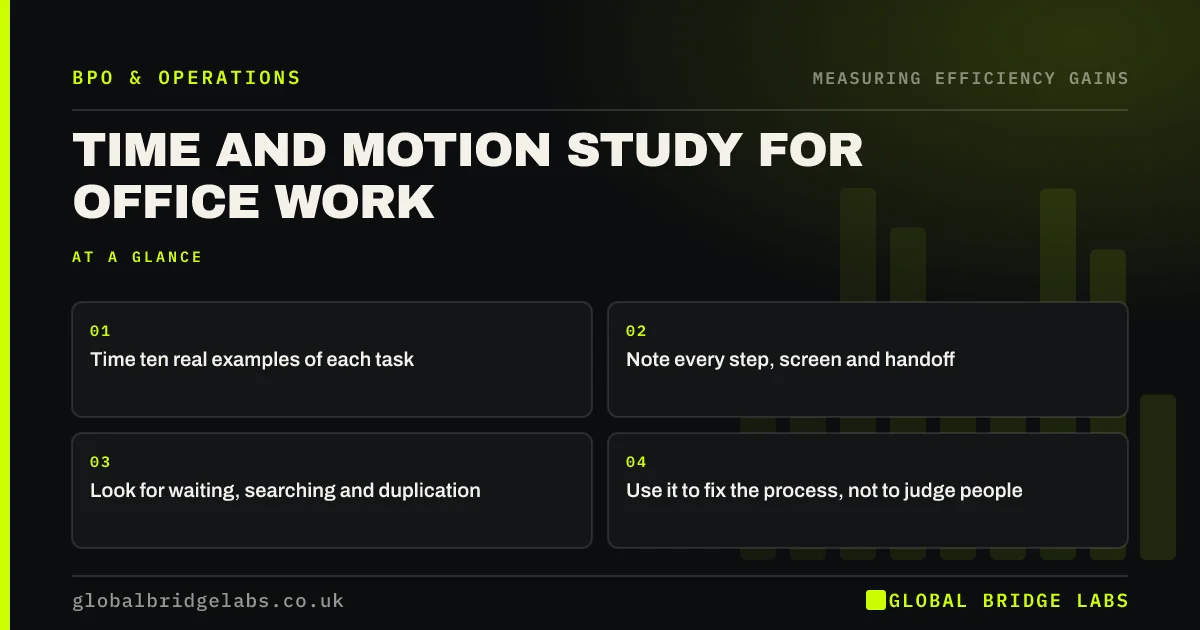
A time and motion study measures how long each step of a task takes and which movements or clicks add nothing. In office work the modern version is light: time ten examples of a task, note every step and screen, and look for waiting, searching and duplication. Use it to fix the process, not to judge individuals, and involve the people who do the work.
- Time ten real examples of each task.
- Note every step, screen and handoff.
- Look for waiting, searching and duplication.
- Use it to fix the process, not to judge people.
Want help running a light time study on one process? Message us on WhatsApp.
Chat on WhatsApp →What is a time and motion study?
A time and motion study combines two early 20th-century methods: time study, associated with Frederick Taylor, which measures how long tasks take, and motion study, developed by Frank and Lillian Gilbreth, which looks at the movements involved and removes unnecessary ones. Applied to offices, motions become clicks, screens, searches and handoffs.
How do you run one in an office?
Pick one task. Ask the person who does it to talk you through ten real examples while you note each step and time it, or have them record their screen. Separate active work from waiting, searching and rework. Agree the findings with them before changing anything.
- 1. Pick one task with clear start and end.
- 2. Observe or record ten real examples.
- 3. List every step and time each one.
- 4. Mark waiting, searching and rework.
- 5. Agree the findings with the team.
What does a study usually find?
In office tasks, studies usually find that the core work is a small share of the time. The rest is switching between screens, searching for information, retyping data and waiting for someone else. Those are the targets for improvement, and most can be fixed without asking anyone to work faster.
What does it look like in numbers?
In an illustrative study of supplier set-up, ten examples average 22 minutes. Only about 8 minutes is entering and checking details. Eight are spent searching emails for missing information and 6 retyping the same data into a second system. A set-up form and a system link cut the task to about 10 minutes. Example figures only.
- Supplier onboarding: set up new suppliers right first time
- Workflow automation for small businesses: where to start
Want a task timed and analysed with you? Send us the process on WhatsApp.
Chat on WhatsApp →How do the results help outsourcing?
The results give you a fair baseline for the handover, show which steps to remove before handing over, and make pricing discussions concrete. They also give the provider a realistic minutes-per-item figure to plan staffing from.
When does a time study backfire?
It backfires when people feel judged, so they work unusually fast or slow while observed, or when it is used to set targets without fixing the process. Explain the purpose, involve the team, study the process rather than the person and share what changes as a result.
What does this look like in practice?
A pattern we see: a business assumes a task is slow because the person doing it is slow. A short time study shows most of the time goes on finding information in old emails. Fixing that helps everyone who does the task.
Time study checklist
Use these when you run one.
- Explain the purpose to the team.
- Time ten real examples.
- Separate work, waiting, searching and rework.
- Agree findings with the people involved.
- Fix the process, then retime.
Next step
Tell us the task you suspect takes longer than it should. We will help you plan a light time study and read the results.
Message us on WhatsApp about a time study, or book a 30-minute consultation.
Chat on WhatsApp →Sources and further reading
- Labour productivity · Office for National Statistics
- What are the Management Standards for work-related stress? · Health and Safety Executive
Frequently asked questions
What is a time and motion study?
It is a method for measuring how long each step of a task takes and identifying movements or steps that add nothing. It combines Frederick Taylor's time study with Frank and Lillian Gilbreth's motion study. In offices it looks at clicks, screens, searching and handoffs.
How do you do a time study on office work?
Pick one task, observe or record ten real examples, list every step and time it, and separate active work from waiting, searching and rework. Agree the findings with the people who do the task, then fix the process and time it again.
Are time and motion studies still useful?
Yes, in a lighter form. A short study of ten examples often shows that most of a task's time goes on searching, retyping or waiting. Used to improve the process rather than to judge people, it is one of the quickest ways to find savings.
Written by

Global Bridge Labs (GBL) is a UK–Sri Lanka partner for social media, websites and BPO. Everything here comes from client delivery, not theory.


