
On this page
- 01Key takeaways
- 02What is division of labour?
- 03Why does specialisation make work faster?
- 04Why can small businesses not specialise in-house?
- 05What is the gain in numbers?
- 06When does specialisation go too far?
- 07What does this look like in practice?
- 08Specialisation checklist
- 09Next step
- 10Sources and further reading
- 11Frequently asked questions
Key takeaways
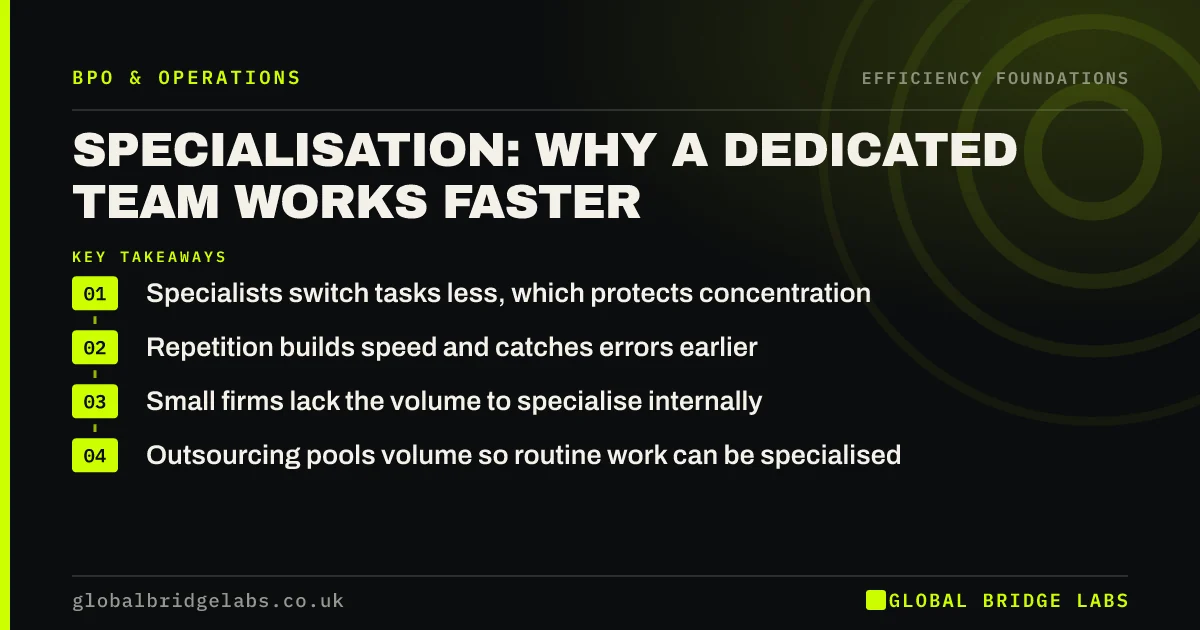
Division of labour raises efficiency because people who do one kind of task all day get faster, make fewer errors and switch less. Small businesses rarely have the volume to specialise internally, so routine work is spread thinly across generalists. A managed team gives a small firm specialised handling without needing enough work to fill specialist roles.
- Specialists switch tasks less, which protects concentration.
- Repetition builds speed and catches errors earlier.
- Small firms lack the volume to specialise internally.
- Outsourcing pools volume so routine work can be specialised.
Want to know which of your tasks would gain from specialised handling? Message us on WhatsApp.
Chat on WhatsApp →What is division of labour?
Division of labour is splitting work into distinct tasks so each person or team does fewer kinds of task more often. Adam Smith described it in 1776 using a pin factory, where dividing the work into steps multiplied output. In an office, it means one team handles invoices, another bookings, rather than everyone doing a little of each.
Why does specialisation make work faster?
Specialisation makes work faster for three reasons: practice, fewer switches and better tools. Someone who raises fifty invoices a day learns every shortcut and exception. They lose less time changing tasks, which the American Psychological Association notes can cost as much as 40% of productive time. And a team focused on one process can justify templates and checks a generalist never builds.
Why can small businesses not specialise in-house?
Small businesses usually lack the volume. If invoicing is six hours a week, nobody can do it full time, so it is shared, and each person does it slowly and differently. A provider pools work from several clients, so its team can specialise in a process type while each client buys only the hours it needs.
What is the gain in numbers?
In an illustrative example, three staff each spend two hours a week on supplier invoices, at about 15 minutes per invoice with one in eight corrected. A specialised team that does the same work daily takes about 8 minutes per invoice with one in forty corrected. Example figures to show the mechanism: about half the time and a fifth of the rework.
- Right first time rate: the quality number that cuts cost
- Purchase-to-pay process: faster, cleaner supplier payments
Want to estimate the gain on your own process? Send us the volumes on WhatsApp.
Chat on WhatsApp →When does specialisation go too far?
Specialisation goes too far when a task is split across so many people that handovers outweigh the gains, or when nobody sees the whole customer journey. Each handover adds a wait and a chance of error. Keep a process with as few handoffs as possible, and give one person the end-to-end view.
What does this look like in practice?
A pattern we see: four people each answer some customer email, each with their own style and their own saved replies. Moving the inbox to one dedicated team with shared templates shortens replies and makes them consistent, because the work is finally done by people who do it all day.
Specialisation checklist
Check these before splitting or handing over work.
- List tasks shared by three or more people.
- Measure time per item and correction rate.
- Group tasks that use the same system and skills.
- Keep handoffs to a minimum.
- Name one owner for the whole process.
Next step
Tell us which tasks are shared across your team. We will help you see which would gain from specialised handling and which should stay with the people who know the customer best.
Message us on WhatsApp to discuss your tasks, or book a 30-minute consultation.
Chat on WhatsApp →Sources and further reading
- Multitasking: switching costs · American Psychological Association
- Labour productivity · Office for National Statistics
Frequently asked questions
What is division of labour in business?
Division of labour is splitting work into separate tasks so each person or team does fewer kinds of work more often. It raises speed and accuracy through practice, fewer task switches and better tools. Adam Smith described it in 1776.
What are the benefits of specialisation?
Specialised staff work faster, make fewer errors, switch tasks less and build better templates and checks. For a small business without enough volume to specialise internally, a managed team that handles the same process for several clients provides those benefits on a part-time basis.
What are the disadvantages of specialisation?
Too much specialisation creates handoffs, and each handoff adds waiting and risk of error. People can also lose sight of the customer. Keep processes end to end where possible and give one person ownership of the whole flow.
Written by

Global Bridge Labs (GBL) is a UK–Sri Lanka partner for social media, websites and BPO. Everything here comes from client delivery, not theory.


