
On this page
- 01Key takeaways
- 02What is a process handoff?
- 03Why does each handoff add cost?
- 04What does that look like in numbers?
- 05How do you reduce handoffs?
- 06Does outsourcing add a handoff?
- 07When are handoffs necessary?
- 08What does this look like in practice?
- 09Handoff checklist
- 10Next step
- 11Sources and further reading
- 12Frequently asked questions
Key takeaways
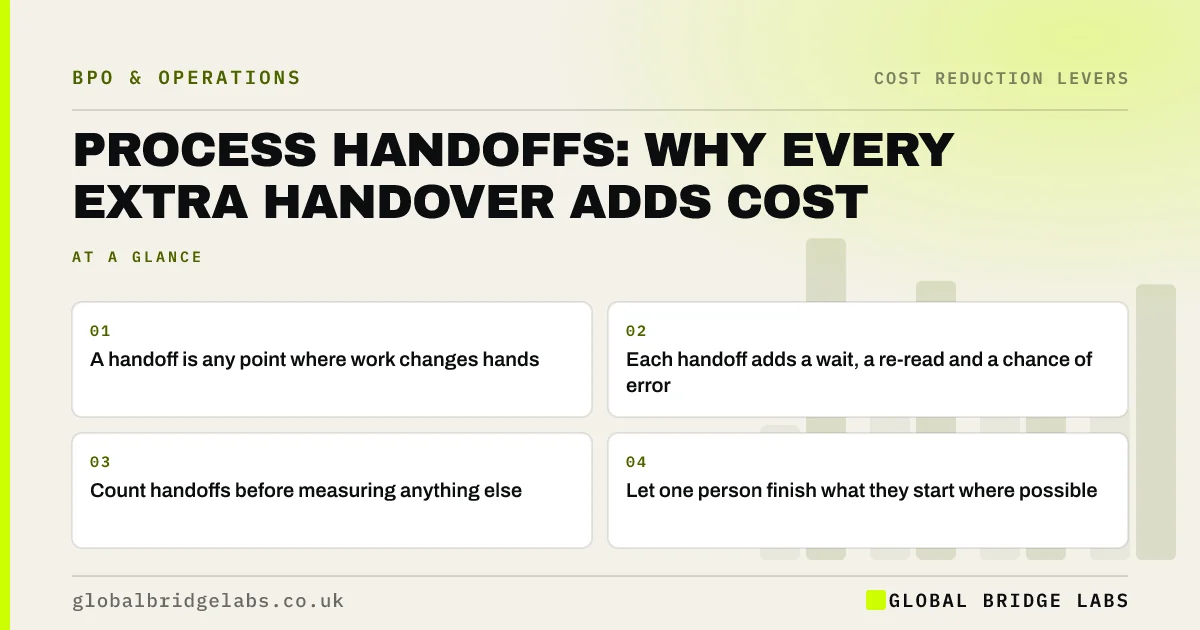
Process handoffs are the points where work passes from one person, team or system to another. Each one adds a wait, a chance of lost information and the time the next person needs to understand the case. Counting them is the fastest way to see why a simple task takes days. Fewer handoffs usually means lower cost and faster service.
- A handoff is any point where work changes hands.
- Each handoff adds a wait, a re-read and a chance of error.
- Count handoffs before measuring anything else.
- Let one person finish what they start where possible.
Want your handoffs counted on one process? Message us on WhatsApp with the steps.
Chat on WhatsApp →What is a process handoff?
A process handoff is the transfer of responsibility for a piece of work from one party to another. It can be between two colleagues, two departments, a business and its supplier, or a person and a system. The work stops being one person's job and becomes another's.
Why does each handoff add cost?
Each handoff adds cost in three ways. The work waits in a queue until the next person reaches it. That person has to read and understand what has been done so far. And some detail is lost in transit, so questions go back. None of this adds anything the customer wanted.
- Queue time: the item waits for attention.
- Set-up time: the receiver gets up to speed.
- Information loss: context that was never written down.
- Diluted ownership: nobody feels responsible for the whole.
What does that look like in numbers?
Take an illustrative refund that needs 15 minutes of work and passes through four people. If each handoff adds an average four-hour wait and 5 minutes of re-reading, three handoffs add 12 working hours of delay and 15 minutes of effort. The working time has doubled and the customer waits about a day and a half longer.
Now give one trained person the authority to do all four steps. The refund takes 15 minutes and is finished the same day.
- Work out your cost per task before you outsource
- Exception handling: the few cases that drive most cost
Want to see what your handoffs add? Send us one process on WhatsApp.
Chat on WhatsApp →How do you reduce handoffs?
Reduce handoffs by widening what one person can complete. Give them the access, the training and the authority to finish the common cases. Replace approvals with limits. Where a handoff must stay, make it clean: one standard note, one place, one named receiver.
- 1. Draw the process and count the handoffs.
- 2. Ask of each: why can the previous person not do this?
- 3. Remove approvals below an agreed value.
- 4. Train and authorise for end-to-end handling.
- 5. Standardise the note for handoffs that remain.
Does outsourcing add a handoff?
It can, and this is a real cost. Sending part of a process to a provider puts a boundary in the middle of it. The answer is to hand over whole processes, from trigger to completion, instead of single steps. A team that owns invoicing end to end has fewer handoffs than an in-house process split across three people.
When are handoffs necessary?
Handoffs are necessary where separation is the control, such as one person raising a payment and another approving it, or where a step needs a qualification the first person lacks. Keep those. Remove the ones that exist only because of how job descriptions were written years ago.
What does this look like in practice?
A pattern we see in customer service: a query is received by one person, passed to another to check the order, passed to a third to authorise the fix, and passed back to the first to reply. The customer experiences one slow answer. Giving the first person access to order records and a refund limit removes most of the journey.
Handoff checklist
Use this on any process that feels slower than it should.
- Count every change of hands.
- Time the wait at each one.
- Challenge every approval.
- Check what access would let one person finish.
- Keep handoffs that are genuine controls.
- Standardise the note for the rest.
Next step
Tell us about a task that passes through several people before it is done. We will count the handoffs with you and show which can go.
Message us on WhatsApp to cut handoffs in one process, or book a 30-minute consultation.
Chat on WhatsApp →Sources and further reading
- Labour productivity · Office for National Statistics
- Multitasking: switching costs · American Psychological Association
Frequently asked questions
What is a handoff in a process?
A handoff is the point at which work passes from one person, team or system to another. Responsibility transfers, and the receiver must pick up where the sender stopped. Handoffs are a common source of delay and error because work queues and information is lost between parties.
How do handoffs cause delays?
Work waits in the receiver's queue until they are free, and then they need time to understand it. If information is missing, a question goes back and the item waits again. A process with five handoffs can spend most of its elapsed time waiting.
How many handoffs are too many?
There is no fixed number. Any handoff that is not a deliberate control or a need for specialist skill is a candidate for removal. As a rough working test, if a routine case passes through more than two or three people, ask what stops one of them completing it.
How do you improve a handoff you cannot remove?
Make it explicit. Use one standard note covering what was done, what is needed and by when. Send it to one agreed place and one named receiver. Agree a response time. A clean handoff loses far less time and information than an informal one.
Written by

Global Bridge Labs (GBL) is a UK–Sri Lanka partner for social media, websites and BPO. Everything here comes from client delivery, not theory.


