On this page
- 01Key takeaways
- 02What is Little's law?
- 03What does it mean for a small business?
- 04How do you use it to cut lead time?
- 05What does it look like in numbers?
- 06How does outsourcing change the equation?
- 07When does Little's law not apply cleanly?
- 08What does this look like in practice?
- 09Work in progress checklist
- 10Next step
- 11Sources and further reading
- 12Frequently asked questions
Key takeaways
Little's law says average lead time equals work in progress divided by throughput. For a small business it means starting more jobs at once makes every job take longer, unless the team finishes work faster. The practical fix is to limit how many items are open at once, finish before starting, and add capacity only where throughput is the real limit.
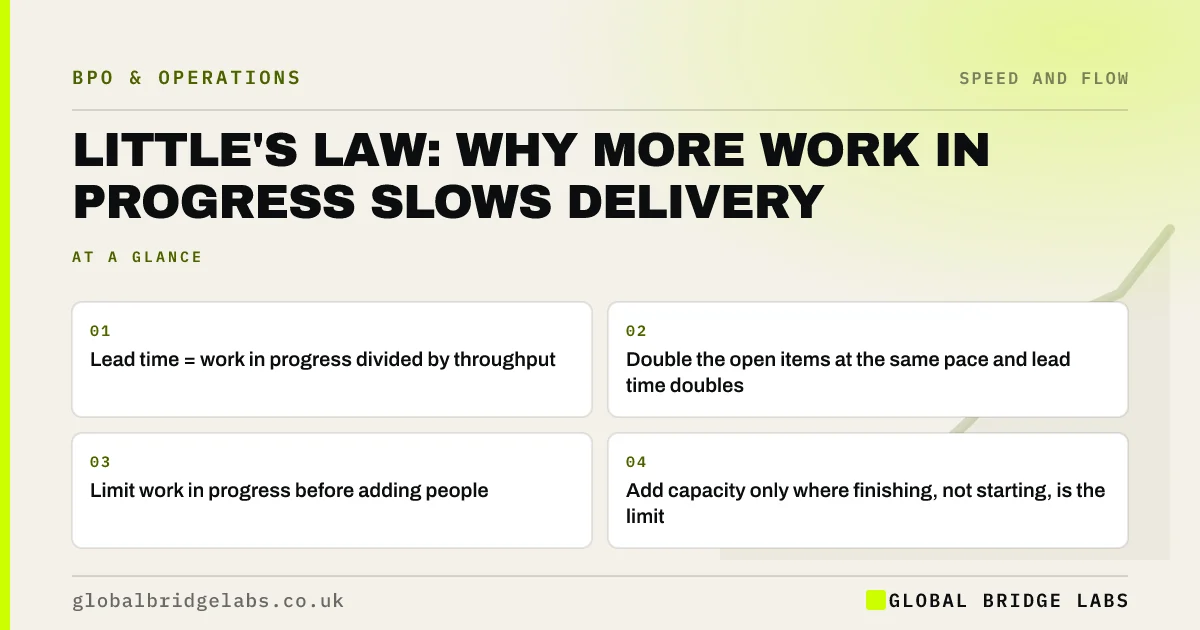
- Lead time = work in progress divided by throughput.
- Double the open items at the same pace and lead time doubles.
- Limit work in progress before adding people.
- Add capacity only where finishing, not starting, is the limit.
Want to apply Little's law to your own queue? Message us on WhatsApp with your numbers.
Chat on WhatsApp →What is Little's law?
Little's law is a rule from queueing theory, proved by John Little in 1961, that links three averages in any stable system: the number of items in it, the rate items leave it, and the time each item spends inside. Written for a business process, average lead time equals average work in progress divided by average throughput.
What does it mean for a small business?
It means lead time is set by how much work is open, not just by how hard people work. If a team finishes 20 quotes a week and has 60 open, the average quote takes three weeks. Starting 20 more without finishing faster pushes it to four. Every new start that is not finished adds to everyone else's wait.
How do you use it to cut lead time?
Use it in two ways. First, cut work in progress: finish open items before starting new ones, close items stuck waiting on the customer, and set a limit on how many can be open per person. Second, raise throughput where it is genuinely too low, by adding capacity or removing rework.
- Count open items today, by process.
- Measure items finished per week.
- Divide to get average lead time.
- Set a work-in-progress limit and hold it.
What does it look like in numbers?
In an illustrative firm, a three-person team has 45 open client requests and finishes 15 a week, so the average request takes three weeks. Holding new starts until open items fall to 15 takes about two weeks of focus. After that, at the same throughput, the average request takes one week. Example figures to show the law at work.
Want this worked out for your team? Send us open items and weekly completions on WhatsApp.
Chat on WhatsApp →How does outsourcing change the equation?
Outsourcing changes the throughput side. A managed team that works a queue daily raises the rate items are finished, so the same work in progress clears faster. It can also take on a one-off backlog to reset work in progress, after which the in-house team holds the limit. Adding throughput without limiting starts simply grows the queue again.
When does Little's law not apply cleanly?
The law holds for averages in a stable system, so it is rough during sudden peaks, launches or seasonal swings. Very different item sizes also blur it, because one large job can sit alongside twenty small ones. Measure similar items together and use the law as a guide, not a precise forecast.
What does this look like in practice?
A pattern we see: a busy team starts every new request on arrival to look responsive, so everyone has twenty things open and nothing finishes. Introducing a simple limit on open items feels slower for a fortnight and then cuts lead time sharply, because work starts finishing.
Work in progress checklist
Use these steps to apply the law.
- Count open items per process and per person.
- Count items finished each week.
- Calculate average lead time.
- Agree a limit on open items.
- Finish or close stuck items before starting new ones.
Next step
Send us your open items and weekly completions for one process. We will show you what lead time they imply and what would bring it down fastest.
Message us on WhatsApp with your queue numbers, or book a 30-minute consultation.
Chat on WhatsApp →Sources and further reading
- Labour productivity · Office for National Statistics
- Multitasking: switching costs · American Psychological Association
Frequently asked questions
What is Little's law in simple terms?
Little's law says the average time an item spends in a process equals the number of items in the process divided by the rate items are finished. If you have 30 open jobs and finish 10 a week, each job takes about three weeks on average.
How do you reduce lead time using Little's law?
Either reduce work in progress or increase throughput. In most small businesses the quicker win is reducing work in progress: finish before starting, close stalled items, and set a limit on open work per person. Then add capacity where finishing is still too slow.
What is a WIP limit?
A work-in-progress limit is a cap on how many items can be open at one stage or for one person. When the limit is reached, new work waits until something finishes. It keeps queues short and makes lead time predictable.
Written by

Global Bridge Labs (GBL) is a UK–Sri Lanka partner for social media, websites and BPO. Everything here comes from client delivery, not theory.