
On this page
- 01Key takeaways
- 02What is a single source of truth?
- 03Why does it matter for efficiency?
- 04How do you set one up?
- 05What does it change in numbers?
- 06How does it help outsourced teams?
- 07When is perfect data not worth chasing?
- 08What does this look like in practice?
- 09Single source checklist
- 10Next step
- 11Sources and further reading
- 12Frequently asked questions
Key takeaways
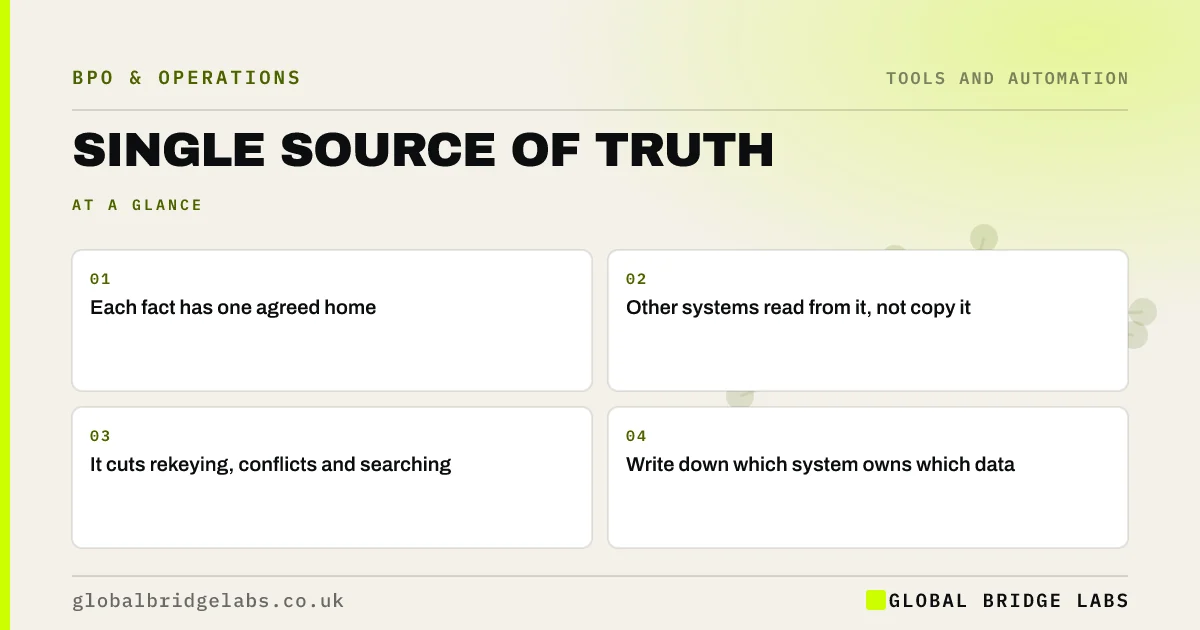
A single source of truth means each business fact, such as a customer's address, a price or a job status, has one agreed home. Every other system reads from it rather than keeping its own copy. It cuts rekeying, conflicting records and time spent asking which version is right, and it makes outsourced work far more reliable.
- Each fact has one agreed home.
- Other systems read from it, not copy it.
- It cuts rekeying, conflicts and searching.
- Write down which system owns which data.
Want help mapping where your business data lives? Message us on WhatsApp.
Chat on WhatsApp →What is a single source of truth?
A single source of truth is the one place where a particular piece of information is created and maintained, and which everyone treats as correct. In a small business the CRM might own customer details, the accounting system own invoices and payments, and the job system own job status. The aim is not one system for everything, but one owner per fact.
Why does it matter for efficiency?
Without it, the same fact lives in several places and drifts. Staff copy data between systems, customers get letters at old addresses, and people waste time asking which spreadsheet is current. For an outsourced team, conflicting sources are a major cause of questions and errors.
How do you set one up?
List your main types of data, such as customers, products, prices, jobs and invoices. For each, choose the system that should own it, usually the one where it is created. Write the list down. Then stop maintaining copies, connect other systems to the owner where possible, and correct the owner when something is wrong.
- 1. List your main data types.
- 2. Choose one owning system for each.
- 3. Write the data map down.
- 4. Retire spreadsheets that hold copies.
- 5. Connect systems to the owner where possible.
What does it change in numbers?
In an illustrative firm, customer details are kept in the CRM, the accounting system and a delivery spreadsheet. About one change in five is missed in at least one place, causing failed deliveries and returned invoices. Making the CRM the owner and syncing the others removes most of those errors and the time spent fixing them. Example figures.
- Right first time rate: the quality number that cuts cost
- Order to dispatch time: how fast should orders leave?
Want to find where your data is duplicated? Send us your list of systems on WhatsApp.
Chat on WhatsApp →How does it help outsourced teams?
It gives the outsourced team one place to look and one place to update, which removes a whole category of questions. Write the data map into the SOP, give access to the owning systems and make updating the owner part of the acceptance criteria.
When is perfect data not worth chasing?
Perfect data is not worth chasing for information that rarely changes or rarely matters. Focus on the facts that drive customer contact, billing and delivery. A short data map for those beats a large integration project that never finishes.
What does this look like in practice?
A pattern we see: two staff keep their own customer spreadsheets, and an outsourced team cannot tell which is current. Agreeing that the CRM is the owner, and retiring the spreadsheets, solves it faster than any new software.
Single source checklist
Check these for your main data.
- Each data type has one owning system.
- The data map is written down.
- Copies in spreadsheets are retired.
- Updates happen in the owner first.
- The outsourced team knows the map.
Next step
Tell us which systems and spreadsheets you use. We will help you draw a simple data map and say where duplicates are costing you time.
Message us on WhatsApp about your data, or book a 30-minute consultation.
Chat on WhatsApp →Sources and further reading
- Lawful basis for processing personal data · Information Commissioner's Office
- Running a limited company: company and accounting records · GOV.UK
Frequently asked questions
What is a single source of truth?
A single source of truth is the one agreed place where a piece of business information is kept and maintained, and which everyone treats as correct. Other systems read from it rather than holding their own copies, which prevents conflicting records.
Does a single source of truth mean one system?
No. Most small businesses use several systems. The principle is that each type of data has one owning system, such as the CRM for customers and the accounting system for invoices, and that changes are made there first.
How do you stop duplicate data across systems?
Choose one owner for each data type, retire spreadsheets that hold copies, connect other systems to the owner where possible, and make updating the owner part of every process. Review the data map when you add a new system.
Written by

Global Bridge Labs (GBL) is a UK–Sri Lanka partner for social media, websites and BPO. Everything here comes from client delivery, not theory.


