
On this page
- 01Key takeaways
- 02Weeks 1 and 2: measure and score
- 03Weeks 3 and 4: fix and document
- 04Weeks 5 to 12: pilot
- 05Day 90: review and decide
- 06What does the plan look like in numbers?
- 07What does it cost?
- 08When should you not follow this plan?
- 09What does this look like in practice?
- 1090-day plan checklist
- 11Next step
- 12Sources and further reading
- 13Frequently asked questions
Key takeaways
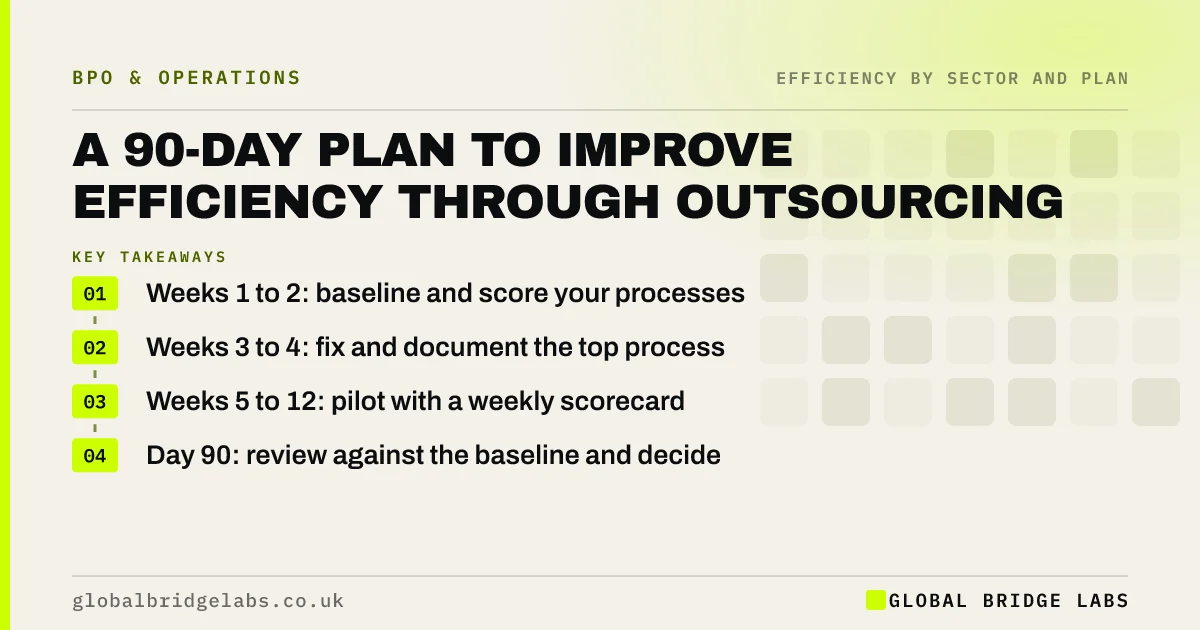
A 90-day plan to improve efficiency through outsourcing has four stages: measure and score in weeks 1 and 2, fix and document in weeks 3 and 4, pilot one process from week 5, and review at day 90. It needs about 2 to 4 hours a week of owner time. The aim is one process running faster and more accurately, with proof, before anything else is handed over.
- Weeks 1 to 2: baseline and score your processes.
- Weeks 3 to 4: fix and document the top process.
- Weeks 5 to 12: pilot with a weekly scorecard.
- Day 90: review against the baseline and decide.
Want this plan tailored to your business? Message us on WhatsApp.
Chat on WhatsApp →Weeks 1 and 2: measure and score
Start by logging lead time, touch time, corrections and senior hours for your ten most time-consuming routine tasks. Score each on the efficiency gain scorecard: flow, focus, accuracy, capacity and visibility. Pick the highest-scoring process that is not your core service.
- Log ten routine tasks for two weeks.
- Record lead time, touch time and corrections.
- Score each on the five efficiency gains.
- Pick one process to start with.
Weeks 3 and 4: fix and document
Remove steps, approvals and duplicate entry that add nothing. Write the process, the top ten exceptions and the acceptance criteria. Set approval limits, name the internal process owner and plan system access so the team can start on day one.
- Simplify the process.
- Write the SOP and key work instructions.
- Agree acceptance criteria and approval limits.
- Name the process owner and plan access.
Weeks 5 to 12: pilot
Run the process with a managed team for eight weeks. Agree turnaround targets and a one-page weekly report. Answer questions daily at first and turn each into a written rule. Move from checking every item to sampling by week 8. Hold a short weekly review and log your own time spent.
- Agree targets and a weekly report.
- Turn every question into a written rule.
- Move to sampling by week 8.
- Log your own review time weekly.
Day 90: review and decide
Compare the baseline with the last two weeks: lead time, on-target share, right-first-time rate, backlog age and senior hours. Note what went well and what needs fixing. Decide to continue, adjust or stop, and whether to add a second process.
What does the plan look like in numbers?
In an illustrative plan, the owner spends about 4 hours a week in weeks 1 to 4, 3 hours a week in the first month of the pilot and about 1 hour a week by the end. The process chosen, customer email, moves from a one-day first reply to about three hours, and the owner's time on it falls from eight hours a week to one. Example figures only.
Want the plan mapped onto your calendar? Send us your top three processes on WhatsApp.
Chat on WhatsApp →What does it cost?
As indicative UK market ranges, managed offshore teams cost £9–£18 per hour and onshore providers £20–£35. Neither is a GBL price. The other cost is your time, about 2 to 4 hours a week through the plan. Weigh both against the senior hours returned and the effect of faster turnaround on customers.
When should you not follow this plan?
Do not follow it if no routine process scores above 5 on the scorecard, if the business is about to change its systems, or if you cannot spare 2 hours a week. In the first case, the process is already lean. In the others, wait until the change settles or the time is available.
What does this look like in practice?
A pattern we see: businesses that try to hand over five processes at once spend months answering questions. Those that start with one, prove it in 90 days and then add the next, reach a larger gain sooner.
Across our client work, owners have got 31 hours a week back once routine work was documented and run by a managed team.
90-day plan checklist
Tick these off as you go.
- Baseline recorded for ten tasks.
- One process chosen and scored.
- Process simplified and written down.
- Owner, limits and access in place.
- Eight-week pilot with weekly reports.
- Day-90 review booked and held.
Next step
Send us your ten most time-consuming routine tasks. We will help you score them, choose the first process and set out the 90 days with you.
Message us on WhatsApp to start your 90-day plan, or book a 30-minute consultation.
Chat on WhatsApp →Sources and further reading
- The Sourcing and Consultancy Playbooks · Cabinet Office
- Contracts and liabilities between controllers and processors · Information Commissioner's Office
- Business transfers, takeovers and TUPE · GOV.UK
Frequently asked questions
How do you start outsourcing to improve efficiency?
Measure and score your routine processes for two weeks, choose the one with the largest efficiency gain, simplify and document it, then run an eight-week pilot with weekly reporting. Review against the baseline at day 90 before handing over anything else.
How much owner time does a 90-day outsourcing plan need?
Usually about 2 to 4 hours a week: more in the first month while measuring, documenting and answering questions, and around an hour a week by the end of the pilot once the process has settled.
Should you outsource several processes at once?
Usually not. Starting with one process lets you learn, fix the handover and prove the gain before adding more. Several processes at once multiply the questions and make it hard to see what is working.
Written by

Global Bridge Labs (GBL) is a UK–Sri Lanka partner for social media, websites and BPO. Everything here comes from client delivery, not theory.


