On this page
- 01Key takeaways
- 02What is an approval bottleneck?
- 03How do you spot one?
- 04How do you remove approval bottlenecks?
- 05What does the gain look like in numbers?
- 06How do approvals work with an outsourced team?
- 07When should approvals stay strict?
- 08What does this look like in practice?
- 09Approval checklist
- 10Next step
- 11Sources and further reading
- 12Frequently asked questions
Key takeaways
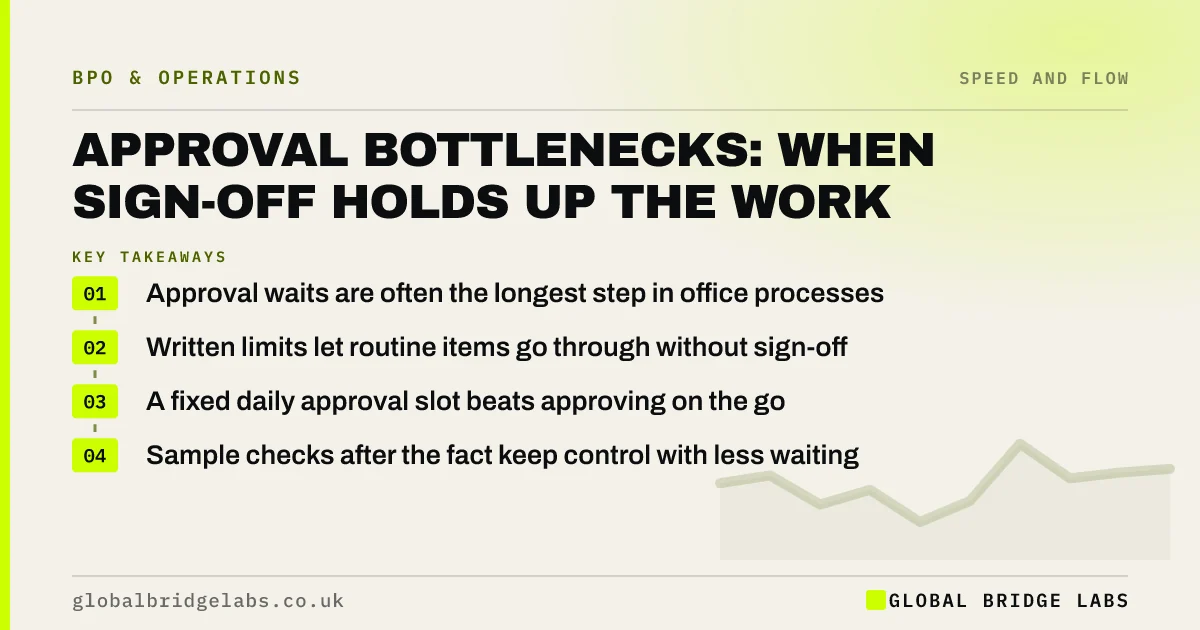
Approval bottlenecks happen when work waits for one person's sign-off. In small businesses that person is usually the owner, and approvals become the longest wait in many processes. Set written approval limits, delegate low-risk decisions, give approvals a fixed daily slot and a named deputy, and check a sample afterwards instead of everything beforehand.
- Approval waits are often the longest step in office processes.
- Written limits let routine items go through without sign-off.
- A fixed daily approval slot beats approving on the go.
- Sample checks after the fact keep control with less waiting.
Want help setting approval limits for your team? Message us on WhatsApp.
Chat on WhatsApp →What is an approval bottleneck?
An approval bottleneck is a step where work stops until a particular person signs it off, and that person is not available quickly enough. It shows up as invoices waiting for payment, quotes waiting to go out or refunds waiting for a decision. The approval itself may take a minute. The wait can take days.
How do you spot one?
Measure the lead time of a process and mark each step where work waits for someone's decision. If one person appears on several of those steps, or if items wait longer at approval than anywhere else, you have found a bottleneck. Ask also how often approvals are refused. If almost never, the approval may not be adding much.
How do you remove approval bottlenecks?
Remove them in four steps. Set written limits so routine items below a value or risk level need no approval. Delegate the next level to a named deputy. Give the remaining approvals a fixed daily slot. Replace some prior approvals with a sample check afterwards, which keeps control while letting work flow.
- 1. List every approval and how often it is refused.
- 2. Set value and risk limits for automatic approval.
- 3. Name a deputy for the next level.
- 4. Book a fixed daily slot for the rest.
- 5. Sample-check approved items each week.
What does the gain look like in numbers?
In an illustrative firm, every supplier invoice needs the director's approval, and the director approves once a week. Setting a limit so invoices under £500 matching a purchase order go straight through covers about 70% of volume. The rest are approved in a daily ten-minute slot. Average invoice wait falls from about three days to under one. Example figures only.
- Purchase-to-pay process: faster, cleaner supplier payments
- Three-way matching: stop paying invoices you should not
Want to see which of your approvals could be delegated? Send us your list on WhatsApp.
Chat on WhatsApp →How do approvals work with an outsourced team?
With an outsourced team, written limits matter even more, because every approval sent back to you is a wait. Give the team clear rules for what they can complete alone, what needs a decision, and how decisions are batched for you. A single daily list of decisions is far faster than ad hoc emails.
When should approvals stay strict?
Keep strict prior approval for payments to new or changed bank details, large or unusual spend, refunds above a set level, anything involving personal data requests and regulated decisions. These are where fraud and errors are most costly. Separate the person who sets up a payment from the person who approves it.
What does this look like in practice?
A pattern we see: the owner approves everything to stay in control, so the business slows to the owner's availability. Writing limits down shows most approvals are for small, routine items that are never refused. Removing those gives the owner more time for the decisions that do need them.
Approval checklist
Review your approvals against these.
- List every approval step in your main processes.
- Note how often each is refused.
- Set written limits for automatic approval.
- Name a deputy for each approver.
- Keep strict approval for bank detail changes.
- Sample-check approved items weekly.
Next step
Send us a list of the things that need your sign-off. We will help you sort them into automatic, delegated and personal, with sensible limits for each.
Message us on WhatsApp to review your approvals, or book a 30-minute consultation.
Chat on WhatsApp →Sources and further reading
- Small Business Guide: cyber security · National Cyber Security Centre
- Late commercial payments: charging interest and debt recovery · GOV.UK
Frequently asked questions
How do you speed up approvals in a small business?
Set written limits so routine, low-value items need no approval, delegate the next level to a named deputy, and give the remaining approvals a fixed daily slot. Replace some prior approvals with weekly sample checks. Keep strict approval for payments and bank detail changes.
What are approval limits?
Approval limits are written thresholds that say who can approve what, usually by value and risk. For example, a team member might approve purchases up to £250, a manager up to £2,000, and the director above that. They let routine work flow without waiting.
Does delegating approvals mean losing control?
Not if limits are written and checked. Control comes from clear rules, separation of duties for payments and regular sample checks, not from one person signing everything. A daily approval list also gives the owner a clearer view than scattered emails.
Written by

Global Bridge Labs (GBL) is a UK–Sri Lanka partner for social media, websites and BPO. Everything here comes from client delivery, not theory.