
On this page
- 01Key takeaways
- 02What is the difference between an SOP and a work instruction?
- 03When do you need each?
- 04How much detail should you include?
- 05What does a good pair look like?
- 06How do you keep them up to date?
- 07When is writing them a waste of time?
- 08What does this look like in practice?
- 09Documentation checklist
- 10Next step
- 11Sources and further reading
- 12Frequently asked questions
Key takeaways
An SOP (standard operating procedure) describes a whole process: what happens, in what order, who does it and why. A work instruction describes how to do one task, click by click or step by step. An outsourced team needs both: one SOP per process and short work instructions for the tasks that cause most questions or errors.
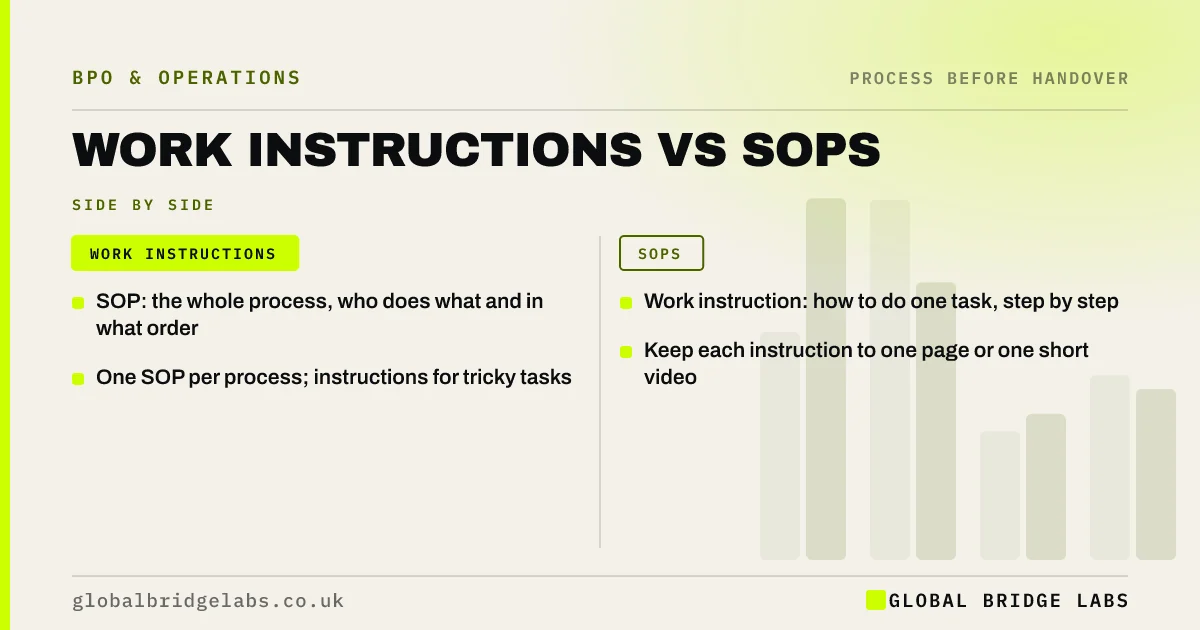
- SOP: the whole process, who does what and in what order.
- Work instruction: how to do one task, step by step.
- One SOP per process; instructions for tricky tasks.
- Keep each instruction to one page or one short video.
Want help deciding what to write for your process? Message us on WhatsApp.
Chat on WhatsApp →What is the difference between an SOP and a work instruction?
An SOP is a process-level document. It lists the steps from start to finish, the roles involved, the decisions and the standards, and it explains why. A work instruction is task-level. It shows exactly how to perform one step, such as raising a credit note in your accounting system, often with screenshots. The SOP says what; the instruction says how.
When do you need each?
You need an SOP whenever more than one person or team is involved in a process, so everyone shares the same map. You need a work instruction when a task is fiddly, done rarely, error-prone or done in a system with many steps. Not every task needs one. Write instructions where questions and errors actually happen.
- SOP: any process shared across people or teams.
- Instruction: tasks with many clicks or system steps.
- Instruction: tasks done rarely, such as year-end jobs.
- Instruction: tasks with a history of errors.
How much detail should you include?
Include enough detail that a trained newcomer can complete the task without asking. For an SOP that usually means one to three pages. For a work instruction, one page or a short screen recording. More detail is not better: long documents go unread. Put the exceptions and the reason for each rule where people will see them.
What does a good pair look like?
In an illustrative example, the SOP for customer refunds covers when refunds are allowed, who approves above £100, the steps from request to payment and the target turnaround. Two work instructions sit beside it: how to issue a refund in the payment system and how to record it in the accounts. Example structure only.
- Acceptance criteria: define done for outsourced work
- Escalation paths for outsourced teams: fast, not chaotic
Want an SOP and instructions outlined for one of your processes? Send it on WhatsApp.
Chat on WhatsApp →How do you keep them up to date?
Give each document an owner and a review date, and update it whenever a question reveals a gap. Keep them in one place, such as a shared knowledge base, with the date of the last change visible. An outsourced team will often flag gaps first, so make it easy for them to suggest edits.
When is writing them a waste of time?
Writing them is a waste of time for tasks that are about to change, such as a system being replaced next month, or for one-off work. In those cases a short brief is enough. Write the documents once the process is stable.
What does this look like in practice?
A pattern we see: a business writes a 20-page manual for a handover and the team still asks basic questions. The manual describes the process but never shows the system steps. Adding three one-page work instructions for the tasks people actually ask about stops most questions.
Documentation checklist
Use these to plan your documents.
- One SOP per shared process.
- Instructions for the five tasks with most questions.
- Each document has an owner and a review date.
- Exceptions are written next to the step they affect.
- Everything is stored in one place.
Next step
Tell us the process you want to document. We will suggest which SOP and work instructions it needs, and how long each should be.
Message us on WhatsApp to plan your documents, or book a 30-minute consultation.
Chat on WhatsApp →Sources and further reading
- The Sourcing and Consultancy Playbooks · Cabinet Office
- Running a limited company: company and accounting records · GOV.UK
Frequently asked questions
What is the difference between an SOP and a work instruction?
An SOP describes a whole process: the steps, the roles, the decisions and the standards. A work instruction describes how to do one task within it, often step by step with screenshots. Use an SOP so everyone shares the map, and work instructions for fiddly or error-prone tasks.
How long should an SOP be?
Usually one to three pages for a typical admin process. It should be long enough that a trained newcomer understands the whole flow, and short enough to be read. Put detailed system steps in separate work instructions rather than in the SOP itself.
Do outsourced teams need SOPs?
Yes. An SOP gives the outsourced team the same picture of the process as your staff, which cuts questions and errors. Work instructions for the trickiest tasks matter just as much, because they are where most questions come from in the first weeks.
Written by

Global Bridge Labs (GBL) is a UK–Sri Lanka partner for social media, websites and BPO. Everything here comes from client delivery, not theory.


