
On this page
- 01Key takeaways
- 02Where does a trades business lose time?
- 03How do you stop missing calls?
- 04How do you speed up quotes and invoices?
- 05What about compliance admin?
- 06What does the gain look like in numbers?
- 07When should the owner keep the office work?
- 08What does this look like in practice?
- 09Trades efficiency checklist
- 10Next step
- 11Sources and further reading
- 12Frequently asked questions
Key takeaways
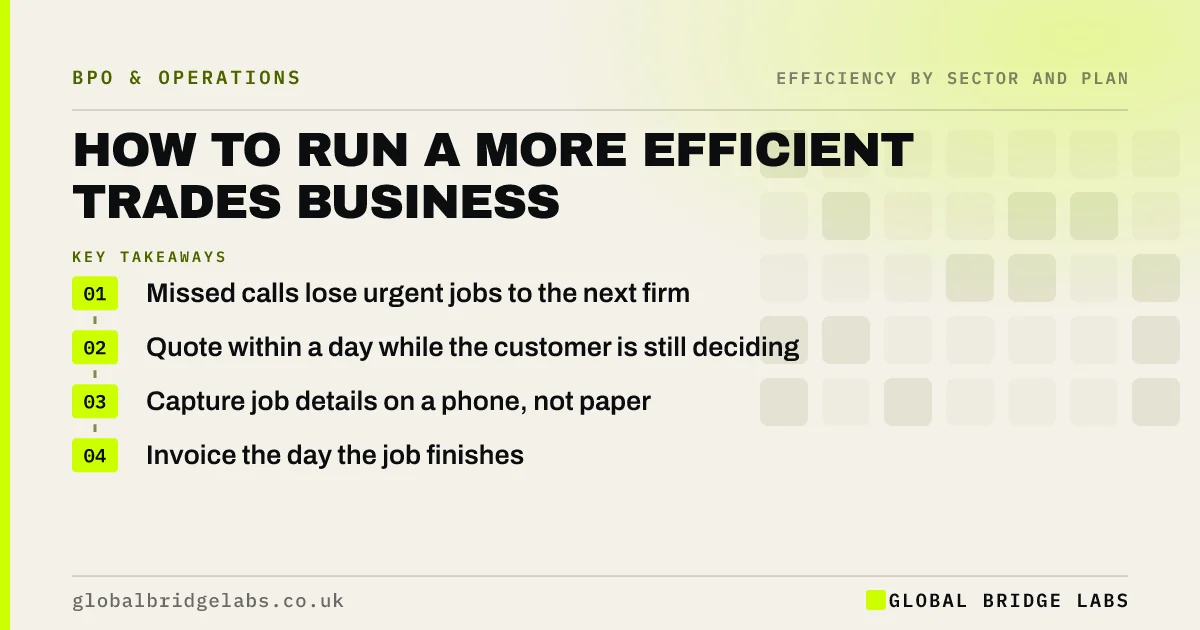
Efficiency in a trades business is decided in the office as much as on site. Missed calls, slow quotes, paper job sheets and late invoices cost more than slow work. Answer every call, quote within a day, capture job details on a phone and invoice the day a job finishes. A managed team can run that office routine while engineers stay on the tools.
- Missed calls lose urgent jobs to the next firm.
- Quote within a day while the customer is still deciding.
- Capture job details on a phone, not paper.
- Invoice the day the job finishes.
Want your trades office running smoother? Message us on WhatsApp.
Chat on WhatsApp →Where does a trades business lose time?
A trades business loses time in four places: calls missed while the owner is on site, quotes written in the evening, job sheets typed up at the weekend and invoices raised days or weeks after completion. Each delay costs either a job or cash, and most land on the owner.
How do you stop missing calls?
Stop missing calls with cover during working hours, either a person in the office or a call answering service that takes details, books jobs to rules and passes on urgent ones. Customers with an urgent problem usually ring the next firm if nobody answers.
How do you speed up quotes and invoices?
Speed up quotes with templates for common jobs, a support person who prepares the draft from the survey notes and a short daily review slot for the owner. Speed up invoices by capturing job details on a phone form and invoicing from them the same day. Both remove the evening and weekend admin.
- Templates for the ten most common jobs.
- Draft quotes prepared from survey notes.
- A 30-minute daily review slot for the owner.
- Phone job sheets that feed invoicing.
What about compliance admin?
Contractors in the Construction Industry Scheme must file monthly returns and verify subcontractors, and many trades need certificates and records kept for each job. These deadlines are fixed, so they suit a written process and a named person, in-house or outsourced, with the owner approving.
What does the gain look like in numbers?
In an illustrative firm with six engineers, the owner spends about 15 hours a week on calls, quotes and invoices, mostly evenings, and invoices go out about ten days after jobs finish. With a managed team handling calls, drafts and invoicing, the owner reviews for about four hours a week and invoices go out within a day. Example figures only.
- How to reduce costs in a trades or construction business
- How to scale a trades business beyond the owner's van
Want this worked out for your firm? Send us your weekly admin hours on WhatsApp.
Chat on WhatsApp →When should the owner keep the office work?
The owner should keep it while the business is small enough that calls and paperwork fit into the working day without evenings. Pricing decisions, complex surveys and customer complaints should stay with the owner even after routine office work is handed over.
What does this look like in practice?
A pattern we see: a growing trades firm loses work because nobody answers the phone in the morning, while the owner spends weekends on invoices. Handing the calls and invoicing to a managed team fixes both, and the owner gets weekends back.
Trades efficiency checklist
Check these in your business.
- Every call answered in working hours.
- Quotes out within a working day.
- Job details captured on a phone.
- Invoices raised the day jobs finish.
- Compliance deadlines in a calendar with an owner.
Next step
Tell us how many engineers you have and how calls, quotes and invoices are handled now. We will suggest what to hand over first.
Message us on WhatsApp about your trades office, or book a 30-minute consultation.
Chat on WhatsApp →Sources and further reading
Frequently asked questions
How can a trades business be more efficient?
Answer every call in working hours, quote within a day using templates, capture job details on a phone instead of paper and invoice the day a job finishes. Most inefficiency in trades businesses is office admin falling on the owner, not slow work on site.
What admin can a trades business outsource?
Call answering and booking, quote preparation from survey notes, invoicing from job records, payment chasing, supplier invoice processing and routine compliance admin. Keep pricing decisions, complex surveys and complaints with the owner.
Should a small trades business use a call answering service?
If calls are often missed while you are on site, yes. A service that takes details, books jobs to your rules and passes on urgent calls usually wins back more work than it costs. Very small firms with few calls may manage with voicemail and quick callbacks.
Written by

Global Bridge Labs (GBL) is a UK–Sri Lanka partner for social media, websites and BPO. Everything here comes from client delivery, not theory.


