
On this page
- 01Key takeaways
- 02Why track time at all?
- 03What should you track?
- 04Why do outcomes matter more?
- 05What does useful tracking show?
- 06What are the data protection rules?
- 07When is detailed tracking justified?
- 08What does this look like in practice?
- 09Time tracking checklist
- 10Next step
- 11Sources and further reading
- 12Frequently asked questions
Key takeaways
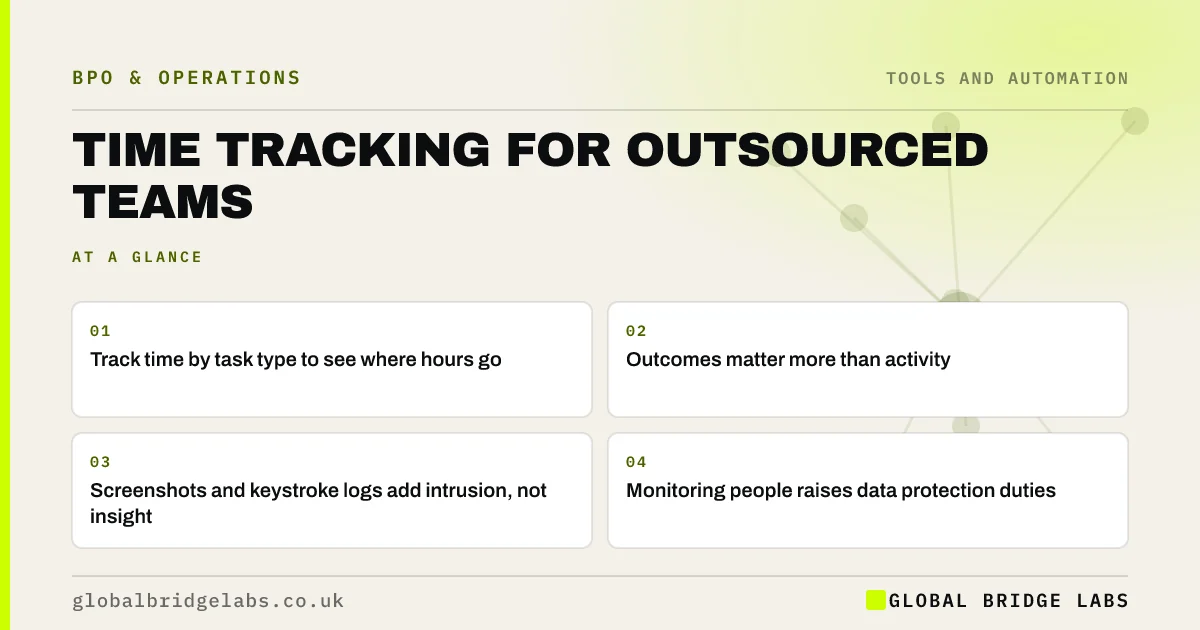
Time tracking for outsourced teams is useful when it records time by task type, so you can see where hours go and price work fairly. It becomes intrusive, and rarely helpful, when it means screenshots and keystroke monitoring. Outcome measures such as turnaround, volumes and accuracy tell you more about efficiency than activity data does.
- Track time by task type to see where hours go.
- Outcomes matter more than activity.
- Screenshots and keystroke logs add intrusion, not insight.
- Monitoring people raises data protection duties.
Want to agree a sensible tracking approach with a provider? Message us on WhatsApp.
Chat on WhatsApp →Why track time at all?
Tracking time by task type shows where hours go, which tasks take longer than expected and how much a process really costs. It is the basis for fair pricing on hourly arrangements and for spotting where a process change would help. It is a planning tool, not a supervision tool.
What should you track?
Track hours by process or task type, volumes completed, and time spent on exceptions or waiting for answers. That shows minutes per item and where time leaks. It is usually enough to track in 15-minute blocks or per task in the work system.
- Hours by process or task type.
- Items completed in each.
- Time on exceptions and rework.
- Time waiting for client answers.
Why do outcomes matter more?
Outcomes matter more because you are buying finished work, not hours at a desk. A team that is always active but slow, or fast but inaccurate, looks fine on activity data. Turnaround, volume, right-first-time rate and backlog age show whether the work is efficient and good.
What does useful tracking show?
In an illustrative arrangement, tracking by task type shows that a quarter of the team's hours go on chasing missing information from the client. Fixing the intake form recovers most of those hours. Screenshot monitoring would have shown the team was busy, but not on what. Example figures only.
- Workflow design for outsourced teams: a practical guide
- How to brief an outsourced team so work comes back right
Want help reading your provider's time data? Send it to us on WhatsApp.
Chat on WhatsApp →What are the data protection rules?
Monitoring workers involves their personal data, so it must have a lawful basis, be necessary and proportionate, and be explained to the people monitored. The ICO expects organisations to consider less intrusive options first. With a provider, monitoring of its staff is primarily the provider's responsibility, but you should not demand more than you need.
When is detailed tracking justified?
Detailed tracking is justified when you are billed hourly and need to check the hours, when you are pricing a new process, or for a short diagnostic period. Even then, task-level time records are usually enough. Agree the approach in the contract.
What does this look like in practice?
A pattern we see: a client asks for screenshot monitoring because they doubt the hours billed. Agreeing task-level time records and weekly volumes instead answers the real question, whether the hours match the work, and builds trust on both sides.
Time tracking checklist
Agree these with your provider.
- Track by task type, not by screen.
- Report volumes alongside hours.
- Flag time spent waiting for you.
- Use outcomes to judge efficiency.
- Keep any monitoring proportionate.
Next step
Tell us how your outsourced work is billed and reported. We will suggest the time and outcome measures that would give you the clearest picture.
Message us on WhatsApp about tracking, or book a 30-minute consultation.
Chat on WhatsApp →Sources and further reading
- Lawful basis for processing personal data · Information Commissioner's Office
- Right to be informed (privacy information) · Information Commissioner's Office
Frequently asked questions
Should you track the time of an outsourced team?
Tracking time by task type is useful for seeing where hours go and for fair hourly billing. Judge efficiency mainly on outcomes, such as turnaround, volumes and accuracy, because you are buying finished work rather than activity.
Is employee monitoring software legal in the UK?
Monitoring can be lawful, but it involves personal data, so it needs a lawful basis, must be necessary and proportionate, and must be explained to the people monitored. The ICO expects less intrusive options to be considered first. Take advice before introducing it.
What is better than time tracking for measuring a team?
Outcome measures: items completed, turnaround against target, right-first-time rate and backlog age. Together they show whether the work is efficient and good. Time data is most useful alongside them, to explain where hours go.
Written by

Global Bridge Labs (GBL) is a UK–Sri Lanka partner for social media, websites and BPO. Everything here comes from client delivery, not theory.


