
On this page
- 01Key takeaways
- 02What is after-call work?
- 03Why does it matter for efficiency?
- 04How do you shorten it?
- 05What does the gain look like in numbers?
- 06How does it work with an outsourced team?
- 07When should after-call work be longer?
- 08What does this look like in practice?
- 09After-call work checklist
- 10Next step
- 11Sources and further reading
- 12Frequently asked questions
Key takeaways
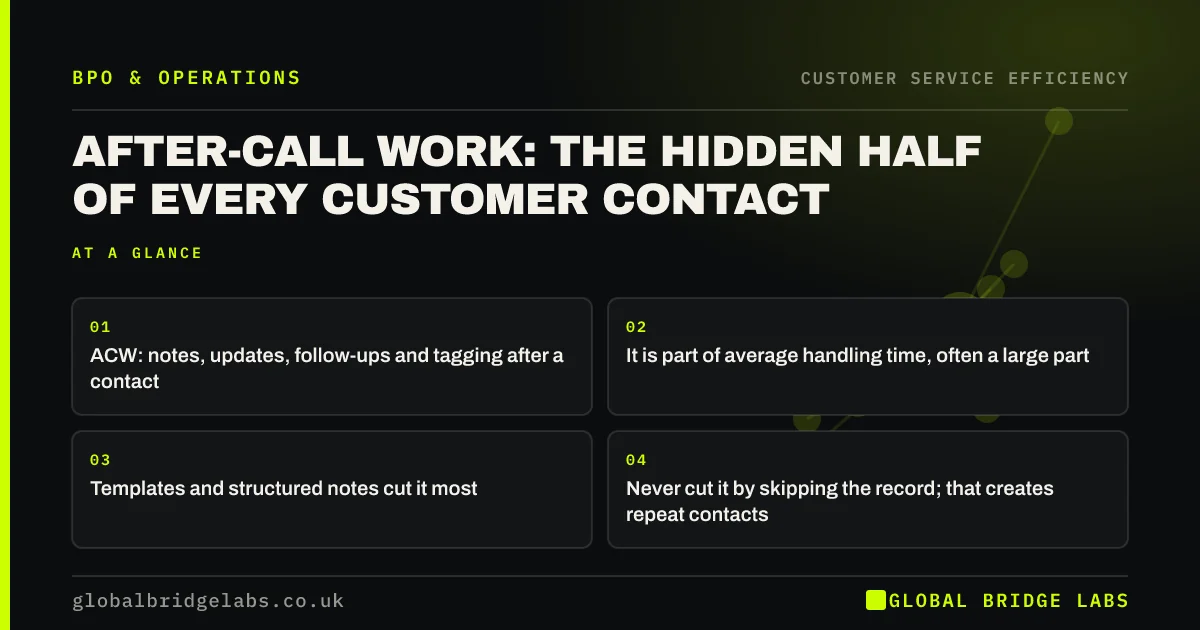
After-call work (ACW), also called wrap-up time, is the work an agent does after a contact ends: notes, updates, follow-up emails and tagging. It is part of average handling time and often a large part. Shorten it with templates, structured notes, fewer systems to update and doing tasks during the call where possible, not by skipping the record.
- ACW: notes, updates, follow-ups and tagging after a contact.
- It is part of average handling time, often a large part.
- Templates and structured notes cut it most.
- Never cut it by skipping the record; that creates repeat contacts.
Want to see how much of your handling time is wrap-up? Message us on WhatsApp.
Chat on WhatsApp →What is after-call work?
After-call work is everything an agent must do to finish a contact once the customer has gone: writing notes, updating the CRM or order system, sending a confirmation, raising a task for another team and tagging the reason. Average handling time is talk time plus hold time plus after-call work.
Why does it matter for efficiency?
It matters because agents cannot take the next contact until it is done. Long after-call work raises handling time, which raises the staff needed for the same service level. It also hides poor processes, such as having to update three systems for one change.
How do you shorten it?
Shorten it by making the record quicker, not thinner. Use structured note templates with set fields, drop-down reason codes, saved replies for confirmations, and one system of record instead of several. Train agents to complete simple updates during the call. Then set a sensible target and watch for outliers.
- Structured note templates with set fields.
- Drop-down contact reasons instead of free text.
- Saved confirmation messages.
- One system of record where possible.
- Update during the call when the customer is waiting anyway.
What does the gain look like in numbers?
In an illustrative team, calls average 5 minutes of talk and 3 minutes of after-call work, because agents update both the CRM and a spreadsheet and write free-text notes. A note template and removing the spreadsheet cut wrap-up to about 1.5 minutes. Handling time falls from 8 to 6.5 minutes, so the same team handles about 20% more calls. Example figures.
- The cost of manual processes, and what to fix first
- Running a business on spreadsheets: when it breaks
Want to estimate your own wrap-up saving? Send us your handling time breakdown on WhatsApp.
Chat on WhatsApp →How does it work with an outsourced team?
With an outsourced team, agree what a complete record looks like and include it in the acceptance criteria. Give access to the systems that need updating, and nothing more. Ask the provider to report after-call work separately from talk time so you can see where handling time goes.
When should after-call work be longer?
Longer wrap-up is justified for complaints, vulnerable customers and regulated conversations, where a full record protects the customer and the business. Pushing agents to cut it there creates risk. Set different expectations by contact type.
What does this look like in practice?
A pattern we see: handling time looks high and the instinct is to shorten calls. Splitting the figure shows the calls are fine and the wrap-up is long, because notes go into two places. Fixing the systems shortens handling time without rushing a single customer.
After-call work checklist
Use these to shorten wrap-up safely.
- Measure ACW separately from talk time.
- List every system updated after a contact.
- Remove duplicates.
- Add a structured note template.
- Set targets by contact type.
Next step
Tell us what your team does after each call or chat. We will help you find what can be cut, combined or done during the contact.
Message us on WhatsApp to review wrap-up time, or book a 30-minute consultation.
Chat on WhatsApp →Sources and further reading
- UK Customer Satisfaction Index · Institute of Customer Service
- Right to be informed (privacy information) · Information Commissioner's Office
Frequently asked questions
What is after-call work?
After-call work, or wrap-up time, is the work an agent does after a contact ends: notes, system updates, follow-up messages and tagging the reason. It is part of average handling time, which is talk time plus hold time plus after-call work.
How long should after-call work take?
It depends on the contact type and systems. Simple contacts may need under a minute; complaints and regulated conversations need longer. Measure your own by contact type, then look for duplicated updates and free-text notes that a template could replace.
How do you reduce wrap-up time?
Use structured note templates, drop-down reason codes, saved confirmation messages and a single system of record, and complete simple updates during the call. Do not cut wrap-up by skipping records, because missing notes cause repeat contacts.
Written by

Global Bridge Labs (GBL) is a UK–Sri Lanka partner for social media, websites and BPO. Everything here comes from client delivery, not theory.


