
On this page
- 01Key takeaways
- 02What are acceptance criteria?
- 03Why do outsourced teams need them?
- 04What do good criteria look like?
- 05How do criteria reduce rework?
- 06How do you agree and update them?
- 07When are criteria not enough?
- 08What does this look like in practice?
- 09Acceptance criteria checklist
- 10Next step
- 11Sources and further reading
- 12Frequently asked questions
Key takeaways
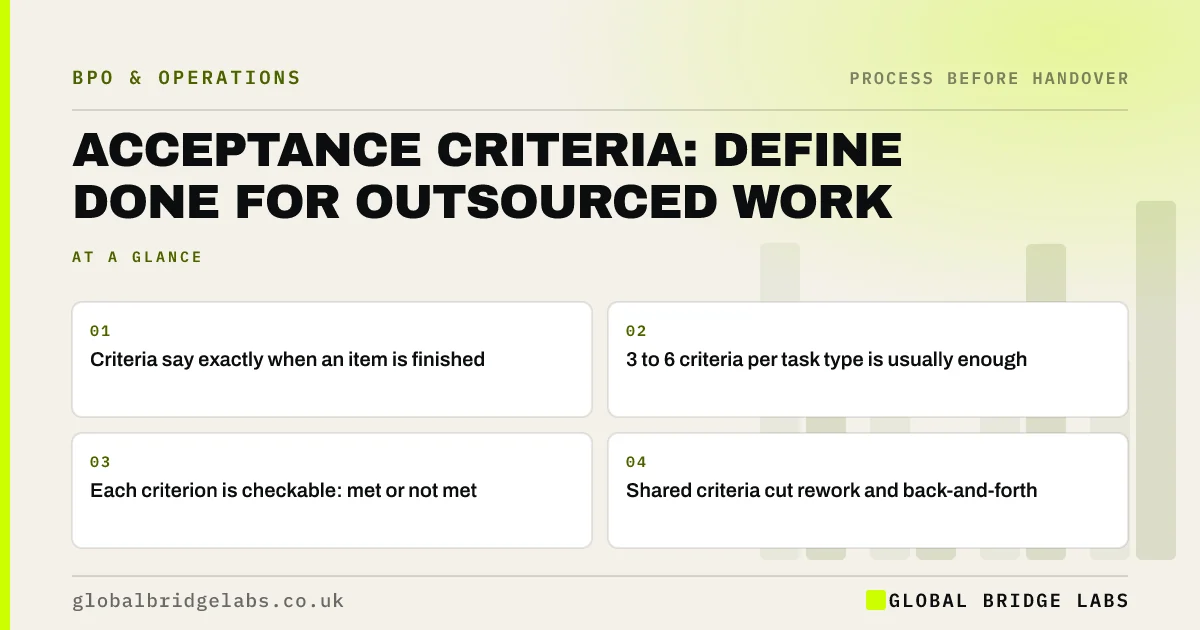
Acceptance criteria for outsourced work are the written conditions a task must meet to count as done. They remove arguments about quality and cut rework, because the team checks against the same list you do. Keep them short, specific and checkable: three to six criteria per task type, each one either met or not.
- Criteria say exactly when an item is finished.
- 3 to 6 criteria per task type is usually enough.
- Each criterion is checkable: met or not met.
- Shared criteria cut rework and back-and-forth.
Want acceptance criteria drafted for your tasks? Message us on WhatsApp.
Chat on WhatsApp →What are acceptance criteria?
Acceptance criteria are a short list of conditions that a completed piece of work must meet before it is accepted. The term comes from software projects, where a feature is not done until it passes its criteria. In outsourced admin and customer service, the same idea defines what a finished invoice, reply or record looks like.
Why do outsourced teams need them?
Outsourced teams need them because they cannot see the unwritten standards your staff absorb over years. Without criteria, quality depends on guesswork, and you find out about gaps only when you check. With criteria, the team checks its own work first, and any sampling you do has a clear standard.
What do good criteria look like?
Good criteria are specific and observable. Not a good reply, but the reply answers every question in the customer's message, uses the customer's name, includes the order number and is sent within two working hours. Each criterion can be checked by looking at the work.
- Invoice: correct customer, PO number, VAT, due date and amount.
- Customer reply: all questions answered, order number, within target.
- CRM record: required fields complete, no duplicate, source recorded.
- Booking: confirmed time, reminder set, details sent to the customer.
How do criteria reduce rework?
Criteria reduce rework by catching errors before handback. In an illustrative example, a team corrects one in eight supplier records after handback. Adding five criteria and a self-check before submission brings it to about one in forty within a month. Example figures; the point is that a shared standard prevents most avoidable errors.
- Checklists that reduce errors in routine business work
- Mistake-proofing admin processes: design errors out
Want to see how criteria could cut your corrections? Send us one task type on WhatsApp.
Chat on WhatsApp →How do you agree and update them?
Draft criteria with the process owner and the provider together, test them on a sample of real work, and adjust any that are unclear. Add a criterion whenever the same error appears twice. Review them at each quarterly review, removing any that no longer matter.
When are criteria not enough?
Criteria are not enough for work that needs judgement, such as complaint handling or tone in a sensitive reply. Add examples of good and poor work, and keep a human review for those cases. Criteria set the minimum; examples show the standard.
What does this look like in practice?
A pattern we see: a client and provider disagree about quality for weeks. Writing down what the client actually checks shows four criteria the provider never knew about. Once they are written, the disagreements stop and corrections fall.
Acceptance criteria checklist
Use these when writing criteria.
- Write 3 to 6 criteria per task type.
- Make each one observable and checkable.
- Test them on ten real items.
- Add one when an error repeats.
- Review them each quarter.
Next step
Send us the task types you plan to hand over. We will help you draft acceptance criteria for each and a simple way to check them.
Message us on WhatsApp to define done, or book a 30-minute consultation.
Chat on WhatsApp →Sources and further reading
- The Sourcing and Consultancy Playbooks · Cabinet Office
- Contracts and liabilities between controllers and processors · Information Commissioner's Office
Frequently asked questions
What are acceptance criteria?
Acceptance criteria are written conditions a piece of work must meet to be accepted as done. For outsourced work they might cover accuracy, completeness, format and timing. Each criterion should be checkable by looking at the work, so both sides judge quality the same way.
How many acceptance criteria should a task have?
Three to six is usually enough for a routine task. Fewer may miss important standards; more becomes a long checklist that slows the work. Add a criterion only when an error repeats, and remove ones that no longer matter.
What is a definition of done?
A definition of done is a shared statement of what must be true for work to count as finished. It is closely related to acceptance criteria and is often used interchangeably. For outsourced work it prevents disagreement about whether an item is complete.
Written by

Global Bridge Labs (GBL) is a UK–Sri Lanka partner for social media, websites and BPO. Everything here comes from client delivery, not theory.


