
On this page
- 01Key takeaways
- 02What is the order-to-cash process?
- 03Where does cash get delayed?
- 04How do you speed it up?
- 05What does the gain look like in numbers?
- 06Where does outsourcing help?
- 07When should you not push harder on collection?
- 08What does this look like in practice?
- 09Order-to-cash checklist
- 10Next step
- 11Sources and further reading
- 12Frequently asked questions
Key takeaways
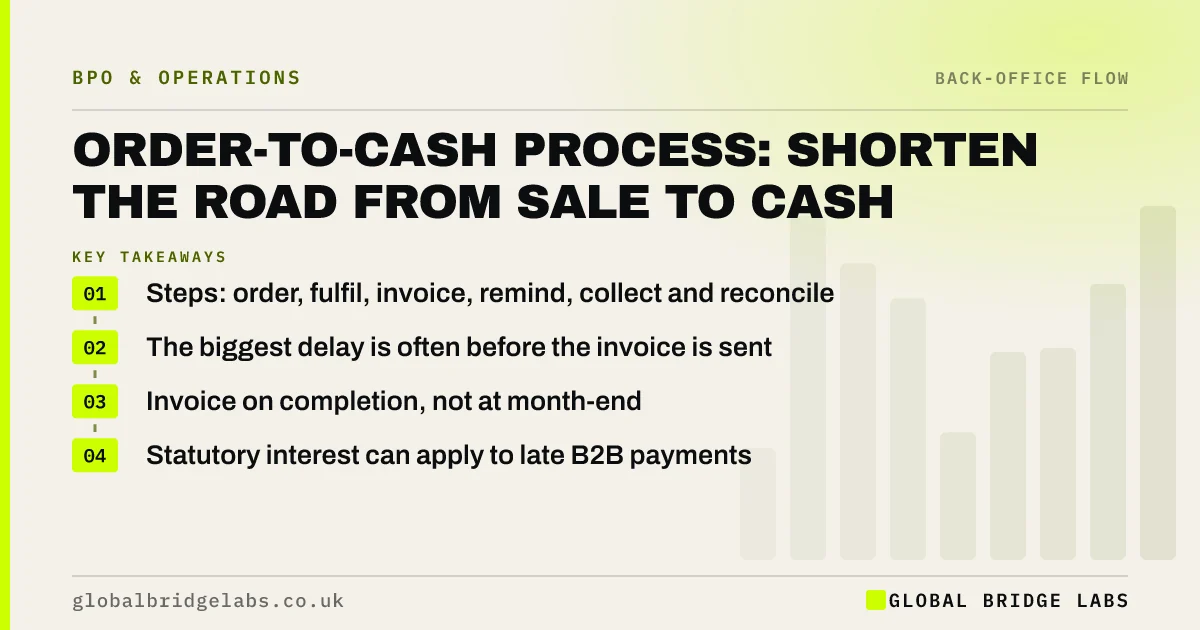
The order-to-cash (O2C) process runs from a customer placing an order to the money arriving in your account. Cash is most often delayed before the invoice is even sent: work finishes, but the invoice waits for someone to raise it. Invoicing on completion, accurate invoices and a set reminder routine shorten the cycle more than chasing harder at the end.
- Steps: order, fulfil, invoice, remind, collect and reconcile.
- The biggest delay is often before the invoice is sent.
- Invoice on completion, not at month-end.
- Statutory interest can apply to late B2B payments.
Want to find where your cash gets delayed? Message us on WhatsApp.
Chat on WhatsApp →What is the order-to-cash process?
Order-to-cash is the full cycle from receiving a customer order to collecting and recording the payment. It covers order entry, fulfilment or delivery, invoicing, payment reminders, collection and reconciliation. Credit control is one part of it, but the earlier steps decide how much chasing is needed.
Where does cash get delayed?
Cash gets delayed in three places. The invoice is raised late because it waits for job sheets or a month-end run. The invoice is wrong, missing a PO number or with the wrong amount, so the customer holds it. Or reminders are irregular, so payment slips. Each adds days, sometimes weeks.
- Late invoicing after work is done.
- Invoice errors that customers reject or query.
- No regular reminder routine.
- Payments not matched, so overdue lists are wrong.
How do you speed it up?
Speed it up by invoicing on completion, using an invoice checklist so invoices are right first time, sending reminders on a fixed schedule and reconciling payments daily so the overdue list is accurate. For business customers, the late payment rules allow statutory interest and fixed compensation on overdue invoices, which can be stated in your terms.
- 1. Raise the invoice the day work is complete.
- 2. Check it against a short checklist.
- 3. Send a reminder before the due date.
- 4. Follow up on set days after it falls due.
- 5. Reconcile payments daily.
What does the gain look like in numbers?
In an illustrative firm billing £80,000 a month, invoices go out an average of 10 days after completion and are paid 35 days after that. Invoicing within a day of completion, with no change to payment behaviour, brings cash in about nine days sooner. At that billing level, that is roughly £24,000 more cash in the bank at any time. Example figures only.
- Outsourcing and cash flow: fixed costs to variable
- Lead time vs cycle time: what your customers actually feel
Want this worked out with your billing figures? Send them on WhatsApp.
Chat on WhatsApp →Where does outsourcing help?
Outsourcing helps with the routine, time-sensitive steps: raising invoices from job records, checking them, sending reminders on schedule and matching payments. A managed team does these daily, which is exactly what in-house teams struggle to keep up when busy. Keep disputes and credit decisions with your own team.
When should you not push harder on collection?
Do not push harder when the customer is disputing the work or the invoice. Resolve the dispute first. Pressure on a disputed invoice damages the relationship and rarely speeds payment. Also take care with consumers in financial difficulty, where a gentler approach is expected.
What does this look like in practice?
A pattern we see in trades and service firms: the owner raises invoices at the weekend from paper job sheets. Moving invoicing to a team that works from completed job records each day closes most of the gap between finishing and billing.
Order-to-cash checklist
Check these in your own cycle.
- Measure days from completion to invoice.
- Use an invoice checklist.
- Set a fixed reminder schedule.
- State late payment terms for business customers.
- Reconcile payments daily.
Next step
Tell us roughly how long invoices take to go out and to be paid. We will show you which step would bring cash in soonest.
Message us on WhatsApp about your cash cycle, or book a 30-minute consultation.
Chat on WhatsApp →Sources and further reading
Frequently asked questions
What is the order-to-cash process?
Order-to-cash is the full cycle from receiving a customer order to collecting and recording the payment: order entry, fulfilment, invoicing, reminders, collection and reconciliation. Shortening it brings cash in sooner without changing prices or sales.
How can I get paid faster?
Invoice the day work is complete, make sure invoices are accurate so they are not queried, send a reminder before the due date and follow up on set days after. Reconcile payments daily so you chase only what is genuinely overdue.
Can I charge interest on late payments?
For business-to-business transactions, UK late payment legislation allows statutory interest and fixed compensation on overdue invoices unless your contract says otherwise. Check the current rules on GOV.UK and state your terms clearly on invoices.
Written by

Global Bridge Labs (GBL) is a UK–Sri Lanka partner for social media, websites and BPO. Everything here comes from client delivery, not theory.


