On this page
- 01Key takeaways
- 02What is bank reconciliation?
- 03Why reconcile daily instead of monthly?
- 04What does a managed team do?
- 05What does it look like in numbers?
- 06How do you keep access safe?
- 07When is outsourcing reconciliation not worth it?
- 08What does this look like in practice?
- 09Reconciliation checklist
- 10Next step
- 11Sources and further reading
- 12Frequently asked questions
Key takeaways
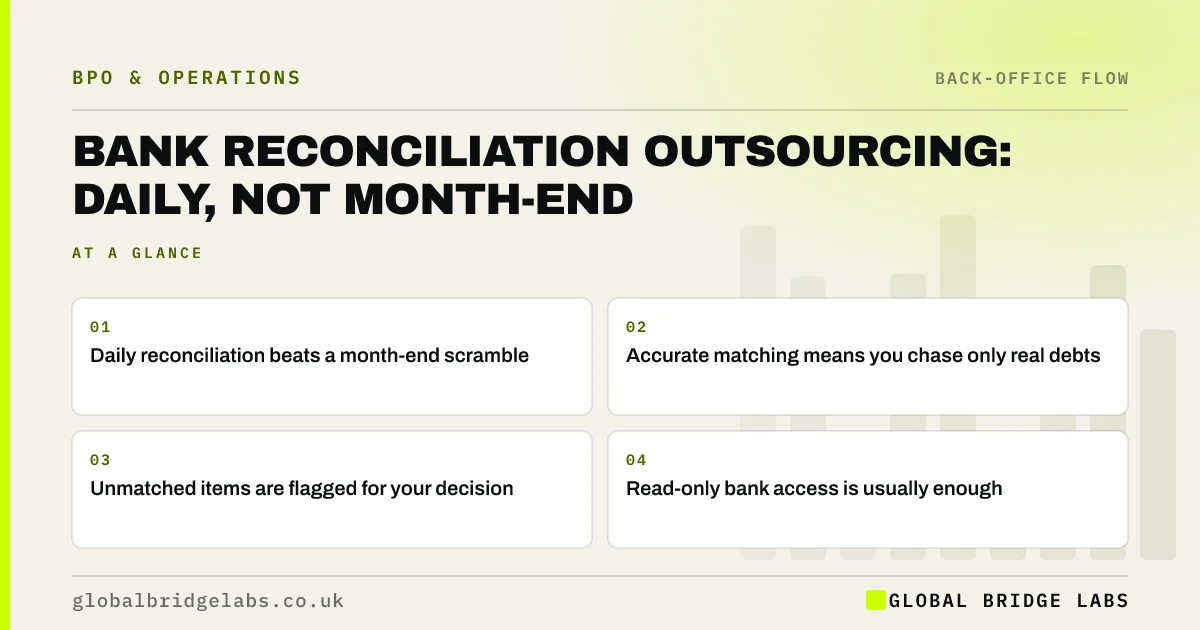
Bank reconciliation outsourcing means a managed team matches every bank transaction to your records, usually daily, and flags anything it cannot match. Daily reconciliation keeps the overdue list accurate, catches errors and fraud early and turns month-end from days of catch-up into a quick check. You keep the decisions on unexplained items.
- Daily reconciliation beats a month-end scramble.
- Accurate matching means you chase only real debts.
- Unmatched items are flagged for your decision.
- Read-only bank access is usually enough.
Want to know if daily reconciliation would help you? Message us on WhatsApp.
Chat on WhatsApp →What is bank reconciliation?
Bank reconciliation is matching the transactions on your bank statement to the entries in your accounting records, so the two agree. Each payment received is matched to an invoice, each payment made to a bill, and anything unexplained is investigated. Most accounting software suggests matches, but someone still has to confirm them and deal with the rest.
Why reconcile daily instead of monthly?
Daily reconciliation keeps your view of cash current. You know which customers have paid, so you do not chase someone who already has. Errors and suspicious transactions are spotted within a day rather than weeks later. Month-end becomes a review instead of a catch-up, which shortens the close.
What does a managed team do?
A managed team confirms suggested matches, matches the remainder against invoices and bills, codes routine transactions such as bank fees, and sends you a short daily or weekly list of anything it cannot explain. It works to written rules on coding and on what counts as an exception.
- Confirm software-suggested matches.
- Match remaining receipts and payments.
- Code routine items to agreed rules.
- Flag unexplained items for your decision.
What does it look like in numbers?
In an illustrative firm with 600 bank transactions a month, the bookkeeper spends about two days at month-end reconciling, and customers are sometimes chased for invoices already paid. A managed team reconciling daily takes around 20 minutes a day, and month-end reconciliation becomes a 30-minute review. Example figures only.
As indicative UK market ranges, managed offshore support costs £9–£18 per hour and onshore £20–£35. Neither is a GBL price.
Want this estimated with your transaction volumes? Send them on WhatsApp.
Chat on WhatsApp →How do you keep access safe?
Give access to your accounting software and a read-only bank feed rather than banking log-ins that allow payments. Use named user accounts with multi-factor authentication. Your bank data includes personal data about customers and staff, so a written processor contract is needed under UK GDPR.
When is outsourcing reconciliation not worth it?
It is not worth it for a business with a few dozen transactions a month, where software matching and a quick weekly check by the owner are enough. It pays off once volumes, payment methods or the number of accounts make the job a regular burden.
What does this look like in practice?
A pattern we see: an online business takes payments through several channels and only reconciles at month-end, so cash looks uncertain for weeks. Daily reconciliation by a managed team gives the owner a reliable cash position every morning.
Reconciliation checklist
Set these up before handing over.
- Connect bank feeds to your accounting software.
- Write coding rules for routine items.
- Define what counts as an exception.
- Give read-only bank access.
- Agree a daily or weekly exception list.
Next step
Tell us how many bank transactions you have each month and how you reconcile now. We will say whether daily reconciliation by a managed team would help.
Message us on WhatsApp about reconciliation, or book a 30-minute consultation.
Chat on WhatsApp →Sources and further reading
- Running a limited company: company and accounting records · GOV.UK
- Contracts and liabilities between controllers and processors · Information Commissioner's Office
Frequently asked questions
Can you outsource bank reconciliation?
Yes. A managed team can match bank transactions to your records daily, code routine items to agreed rules and flag anything it cannot explain for your decision. Read-only bank access and access to your accounting software are usually enough.
How often should you reconcile bank accounts?
Busy businesses benefit from daily reconciliation, because it keeps the cash position and overdue list accurate and catches errors early. Smaller businesses may reconcile weekly. Leaving it to month-end makes errors harder to trace and the close slower.
Is it safe to give an outsourced team bank access?
It can be, with the right controls. Use read-only bank feeds rather than payment log-ins, named accounts with multi-factor authentication, and a written processor contract under UK GDPR. Keep payment approval with your own team.
Written by

Global Bridge Labs (GBL) is a UK–Sri Lanka partner for social media, websites and BPO. Everything here comes from client delivery, not theory.