
On this page
- 01Key takeaways
- 02What is a process owner?
- 03What does a process owner do each week?
- 04Who should be the process owner?
- 05What does the role cost in time?
- 06What goes wrong without one?
- 07When can ownership be shared?
- 08What does this look like in practice?
- 09Process owner checklist
- 10Next step
- 11Sources and further reading
- 12Frequently asked questions
Key takeaways
A process owner is the one person accountable for how a process works end to end: its rules, its documents, its performance and its improvement. When a process is outsourced, the owner stays in your business. They set the rules, make or delegate decisions, read the weekly report and agree changes. Without one, outsourced work drifts.
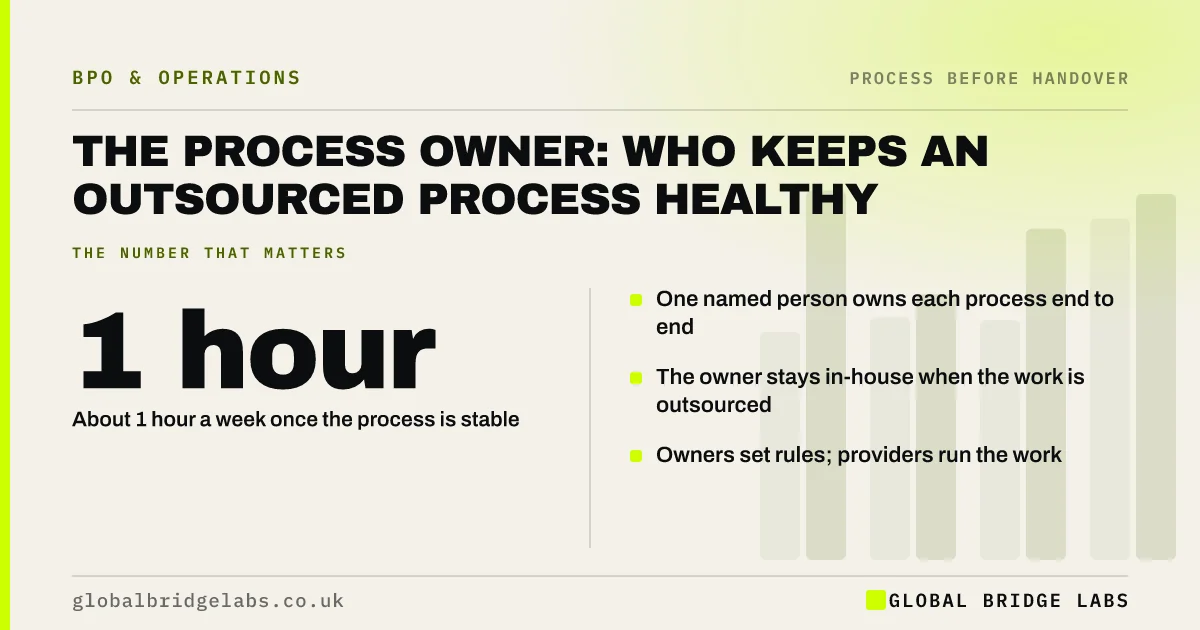
- One named person owns each process end to end.
- The owner stays in-house when the work is outsourced.
- About 1 hour a week once the process is stable.
- Owners set rules; providers run the work.
Not sure who should own a process you plan to outsource? Message us on WhatsApp.
Chat on WhatsApp →What is a process owner?
A process owner is the person accountable for a business process from start to finish, regardless of which team does each step. They decide how it should work, keep its documents current, watch its performance and approve changes. They do not need to do the work, and often should not, but they must have the authority to change the rules.
What does a process owner do each week?
Each week the process owner reads the performance report, answers the decisions the team could not make alone, reviews a small sample of work and turns any repeated question into a written rule. Each quarter they review the process with the provider and agree one improvement.
- Read the weekly report on volumes, turnaround and errors.
- Clear the decision list.
- Sample a few completed items.
- Turn repeated questions into written rules.
- Agree one improvement each quarter.
Who should be the process owner?
The owner should be someone who understands the outcome the process serves and can make decisions about it, such as a finance lead for invoicing or an operations lead for orders. In a very small business it is often the owner at first, then handed to a manager once the process is stable.
What does the role cost in time?
In an illustrative handover, the process owner spends about three hours a week in the first month and about one hour a week from month three. That hour is the cheapest insurance an outsourced process has: it catches drift early and keeps decisions moving. Example figures only.
- How much of your time does an outsourced team need?
- How long before outsourcing makes you more efficient?
Want the process owner routine set out for your handover? Send us the process on WhatsApp.
Chat on WhatsApp →What goes wrong without one?
Without a process owner, several people give the provider instructions, rules change without being written down, and nobody reads the report. Questions go unanswered and items wait. Over months the process drifts from what the business needs, and the provider is blamed for problems it cannot fix alone.
When can ownership be shared?
Ownership should not be shared, but it can be delegated during holidays to a named deputy with the same authority. For very small processes, one person can own several. What matters is that for every process, everyone knows who decides.
What does this look like in practice?
A pattern we see: an outsourced process works well for months, then quality slips after the person who set it up leaves. Nobody else knew they were the owner. Naming the owner in the documents and a deputy in the RACI matrix avoids the gap.
Process owner checklist
Agree these for every outsourced process.
- One named owner and one deputy.
- Owner has authority to change the rules.
- Weekly report goes to the owner.
- Decision list is cleared daily or weekly.
- Quarterly review is booked.
Next step
Tell us the processes you plan to hand over and who looks after them today. We will help you name owners and set a simple weekly routine for each.
Message us on WhatsApp to plan ownership, or book a 30-minute consultation.
Chat on WhatsApp →Sources and further reading
- The Sourcing and Consultancy Playbooks · Cabinet Office
- Controllers and processors · Information Commissioner's Office
Frequently asked questions
What does a process owner do?
A process owner is accountable for a process end to end. They set its rules, keep its documents current, read its performance report, make or delegate decisions and agree improvements. They do not need to do the work themselves, but they need the authority to change how it is done.
Should the process owner be in-house if the work is outsourced?
Yes. The provider runs the work, but your business must own the rules, standards and decisions. An in-house owner keeps the process aligned with what customers need and gives the provider one clear contact for questions.
What is the difference between a process owner and a process manager?
A process owner is accountable for how the process is designed and performs. A process manager or team leader runs the daily work within it. With outsourcing, the provider usually supplies the manager and your business supplies the owner.
Written by

Global Bridge Labs (GBL) is a UK–Sri Lanka partner for social media, websites and BPO. Everything here comes from client delivery, not theory.


