
On this page
- 01Key takeaways
- 02What is the difference between lead time and cycle time?
- 03Why do customers feel lead time, not cycle time?
- 04How do you measure both?
- 05What does the gap look like in numbers?
- 06How do you shorten lead time?
- 07When is a long lead time acceptable?
- 08What does this look like in practice?
- 09Lead time checklist
- 10Next step
- 11Sources and further reading
- 12Frequently asked questions
Key takeaways
Lead time vs cycle time is the difference between how long the customer waits and how long the work takes once someone starts it. Customers feel lead time. In most office processes, lead time is several times cycle time because work waits before anyone picks it up. Shortening that wait is usually the fastest efficiency gain available.
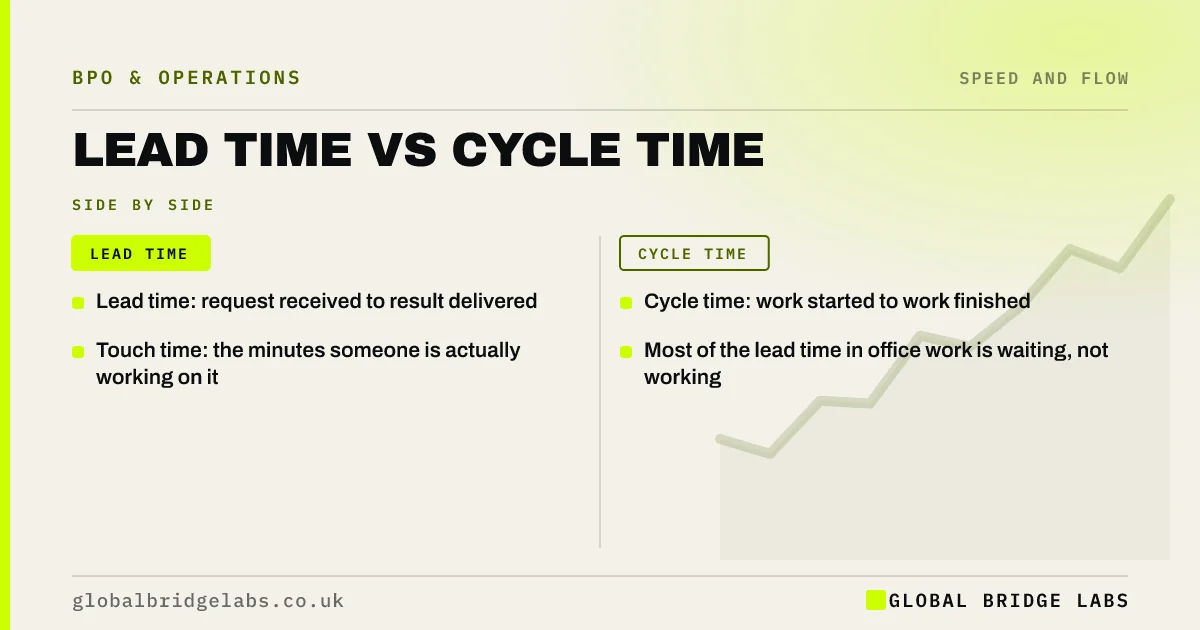
- Lead time: request received to result delivered.
- Cycle time: work started to work finished.
- Touch time: the minutes someone is actually working on it.
- Most of the lead time in office work is waiting, not working.
Want to measure lead and cycle time on one of your processes? Message us on WhatsApp.
Chat on WhatsApp →What is the difference between lead time and cycle time?
Lead time runs from the moment a customer asks to the moment they get the result. Cycle time runs from the moment someone starts work on it to the moment it is finished. The gap between them is queue time: the request sitting in an inbox or on a list. Touch time sits inside cycle time and counts only active work.
Definitions vary between textbooks, so write down the start and end points you are using and keep them the same each time you measure.
Why do customers feel lead time, not cycle time?
Customers only see the whole wait. A quote that takes 40 minutes to prepare but arrives on day four feels slow, however quickly it was written. Businesses tend to measure cycle time because it is under their control, which hides the queue. Customer satisfaction follows lead time, and so do lost sales when a competitor answers first.
How do you measure both?
Take ten recent items in one process. For each, record when the request arrived, when work started, when it finished and when the customer received it. Lead time is arrival to receipt. Cycle time is start to finish. The average gap tells you how much of the wait is queue.
- 1. Pick one process with a clear request and result.
- 2. Record four timestamps for ten recent items.
- 3. Calculate average lead time and cycle time.
- 4. Note where items waited longest and why.
What does the gap look like in numbers?
In an illustrative example, new client onboarding has a lead time of eight working days but a cycle time of two days and a touch time of about three hours. Six days are spent waiting for someone to start, mostly because the person who sets up accounts also handles client calls. Moving the setup to a team that works the queue daily brings lead time to about three days. Example figures only.
- Work queue management: stop jobs waiting in the back office
- Little's law: why more work in progress slows delivery
Want help finding your own queue time? Send us ten timestamps on WhatsApp.
Chat on WhatsApp →How do you shorten lead time?
Shorten lead time by attacking the queue first: give the work a daily owner, limit how much is started at once, remove approvals that add waiting, and process items as they arrive rather than in weekly batches. Only then look at making the work itself faster. Outsourcing helps when nobody in-house can work the queue every day.
When is a long lead time acceptable?
A long lead time is acceptable when the customer expects it and the wait does not cost you the sale, such as a scheduled annual review. It is also unavoidable when you wait on a third party, such as a lender or a supplier. Measure your part separately so you know what you can change.
What does this look like in practice?
A pattern we see: a firm proud of its fast turnaround measures from when work starts. Measuring from when the customer asked shows the real lead time is three times longer. The first fix is rarely about working faster. It is about who picks up new requests and when.
Lead time checklist
Use these checks on any customer-facing process.
- Define lead time from the customer's point of view.
- Record four timestamps for ten items.
- Find the longest wait and who it waits for.
- Give the queue a daily owner.
- Measure again after four weeks.
Next step
Send us the process where customers wait longest. We will help you split the wait into queue and work, and say what would shorten it most.
Message us on WhatsApp to review your lead times, or book a 30-minute consultation.
Chat on WhatsApp →Sources and further reading
- Labour productivity · Office for National Statistics
- UK Customer Satisfaction Index · Institute of Customer Service
Frequently asked questions
What is the difference between lead time and cycle time?
Lead time is the total time the customer waits, from request to result. Cycle time is the time from when work starts to when it finishes. The difference is queue time, when the request waits for someone to pick it up. Customers feel lead time.
How do you calculate lead time?
Record when each request arrives and when the customer receives the result, then take the average across at least ten items. Use working hours or working days consistently, and write the definition down so future measurements can be compared.
What is a good lead time?
It depends on what customers expect and what competitors offer. For enquiries and quotes, same day or next working day is a common expectation. The more useful test is the ratio: if lead time is many times touch time, there is queue to remove.
Written by

Global Bridge Labs (GBL) is a UK–Sri Lanka partner for social media, websites and BPO. Everything here comes from client delivery, not theory.


