
On this page
- 01Key takeaways
- 02What is a support ticket backlog?
- 03Why do backlogs build?
- 04How do you clear a backlog?
- 05What does clearing look like in numbers?
- 06How do you keep it clear?
- 07When is a small backlog acceptable?
- 08What does this look like in practice?
- 09Backlog checklist
- 10Next step
- 11Sources and further reading
- 12Frequently asked questions
Key takeaways
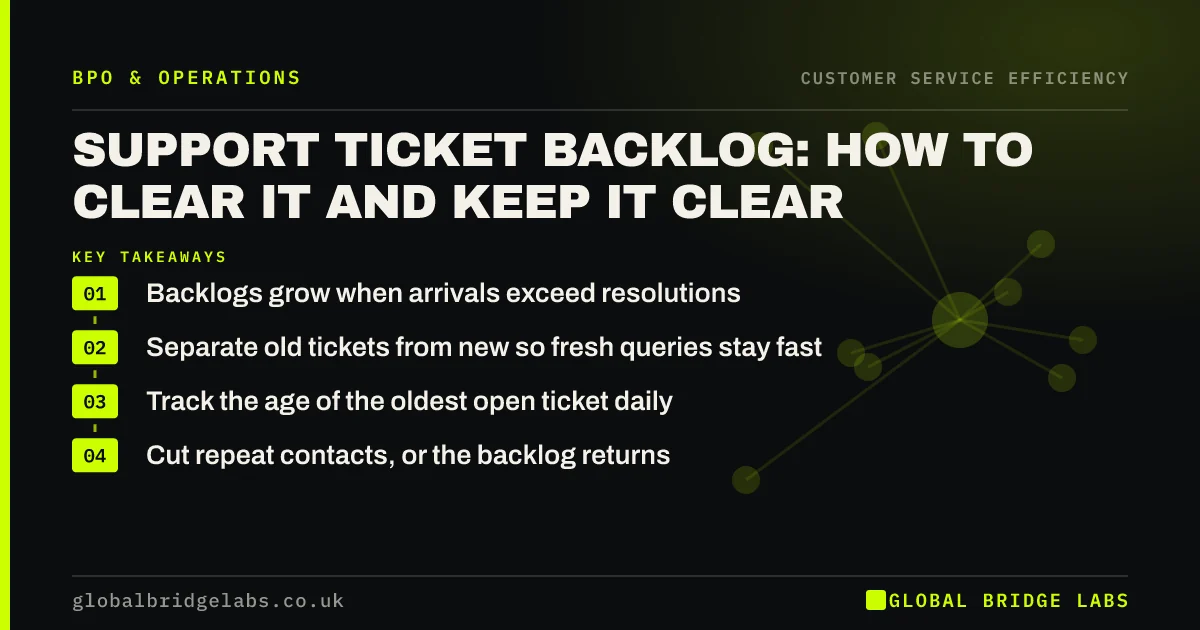
A support ticket backlog builds when new tickets arrive faster than the team resolves them. Clear it by separating old tickets from new, closing the ones that no longer need a reply, and adding temporary capacity. Keep it clear by matching staffing to arrival patterns, reducing repeat contacts and tracking the age of the oldest open ticket daily.
- Backlogs grow when arrivals exceed resolutions.
- Separate old tickets from new so fresh queries stay fast.
- Track the age of the oldest open ticket daily.
- Cut repeat contacts, or the backlog returns.
Sitting on a support backlog? Message us on WhatsApp with its size and age.
Chat on WhatsApp →What is a support ticket backlog?
A support backlog is the set of open customer tickets that have passed their target response or resolution time. Some open tickets are normal. A backlog is when the open count keeps rising or the oldest ticket keeps getting older, which means customers are waiting longer each week.
Why do backlogs build?
Backlogs build for three reasons. Volume rises, from a launch, a peak or a delivery problem. Capacity falls, from absence or staff moving to other work. Or repeat contacts multiply, as customers chase unanswered tickets, which adds volume and makes the backlog grow faster.
How do you clear a backlog?
Clear it in four steps. Merge duplicates and close tickets the customer has already resolved. Split the remaining old tickets from new arrivals, so new queries are answered on time while a separate effort works the old ones. Send a short holding reply to the oldest. Then work them oldest first with templates for the common types.
- 1. Merge duplicates and close resolved tickets.
- 2. Split old tickets from new arrivals.
- 3. Send holding replies to the oldest.
- 4. Work old tickets oldest first, using templates.
What does clearing look like in numbers?
In an illustrative business, 600 tickets are open and 80 arrive daily, while the team resolves 75. Merging duplicates closes 120. A temporary team of two resolves 60 old tickets a day on top. The backlog is gone in about eight working days. Then a small change, two extra hours of cover at the Monday peak, stops it rebuilding. Example figures only.
- Little's law: why more work in progress slows delivery
- Overflow outsourcing: hand off only work above your limit
Want a clearance plan for your own backlog? Send us open count and daily arrivals on WhatsApp.
Chat on WhatsApp →How do you keep it clear?
Keep it clear by staffing to when tickets arrive, not to the daily average, and by fixing the top causes of contact. Track open tickets and oldest-ticket age every day. Set a trigger, such as the oldest ticket passing two working days, that brings in extra capacity before the backlog becomes a crisis.
When is a small backlog acceptable?
A small, stable backlog of non-urgent tickets can be fine, for example feature suggestions that are logged and reviewed monthly. What matters is that customers know what to expect and urgent tickets are never in it. Separate these from service tickets so they do not distort the numbers.
What does this look like in practice?
A pattern we see: a team clears a backlog with weekend overtime, then it returns a month later. The weekly arrival pattern shows a Monday surge the team cannot absorb. Adding flexible cover for Monday mornings costs less than the overtime and keeps the queue steady.
Backlog checklist
Use these to clear and hold your queue.
- Count open tickets and the oldest one today.
- Merge duplicates and close resolved tickets.
- Split old and new work.
- Find the top three contact reasons.
- Staff to arrival peaks.
- Set a trigger for extra capacity.
Next step
Tell us how many tickets are open, how old the oldest is and roughly how many arrive each day. We will outline how to clear the backlog and what would stop it returning.
Message us on WhatsApp about your backlog, or book a 30-minute consultation.
Chat on WhatsApp →Sources and further reading
- UK Customer Satisfaction Index · Institute of Customer Service
- Stop trying to delight your customers (Dixon, Freeman and Toman, 2010) · Harvard Business Review
Frequently asked questions
How do you clear a customer service backlog?
Merge duplicates and close resolved tickets, split old tickets from new arrivals so new queries stay on time, send holding replies to the oldest, then work the old tickets oldest first with templates. Temporary extra capacity shortens the clearance considerably.
What causes a support ticket backlog?
Rising volume, falling capacity or repeat contacts. Repeat contacts are the hidden driver: customers chase tickets that have not been answered, which adds volume and makes the backlog grow faster than the original problem alone.
How do you stop a backlog coming back?
Staff to when tickets actually arrive rather than the daily average, fix the top reasons customers contact you, and track the oldest open ticket every day. Agree a trigger point that brings in extra capacity before the queue grows.
Written by

Global Bridge Labs (GBL) is a UK–Sri Lanka partner for social media, websites and BPO. Everything here comes from client delivery, not theory.


