On this page
- 01Key takeaways
- 02What is the efficiency gain scorecard?
- 03How do you score each line?
- 04How do you read the total?
- 05What does a scored example look like?
- 06When should you not rely on the score?
- 07How does this differ from the cost lever scorecard?
- 08What does this look like in practice?
- 09Scorecard checklist
- 10Next step
- 11Sources and further reading
- 12Frequently asked questions
Key takeaways
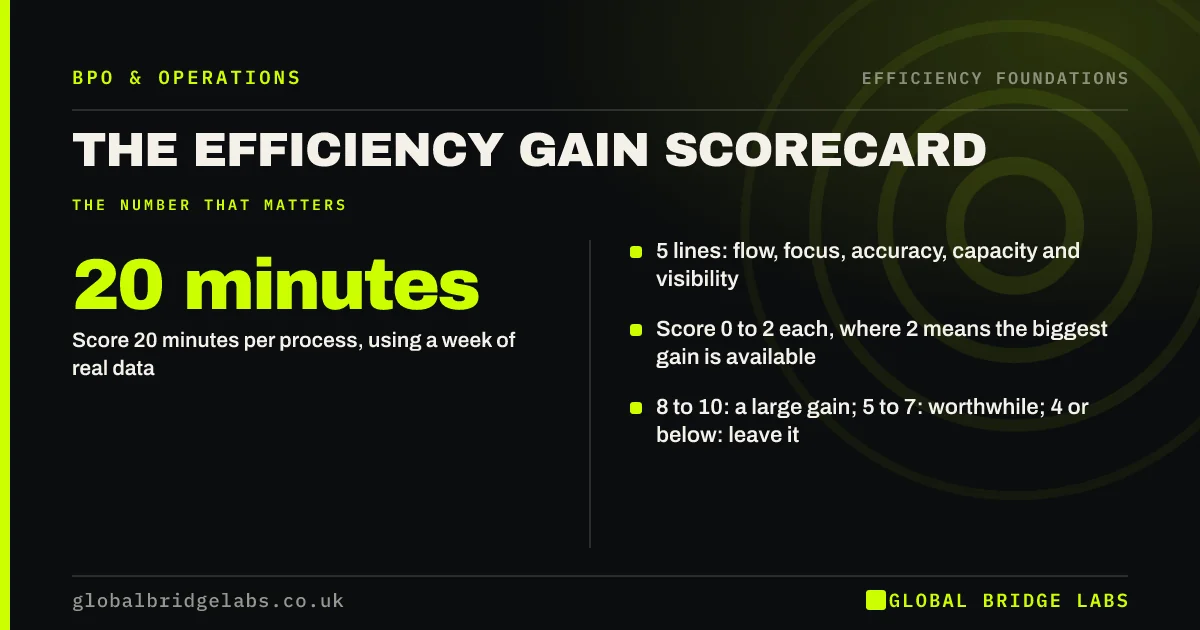
The GBL Efficiency Gain Scorecard rates a process from 0 to 2 on five lines: flow, focus, accuracy, capacity and visibility, where 2 means the problem is severe and the gain available is large. A score of 8 to 10 out of 10 means a large efficiency gain is available, 5 to 7 is worthwhile, and 4 or below means the process is already lean.
- 5 lines: flow, focus, accuracy, capacity and visibility.
- Score 0 to 2 each, where 2 means the biggest gain is available.
- 8 to 10: a large gain; 5 to 7: worthwhile; 4 or below: leave it.
- Score 20 minutes per process, using a week of real data.
Want us to score your top three processes with you? Message us on WhatsApp.
Chat on WhatsApp →What is the efficiency gain scorecard?
The GBL Efficiency Gain Scorecard is a five-line assessment that shows where outsourcing would make a process faster, more accurate or less disruptive. Each line is scored 0, 1 or 2, giving a total out of 10. A high score is not a judgement on your team. It shows where the process design leaves the most room for gain.
How do you score each line?
Score each line using a week of real data, not impressions. Two people scoring separately and then comparing gives a fairer result than one person alone.
- Flow: 0 if lead time is under twice touch time; 1 if up to five times; 2 if more.
- Focus: 0 if no senior time goes on it; 1 if under 3 hours a week; 2 if more.
- Accuracy: 0 if under 1 in 50 items are corrected; 1 if up to 1 in 10; 2 if more.
- Capacity: 0 if the queue is steady; 1 if it backs up in peaks; 2 if always behind.
- Visibility: 0 if turnaround is reported weekly; 1 if sometimes; 2 if never.
How do you read the total?
A total of 8 to 10 means the process has a large efficiency gain available and is a strong candidate for a written process and a managed team. A total of 5 to 7 is worth improving, often with a process fix first. A total of 4 or below means the process already runs well, so leave it and look elsewhere.
The line with the highest score tells you what to fix first. A process scoring 2 on accuracy needs a checklist and acceptance criteria before anything else.
What does a scored example look like?
In an illustrative example, a firm scores its supplier invoice process. Invoices take 10 minutes each but wait nine days for approval (flow 2), the director spends 4 hours a week on them (focus 2), one in eight is corrected (accuracy 2), the queue builds at month-end (capacity 1) and nobody reports turnaround (visibility 2). The total is 9: a large gain is available.
- Purchase-to-pay process: faster, cleaner supplier payments
- Approval bottlenecks: when sign-off holds up the work
Want a second opinion on your own scores? Send them to us on WhatsApp.
Chat on WhatsApp →When should you not rely on the score?
Do not rely on the score for work that is your product, your client relationship or highly confidential judgement. A high score there means the process needs redesign in-house, not a handover. Also rescore after any big change in volume, because capacity scores move with demand.
How does this differ from the cost lever scorecard?
The cost lever scorecard asks where money is lost. The efficiency gain scorecard asks where time, attention and accuracy are lost. They often point to the same process, but not always. A process can be cheap and still slow customers down. Use both when building a business case.
What does this look like in practice?
A pattern we see when owners score their own processes: the one they expected to top the list, usually customer email, scores 6. The one they had not thought about, often supplier payments or document chasing, scores 9 because it waits on one person and is never measured.
Scorecard checklist
Follow these steps for each process.
- Pick one process with a clear start and end.
- Collect a week of lead time, touch time and corrections.
- Score the five lines separately with a colleague.
- Agree the total and the highest-scoring line.
- Fix that line first, then rescore in 30 days.
Next step
Send us your three highest-scoring processes and their line scores. We will tell you which look ready to hand over and which need a process fix first.
Message us on WhatsApp with your scores, or book a 30-minute consultation.
Chat on WhatsApp →Sources and further reading
- Multitasking: switching costs · American Psychological Association
- Labour productivity · Office for National Statistics
Frequently asked questions
What is an outsourcing efficiency assessment?
It is a structured check of a process to see where outsourcing would make it faster, more accurate or less disruptive to senior people. The GBL Efficiency Gain Scorecard does this on five lines (flow, focus, accuracy, capacity and visibility), scored 0 to 2 each for a total out of 10.
What score means a process should be outsourced?
A total of 8 to 10 means a large efficiency gain is available and the process is a strong candidate, provided it is not your core product. A total of 5 to 7 is worth improving, often with a process fix first. A total of 4 or below means it already runs well.
How often should you rescore a process?
Rescore 30 days after any change and then every quarter. Scores move when volumes change, when a key person leaves or when a new system is introduced, so a quarterly check keeps the picture current.
Written by

Global Bridge Labs (GBL) is a UK–Sri Lanka partner for social media, websites and BPO. Everything here comes from client delivery, not theory.