On this page
- 01Key takeaways
- 02What is comparative advantage?
- 03How does it apply to a small business?
- 04What does it look like in numbers?
- 05Why do owners resist the idea?
- 06When does comparative advantage not justify outsourcing?
- 07What does this look like in practice?
- 08Comparative advantage checklist
- 09Next step
- 10Sources and further reading
- 11Frequently asked questions
Key takeaways
Comparative advantage means a business gains by doing the work where its edge is largest and handing over the rest, even work it does well. An owner who invoices faster than anyone still loses if those hours could win clients. The test is not who is best at a task, but what each hour could be used for instead.
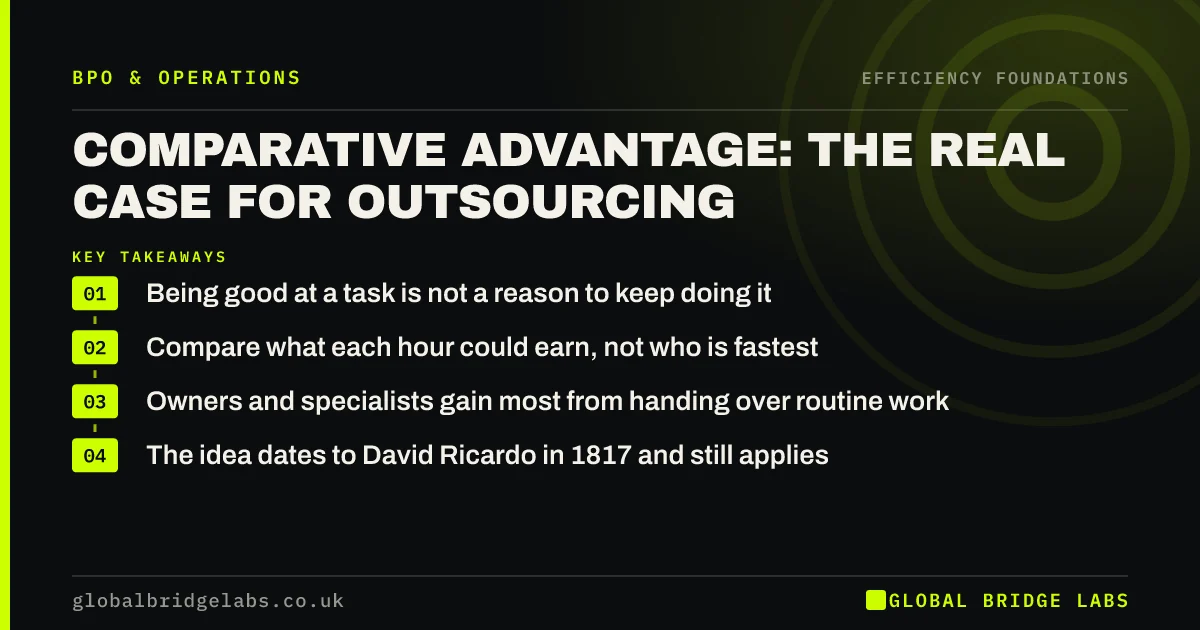
- Being good at a task is not a reason to keep doing it.
- Compare what each hour could earn, not who is fastest.
- Owners and specialists gain most from handing over routine work.
- The idea dates to David Ricardo in 1817 and still applies.
Want to see where your own hours are worth most? Message us on WhatsApp.
Chat on WhatsApp →What is comparative advantage?
Comparative advantage is the idea that a person or business should focus on the work where its relative edge is greatest, and trade for the rest. The economist David Ricardo set it out in 1817 to explain trade between countries. Absolute advantage is being best at something. Comparative advantage is giving up the least to do it.
How does it apply to a small business?
It applies whenever a senior person does routine work well. A partner may process expenses in half the time a junior would, but every hour on expenses is an hour not spent advising clients. If that hour earns several times more in client work, the business is better off handing over the expenses, even to someone slower.
What does it look like in numbers?
In an illustrative firm, a director does 6 hours a week of admin and bills client work at £100 an hour. A managed team takes 8 hours to do the same admin at an indicative £12 an hour, costing £96. If the director bills even 3 of the 6 hours freed, that is £300 earned against £96 spent. Example figures, not a benchmark.
- Director: 6 hours a week on admin, worth £100 an hour elsewhere.
- Managed team: 8 hours at an indicative £12, about £96.
- If 3 freed hours are billed: £300 a week earned.
- The slower option still wins on the whole business.
Want this sum run on your own diary? Send us your week on WhatsApp.
Chat on WhatsApp →Why do owners resist the idea?
Owners resist because they can see the cost of handing over and cannot see the cost of keeping. The provider's invoice is visible, while the client work not done is not. There is also pride: being the fastest person at a task feels like a reason to keep it. Writing down what the freed hours will be used for makes the trade visible.
When does comparative advantage not justify outsourcing?
It does not justify outsourcing when the freed hours will not be used for higher-value work, when the task is small, or when handing it over adds more coordination than it saves. It also fails when the task is part of your value to clients, such as a founder's personal review of every proposal.
What does this look like in practice?
A pattern we see: the owner says the admin takes them only an hour a day because they are quick. Logging shows it is spread across the day in small pieces, and the real cost is the broken concentration around each one. The gain from handing it over is larger than the hour suggests.
Comparative advantage checklist
Use these steps to apply the idea to your own week.
- List the tasks you do that others could do.
- Estimate what one hour of your core work is worth.
- Compare it with the cost of handing each task over.
- Decide in advance what freed hours will be used for.
- Hand over the task with the largest gap first.
Next step
Send us a rough list of the routine tasks you do each week. We will help you work out which ones cost you the most in lost core work.
Message us on WhatsApp with your list, or book a 30-minute consultation.
Chat on WhatsApp →Sources and further reading
- Labour productivity · Office for National Statistics
- Employee earnings in the UK (Annual Survey of Hours and Earnings) · Office for National Statistics
Frequently asked questions
What is comparative advantage in simple terms?
Comparative advantage means focusing on the work where you give up the least by doing it, and letting others do the rest, even work you are good at. It was described by David Ricardo in 1817 and applies to people and businesses as well as countries.
Should I outsource tasks I am good at?
Often, yes. If your hours are worth more on core work such as selling or delivering for clients, handing over even tasks you do quickly frees that value. The exception is where your personal involvement is part of what clients pay for.
What is the difference between comparative and absolute advantage?
Absolute advantage is being better at a task than anyone else. Comparative advantage is about what you give up to do it. An owner can have absolute advantage at invoicing and still be better off handing it over, because their time is worth more elsewhere.
Written by

Global Bridge Labs (GBL) is a UK–Sri Lanka partner for social media, websites and BPO. Everything here comes from client delivery, not theory.