
On this page
- 01Key takeaways
- 02What happens in the first month?
- 03What changes in month two?
- 04What changes in month three?
- 05What does the timeline look like in numbers?
- 06What slows the timeline down?
- 07When should you stop waiting for improvement?
- 08What does this look like in practice?
- 09Timeline checklist
- 10Next step
- 11Sources and further reading
- 12Frequently asked questions
Key takeaways
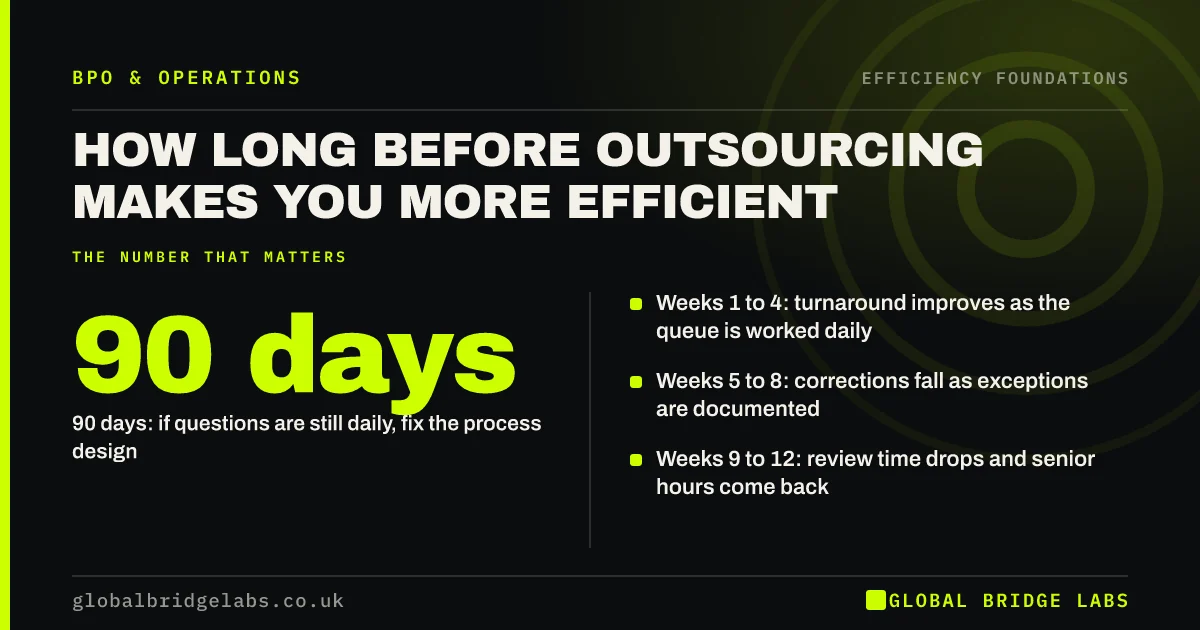
Outsourcing usually improves turnaround within the first month, accuracy by month two and senior time by month three. The first weeks feel slower because questions and reviews are front-loaded. A process that is still generating daily questions after 90 days has a design problem, not a settling-in problem.
- Weeks 1 to 4: turnaround improves as the queue is worked daily.
- Weeks 5 to 8: corrections fall as exceptions are documented.
- Weeks 9 to 12: review time drops and senior hours come back.
- 90 days: if questions are still daily, fix the process design.
Planning a handover and want a realistic timeline? Message us on WhatsApp.
Chat on WhatsApp →What happens in the first month?
In the first month the provider learns the process and starts working the queue every day, so waiting time falls quickly. Your own time goes up, because you answer questions and check most of the work. Expect two to four hours a week of review per process at this stage, and treat each question as a gap in the written process.
What changes in month two?
In month two the questions turn into documented rules, so corrections fall and the team handles more exceptions alone. Move from checking every item to sampling, for example one in five. This is when right-first-time rate starts to show whether the process is stable.
What changes in month three?
By month three review settles to a short weekly check and senior hours come back in full. This is the right point to measure the gain against your baseline, decide whether to add a second process, and agree one improvement with the provider for the next quarter.
What does the timeline look like in numbers?
In an illustrative handover of customer email, average first reply falls from about a day to four hours in month one, corrections fall from one in ten to one in thirty by month two, and the owner's review time falls from four hours a week to one by month three. Example figures to show the shape, not a promise.
- Response time vs resolution time: which one to improve
- How much of your time does an outsourced team need?
Want a timeline built around your own process? Send it to us on WhatsApp.
Chat on WhatsApp →What slows the timeline down?
The timeline slows when the process is not written down, when system access arrives late, when several people give the team conflicting instructions, or when volumes are too low for the team to build practice. Each adds weeks. A single named contact and access ready on day one save the most time.
When should you stop waiting for improvement?
Stop waiting if turnaround has not improved after six weeks, or if questions are still daily after 90 days. At that point the cause is usually the process, the brief or the fit of the provider. Review all three before extending the arrangement.
What does this look like in practice?
A pattern we see: an owner judges the arrangement in week two, when they are answering more questions than ever, and nearly stops. By week ten the questions have stopped and the work is coming back right. Agreeing the 90-day shape at the start keeps the early weeks in perspective.
Timeline checklist
Put these in place before day one.
- Write the process and the top ten exceptions.
- Have system access ready on day one.
- Name one internal contact for questions.
- Record baseline turnaround and corrections.
- Book reviews at days 30, 60 and 90.
Next step
Tell us which process you plan to hand over. We will outline a 90-day timeline with you, including what to measure at each review.
Message us on WhatsApp to plan your timeline, or book a 30-minute consultation.
Chat on WhatsApp →Sources and further reading
- Contracts and liabilities between controllers and processors · Information Commissioner's Office
- The Sourcing and Consultancy Playbooks · Cabinet Office
Frequently asked questions
How long does it take for outsourcing to start working?
Turnaround usually improves within the first month because the queue is worked daily. Accuracy improves over the second month as exceptions are documented, and review time falls by the third. Most processes are stable within 90 days if they were written down at the start.
Why does outsourcing feel slower at first?
Because questions and reviews are front-loaded. The team is learning your exceptions and you are checking most of the work. Each answered question should become a written rule, so the effort falls week by week. If it does not, the process needs more definition.
When should I judge whether outsourcing is working?
Judge turnaround after four to six weeks and the full result after 90 days, against a baseline you recorded before the handover. Judging in the first fortnight measures the learning period, not the arrangement.
Written by

Global Bridge Labs (GBL) is a UK–Sri Lanka partner for social media, websites and BPO. Everything here comes from client delivery, not theory.


