
On this page
- 01Key takeaways
- 02What is a process maturity model?
- 03What are the five levels?
- 04How do you place your process?
- 05What does moving up a level look like?
- 06Why is level 3 the minimum for outsourcing?
- 07When does maturity not matter much?
- 08What does this look like in practice?
- 09Process maturity checklist
- 10Next step
- 11Sources and further reading
- 12Frequently asked questions
Key takeaways
A process maturity model rates how well-defined and controlled a process is, from ad hoc to continuously improving. For a small business, five levels are enough: ad hoc, repeatable, defined, measured and improving. A process at level three, defined and written down, is ready to hand over. Below that, outsourcing usually adds questions rather than speed.
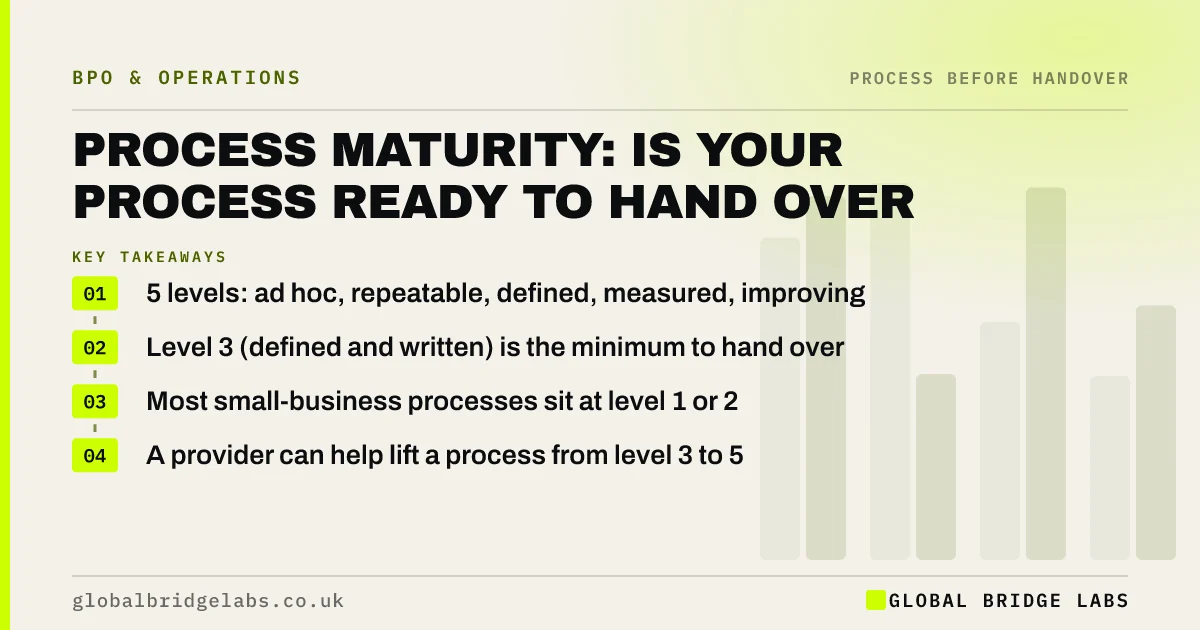
- 5 levels: ad hoc, repeatable, defined, measured, improving.
- Level 3 (defined and written) is the minimum to hand over.
- Most small-business processes sit at level 1 or 2.
- A provider can help lift a process from level 3 to 5.
Want to place your processes on the scale? Message us on WhatsApp with a short description.
Chat on WhatsApp →What is a process maturity model?
A process maturity model is a scale that describes how consistently and predictably a process runs. The best-known version is the Capability Maturity Model developed at Carnegie Mellon University's Software Engineering Institute, which uses five levels. The simplified version here keeps the idea and drops the formal assessment.
What are the five levels?
Each level builds on the one before. A process moves up when it becomes more consistent, more visible and easier to improve.
- 1. Ad hoc: done differently each time, depends on who is free.
- 2. Repeatable: one person does it the same way, but it is not written.
- 3. Defined: written down, so anyone trained can follow it.
- 4. Measured: turnaround and errors are tracked weekly.
- 5. Improving: changes are tested and the measures move.
How do you place your process?
Ask three questions. Could someone new follow it from a document? If not, it is level 1 or 2. Do you know its turnaround and error rate this month? If not, it is no higher than level 3. Has a change in the last quarter improved those numbers? If yes, it is level 5.
What does moving up a level look like?
In an illustrative example, a booking process at level 2 depends on one administrator. Writing the steps and exceptions takes it to level 3 in a week. Adding a weekly count of bookings, turnaround and corrections takes it to level 4 a month later. With a managed team running it, one tested change a quarter takes it to level 5. Example path only.
- Outsourced appointment booking and diary management
- Continuous improvement in outsourcing: savings past year one
Want a plan to move one process up a level? Send it to us on WhatsApp.
Chat on WhatsApp →Why is level 3 the minimum for outsourcing?
Level 3 is the minimum because a provider needs a written method to work from. At level 1 or 2 the knowledge is in someone's head, so every gap becomes a question. Once the process is defined, a provider's daily practice and reporting often moves it to levels 4 and 5 faster than an in-house team can.
When does maturity not matter much?
Maturity matters little for small, low-risk tasks done by one person, where level 2 is fine. It matters most for processes that touch customers, money or personal data, and for any process you want someone else to run.
What does this look like in practice?
A pattern we see: an owner rates all their processes as level 3 because they are done consistently. Asking whether someone new could follow them from a document moves most to level 2. That honest rating is the start of a sensible handover plan.
Process maturity checklist
Rate each process with these questions.
- Is the method written down?
- Could someone new follow it?
- Is turnaround measured weekly?
- Are errors counted?
- Has a recent change improved the numbers?
Next step
Send us your main processes with a one-line description of how each runs today. We will place them on the scale with you and say which are ready to hand over.
Message us on WhatsApp to rate your processes, or book a 30-minute consultation.
Chat on WhatsApp →Sources and further reading
- The Sourcing and Consultancy Playbooks · Cabinet Office
- Labour productivity · Office for National Statistics
Frequently asked questions
What are the levels of process maturity?
A simple five-level model is: ad hoc, repeatable, defined, measured and improving. Ad hoc processes depend on who is free. Defined processes are written down. Measured processes track turnaround and errors. Improving processes test changes and show the numbers moving.
How mature should a process be before outsourcing?
At least defined, meaning the method and common exceptions are written down so someone trained could follow it. Below that, a provider has to learn from questions, which slows everything down. A good provider can then help raise it to measured and improving.
How do you improve process maturity?
Write the process down to reach the defined level, then start measuring turnaround and errors weekly. Once the numbers are visible, test one change at a time and keep the ones that improve them. Each step usually takes weeks, not months.
Written by

Global Bridge Labs (GBL) is a UK–Sri Lanka partner for social media, websites and BPO. Everything here comes from client delivery, not theory.


