
On this page
- 01Key takeaways
- 02What is a RACI matrix?
- 03Why does outsourcing need one?
- 04How do you build one?
- 05What does an example look like?
- 06How does RACI improve efficiency?
- 07When is a RACI matrix overkill?
- 08What does this look like in practice?
- 09RACI checklist
- 10Next step
- 11Sources and further reading
- 12Frequently asked questions
Key takeaways
A RACI matrix for outsourcing lists each task and marks who is Responsible for doing it, who is Accountable for the result, who must be Consulted and who is Informed. It stops work falling between your team and the provider. Keep one Accountable person per task and as few Consulted as possible, because each one adds waiting.
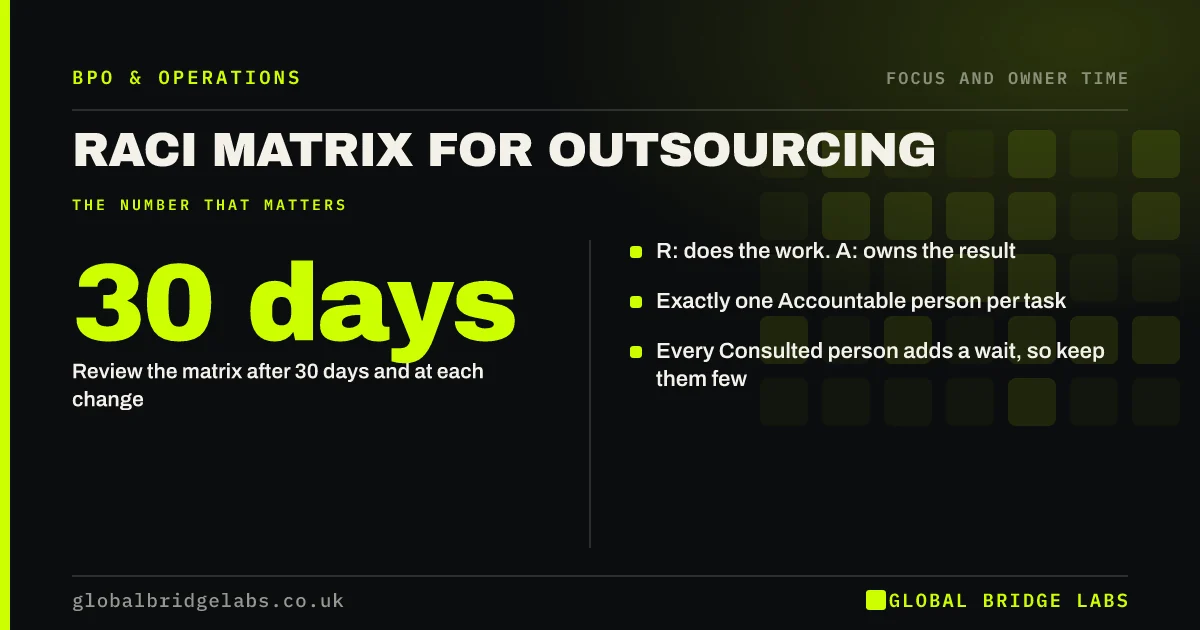
- R: does the work. A: owns the result. C: asked first. I: told after.
- Exactly one Accountable person per task.
- Every Consulted person adds a wait, so keep them few.
- Review the matrix after 30 days and at each change.
Want a RACI matrix drafted for your handover? Message us on WhatsApp.
Chat on WhatsApp →What is a RACI matrix?
A RACI matrix is a simple table that lists tasks down one side and people or teams across the top, with a letter in each cell: R for Responsible, A for Accountable, C for Consulted and I for Informed. It makes ownership visible so everyone knows who acts, who decides and who needs to know.
Why does outsourcing need one?
Outsourcing adds a second team, so tasks that were informally shared can fall between the two. Who chases a late supplier? Who decides on a refund? Who tells the customer? Without written answers, the team waits for instructions or two people do the same job. A RACI matrix settles it before the work starts.
How do you build one?
List every task in the process at the level someone would act on, for example raise invoice, approve credit note, chase overdue payment. Add columns for each role on both sides. Mark R and A first, then C and I. Check each row has one A and at least one R, and challenge every C.
- 1. List tasks at the level someone acts on.
- 2. Add columns for each role, yours and the provider's.
- 3. Mark R and A for every task.
- 4. Add C and I only where truly needed.
- 5. Check one A per row and remove extra Cs.
What does an example look like?
In an illustrative accounts receivable handover, the provider is Responsible for raising invoices and sending reminders. The finance lead is Accountable for both. For credit notes over £250 the provider is Responsible for drafting, the finance lead is Accountable and the account manager is Consulted. The sales team is Informed of overdue accounts weekly. Example roles only.
- Order-to-cash process: shorten the road from sale to cash
- Approval bottlenecks: when sign-off holds up the work
Want help filling in a matrix for your process? Send us the task list on WhatsApp.
Chat on WhatsApp →How does RACI improve efficiency?
RACI improves efficiency by cutting the time work waits for someone to realise it is theirs, and by removing unnecessary sign-offs. Every Consulted role is a wait, so reviewing the Cs often reveals approvals that can become Informed instead. The result is fewer questions and faster decisions.
When is a RACI matrix overkill?
It is overkill for a simple task done by one person end to end, such as a single data entry job with no decisions. In that case a work instruction and one named contact are enough. RACI earns its place when several people on both sides touch the same process.
What does this look like in practice?
A pattern we see: a provider and a client both assume the other is chasing overdue invoices, so nobody does for a month. A one-page RACI matrix agreed in the first week would have prevented it. It is a short document that saves a lot of confusion.
RACI checklist
Check your matrix against these.
- Every task has exactly one A.
- Every task has at least one R.
- Each C is truly needed before work proceeds.
- Both teams have agreed the matrix.
- It is reviewed after 30 days.
Next step
Send us the tasks in the process you plan to hand over. We will help you draft a RACI matrix that keeps ownership clear and waiting short.
Message us on WhatsApp to draft your matrix, or book a 30-minute consultation.
Chat on WhatsApp →Sources and further reading
- The Sourcing and Consultancy Playbooks · Cabinet Office
- Controllers and processors · Information Commissioner's Office
Frequently asked questions
What does RACI stand for?
RACI stands for Responsible, Accountable, Consulted and Informed. Responsible people do the work, the Accountable person owns the result, Consulted people give input before work proceeds, and Informed people are told afterwards. It is used to make roles clear across teams.
Can there be more than one Accountable person?
No. Each task should have exactly one Accountable person, so there is always a single owner of the result. Several people can be Responsible for doing parts of the work, but shared accountability usually means nobody acts when something goes wrong.
How do you use a RACI matrix with an outsourcing provider?
List each task in the outsourced process and mark the provider's and your roles against it. Agree the matrix before the handover, keep it with the process documents and review it after 30 days. Use it to settle who acts when something unexpected happens.
Written by

Global Bridge Labs (GBL) is a UK–Sri Lanka partner for social media, websites and BPO. Everything here comes from client delivery, not theory.


