
On this page
- 01Key takeaways
- 02What do you need to know first?
- 03How do you calculate the base number?
- 04Why is the minimum not enough?
- 05How do you allow for shrinkage?
- 06How is email and messaging different?
- 07When does a small team not need the maths?
- 08What does this look like in practice?
- 09Staffing checklist
- 10Next step
- 11Sources and further reading
- 12Frequently asked questions
Key takeaways
To work out how many customer service agents you need, multiply contacts per hour by average handling time, add a buffer so customers do not queue, then allow for breaks, training and absence. For live calls and chat the buffer matters most, because contacts arrive at random. Erlang C is the standard model for that. Email needs less buffer.
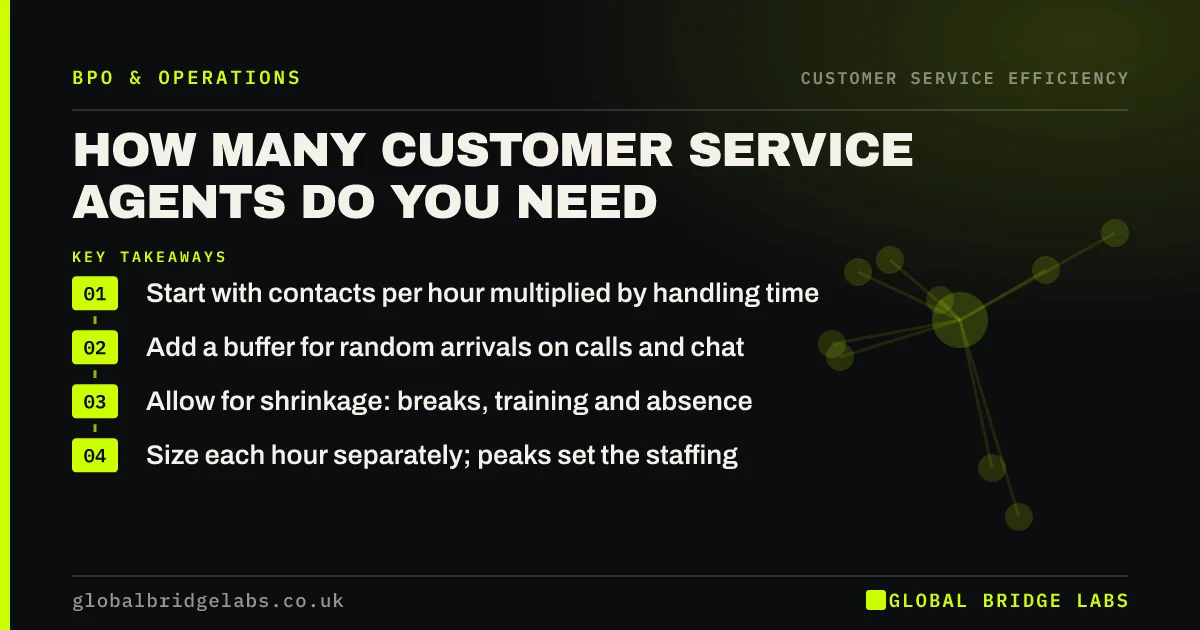
- Start with contacts per hour multiplied by handling time.
- Add a buffer for random arrivals on calls and chat.
- Allow for shrinkage: breaks, training and absence.
- Size each hour separately; peaks set the staffing.
Want your staffing worked out from your own volumes? Message us on WhatsApp.
Chat on WhatsApp →What do you need to know first?
You need four numbers: contacts per hour for each hour of the day, average handling time including after-call work, the service level you want, such as 80% of calls answered within 20 seconds, and your shrinkage, the share of paid time not available for contacts. Two to four weeks of data are enough to start.
How do you calculate the base number?
The base number is workload in hours. Multiply contacts in an hour by average handling time in hours. In an illustrative example, 30 calls an hour at 6 minutes each is 180 minutes, or 3 hours of work in one hour, so you need at least three people on the phones. That is the minimum, with no allowance for queues.
- 1. Count contacts per hour for each hour.
- 2. Measure average handling time.
- 3. Multiply for workload hours per hour.
- 4. That figure is the bare minimum headcount.
Why is the minimum not enough?
The minimum is not enough because calls do not arrive evenly. With exactly three agents for three hours of work, any cluster of calls creates a queue, and the queue rarely clears. Erlang C, a formula developed from the work of the Danish engineer A. K. Erlang, estimates how many extra agents keep waiting times within your target.
In the illustrative example, hitting 80% of calls within 20 seconds usually needs four or five agents rather than three. Free online Erlang calculators do the sum if you enter calls, handling time and target.
How do you allow for shrinkage?
Shrinkage is paid time when agents are not available: breaks, training, meetings, holiday and sickness. Contact centres commonly plan for around 30%, but measure your own. Divide the agents needed on the phones by one minus shrinkage. Five agents needed at 30% shrinkage means about seven scheduled.
Want this worked through for your busiest hours? Send us your volumes on WhatsApp.
Chat on WhatsApp →How is email and messaging different?
Email and messages can wait in a queue, so you do not need a buffer for random arrivals in the same way. Size them on workload against your response target. If 200 emails a day take 5 minutes each, that is about 17 hours of work, so roughly two and a half people, before shrinkage. Chat sits in between, because agents can handle more than one at once.
When does a small team not need the maths?
A very small operation, with a few calls an hour, does not need Erlang. The question there is cover: who answers when the one person is busy or away. An answering service or shared cover often solves it more cheaply than another hire.
What does this look like in practice?
A pattern we see: a business staffs to its daily average and wonders why Monday mornings overflow. Sizing hour by hour shows that four hours a week need nearly double the usual team. Flexible cover for those hours fixes the queue without adding full-time staff.
Staffing checklist
Gather these before you calculate.
- Contacts per hour for two to four weeks.
- Average handling time including after-call work.
- Your target service level.
- Your measured shrinkage.
- Separate figures for calls, chat and email.
Next step
Send us your contact volumes by hour and roughly how long each contact takes. We will estimate the staffing you need and when flexible cover would help most.
Message us on WhatsApp for a staffing estimate, or book a 30-minute consultation.
Chat on WhatsApp →Sources and further reading
- Holiday entitlement · GOV.UK
- Sickness absence in the UK labour market · Office for National Statistics
Frequently asked questions
How do you calculate how many customer service agents you need?
Multiply contacts per hour by average handling time to get workload, add a buffer for random arrivals using an Erlang C calculator for calls and chat, then divide by one minus shrinkage to allow for breaks, training and absence. Do this for each hour, because peaks set the staffing.
What is Erlang C?
Erlang C is a queueing formula used in contact centres to estimate how many agents are needed to meet a waiting-time target, given call volume and handling time. It is based on work by the Danish engineer A. K. Erlang. Free online calculators apply it for you.
What is shrinkage in customer service?
Shrinkage is the share of paid agent time not available for handling contacts, because of breaks, training, meetings, holiday and sickness. Many contact centres plan for around 30%, but you should measure your own and use that figure.
Written by

Global Bridge Labs (GBL) is a UK–Sri Lanka partner for social media, websites and BPO. Everything here comes from client delivery, not theory.


