On this page
- 01Key takeaways
- 02What information should every business website have?
- 03Why does missing information cost you enquiries?
- 04What is the GBL Website Information Inventory?
- 05What should a website say about who you are?
- 06What should it say about what you sell?
- 07What should it say about how buying from you works?
- 08What proof and policies do buyers check?
- 09What contact and after-sale details belong on the site?
- 10Which disclosures does UK law require on a website?
- 11What extra information do regulated firms need?
- 12What do local service businesses need to show?
- 13How do you keep website information accurate?
- 14What does it cost to fill the information gaps?
- 15When is more information the wrong answer?
- 16What does this look like in practice?
- 17Website information: ten things to check today
- 18Next step
- 19Sources and further reading
- 20Frequently asked questions
Key takeaways
Every business website should state who you are, what you sell and to whom, why buyers can trust you, how buying from you works, and how to reach you, plus the disclosures UK law requires. Global Bridge Labs (GBL) groups this into 30 items in five layers. Most sites miss five to ten of them.
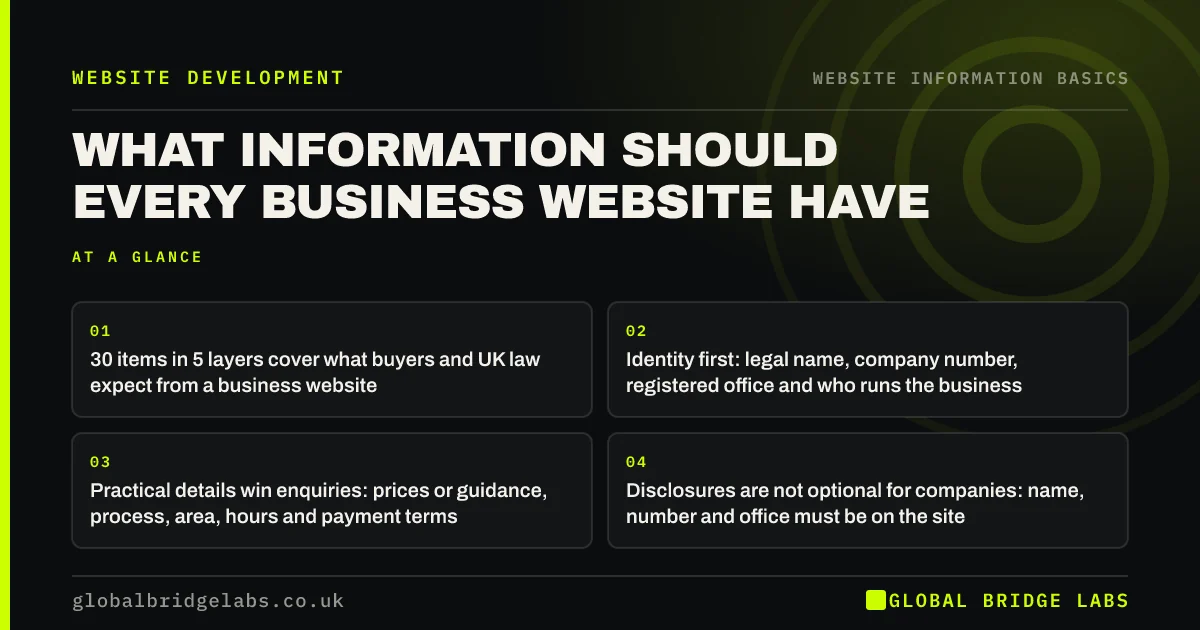
- 30 items in 5 layers cover what buyers and UK law expect from a business website.
- Identity first: legal name, company number, registered office and who runs the business.
- Practical details win enquiries: prices or guidance, process, area, hours and payment terms.
- Disclosures are not optional for companies: name, number and office must be on the site.
Want your site checked against all 30 items? Message us on WhatsApp.
Chat on WhatsApp →What information should every business website have?
Every business website needs five layers of information: identity (who you are), offer (what you sell and to whom), proof (why trust you), practicalities (prices, process, hours, payment and policies) and contact and compliance (how to reach you, plus legal disclosures). Leave out a layer and buyers either guess, phone to ask or leave.
Global Bridge Labs (GBL) turns those layers into 30 specific items, six per layer, called the GBL Website Information Inventory. It is not a design checklist. It asks only whether a fact a buyer or regulator needs is on the site, accurate and easy to find.
Why does missing information cost you enquiries?
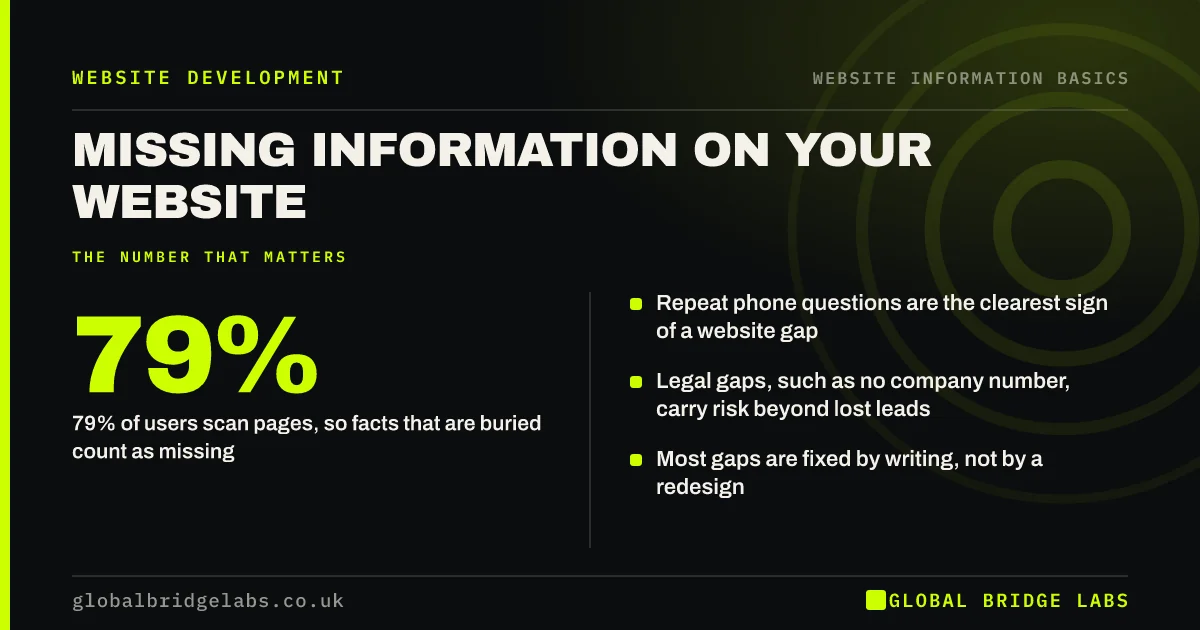
Missing information costs enquiries because buyers rarely ask; they move to a competitor whose site answers the question. Nielsen Norman Group found 79% of users scan pages rather than read them, so facts that are absent or buried are, in practice, missing. Each unanswered question is a small reason not to enquire.
There is a legal cost as well. A limited company that leaves its registered number or office off its website breaches the trading disclosure rules, and information you publish about a service can bind you under the Consumer Rights Act 2015. Getting the facts on the page, and right, protects both sales and the business.
What is the GBL Website Information Inventory?
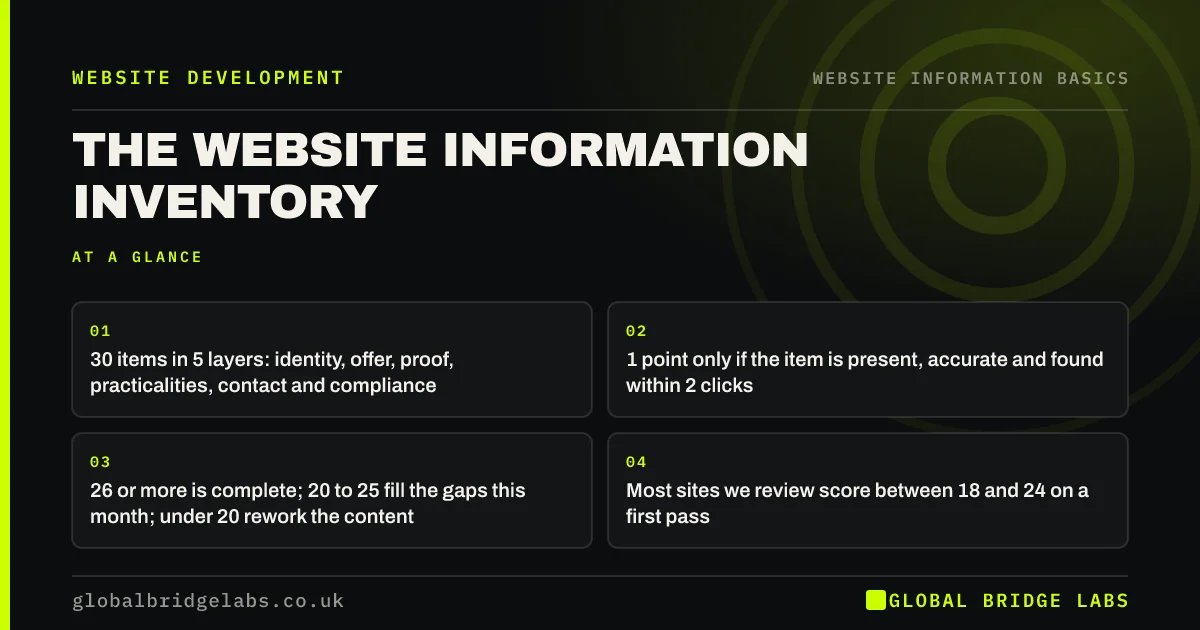
The GBL Website Information Inventory is a 30-item check of the facts a UK business website should carry, grouped into five layers of six: identity, offer, proof, practicalities, and contact and compliance. Score one point per item that is present, accurate and findable in two clicks. 26 or more is complete, 20 to 25 means fill the gaps this month, and under 20 means buyers are being under-informed.
- Identity: names, company details, description, people, premises, regulator.
- Offer: services, who it is for, inclusions, prices, area, process.
- Proof: reviews, examples, qualifications, insurance, track record, policies.
- Practicalities: hours, payment, cancellation, delivery or booking, aftercare, complaints.
- Contact and compliance: contact details, next steps, privacy, terms, disclosures, sector notices.
What should a website say about who you are?
A website should say plainly who is behind the business: the name buyers know you by and, if different, the legal name; company or sole trader details; the people who run it; where you are based; and any regulator or register you belong to. Anonymous websites lose trust fast, especially for higher-value or regulated services.
- Trading name or company name: which goes on your website?
- Sole trader website details: what you must show
- Should your own name be on your business website?
- 'Established in' dates on your website: do they help?
- Describe your business in one sentence on your website
- Show your regulator and registration number online
- Should you show your insurance cover on your website?
- Group and parent company details on your website
- Should you say how big your team is on your website?
- Photos of your premises: proof you are a real business
What should it say about what you sell?
A website should list every service or product you want enquiries for, say who each one suits, state what is and is not included, and explain how the work is done. Buyers compare like for like, so vague service names such as 'solutions' or 'packages' without contents make you hard to shortlist.
- Aftercare information on your website: what to include
- Say what is included in your service, line by line
- Say what you do not do on your website
- Minimum job size or order value on your website
- A 'what to expect' page that calms buyer nerves
- Product specifications and data sheets on your site
- Brands you supply or fit: list them on your website
- Publish your service levels on your website
- Show sample reports and deliverables on your website
- Explain your materials and methods on your website
What should it say about how buying from you works?
A website should explain the practical side of buying: when you are open, how and when people pay, what deposits apply, how cancellations, returns and delivery work, what guarantee or warranty is offered and how complaints are handled. These details remove the last objections, and for consumer sales many of them are legal requirements before a contract is made.
- Holiday and seasonal opening hours on your website
- Which payment methods should your website list?
- Deposits and payment terms: say them on your website
- Your cancellation policy on your website: what to say
- A returns policy page that meets UK law
- Delivery information page: what to include
- Publish a complaints procedure on your website
- Warranty information on your website: what to state
- A 'how to book' page that removes the guesswork
- Finance options on your website: FCA rules first
What proof and policies do buyers check?
Buyers check evidence that you are competent and safe to use: qualifications, client names, checks on staff, and the policies a larger customer or a tender will ask for, such as health and safety, data protection and equality. Publishing these up front saves a round of questionnaires and signals that the business is organised.
- A client list on your website: permission and choice
- Qualifications on your website: which ones to list
- Saying staff are DBS checked on your website
- Should your health and safety policy be on your website?
- Which company policies to publish on your website
- Tell clients how you protect their data
- An equality and diversity policy on your website
- A safeguarding policy on your website: who needs one
- References on request: offer them on your website
- Show buyers your business is financially stable
What contact and after-sale details belong on the site?
Beyond a phone number and email, a website should tell people who to contact for what, what happens after they enquire, what to do out of hours and how existing customers get help. Visitors who are not buyers, such as suppliers, journalists and overseas customers, also need a clear route so they stop using the sales line.
- Separate contacts for sales, support and accounts
- A support page for existing customers
- Parking and access details on your website
- Accessibility information about your premises, online
- A supplier information page: invoices and onboarding
- A press contact on your website: who needs one
- A service status page: when a small business needs one
- Say what happens after someone enquires
- Out-of-hours and emergency contact details online
- Contact details that work for overseas customers
Which disclosures does UK law require on a website?
UK companies and LLPs must show their registered name, number, place of registration and registered office on their website under the Trading Disclosures Regulations 2015. Sites that sell online must also meet the Electronic Commerce Regulations 2002 and, for consumers, the Consumer Contracts Regulations 2013. Larger firms have extra duties, such as modern slavery and gender pay gap reporting.
- Legal requirements for a UK business website
- Company number on your website: where and how
- Should your VAT number be on your website?
- Modern slavery statement on your website: who needs one
- An accessibility statement for a business website
- Dispute resolution details: what to say on your website
- Prices with or without VAT: what your website shows
- Subscription terms on your website: what to show
- Should your website say where you use AI?
- Affiliate and sponsored links: disclosure on your site
- Gender pay gap reports: does your website need one?
What extra information do regulated firms need?
Regulated firms must add the details their regulator requires, such as an FCA status statement, a CQC rating, an Ofsted registration or an ATOL number, and they need to word claims within their sector's advertising rules. These items sit on top of the 30, and a missing one can be a compliance breach rather than just a lost lead.
- What a home care agency's website must show
- What an insurance broker's website should include
- What a travel agent's website must show
- What an optician's website should tell patients
- What a pharmacy website must display
- What a counsellor's website should include
- What an osteopath or chiropractor's website must show
- What a nursery website should tell parents
- What a tutoring business website should include
- What a driving instructor's website should include
What do local service businesses need to show?
Local service businesses need to show their registrations and licences (Gas Safe, MCS, a waste carrier number or an animal licence), the area they cover, call-out and pricing basics, and how quickly they respond. These are the facts people check before letting someone into their home or handing over a job.
- What a locksmith's website needs to show
- What a pest control website should include
- What a solar installer's website must show
- What a gas engineer's website must show
- What a skip hire website needs to show
- What a funeral director's website must show
- What a dog boarding or daycare website must show
- What a catering company website should include
- What a photographer's business website should include
- What a training provider's website should include
How do you keep website information accurate?
Keep information accurate by holding every fact in one master sheet with a named owner, checking the site against it each quarter and updating it the same week anything changes: a move, a new owner, a closure or a price change. Inaccurate information is worse than missing information, because buyers act on it.
- Who should check the legal information on your website?
- Inaccurate information on your website: the legal risk
- Moved premises? Update your website information first
- Conflicting information across your website: fix it
- What buyers want to know before they ask for a quote
- Closing temporarily? What your website should say
- Google Business Profile vs website: what goes where
- Bought a business? Update its website information first
- What filling your website's information gaps costs
- A website information template to fill in
What does it cost to fill the information gaps?
Filling information gaps on an existing site is usually focused work, which our website cost guidance puts at around £500–£3,000 in the UK, or a few days of your own time. Freelance help is often £50–£100 an hour. A full redesign at £3,000–£12,000 is rarely needed just to add missing facts.
GBL does not publish a price list, because the work depends on how many pages are affected and whether the facts already exist in your business. The fastest route is usually to gather the facts first, then decide who writes and publishes them.
When is more information the wrong answer?
More information is the wrong answer when it buries the facts buyers need under detail they do not. A homepage should summarise and link; detail belongs on service, policy and support pages. Policies nobody asks for, old news and internal jargon all add reading time without adding confidence.
What does this look like in practice?
A pattern we see often: a business with a well-designed site still fields the same phone questions every week about area, price range, lead times and payment. Each question is a missing item from the inventory. Adding those facts to the right pages tends to cut repeat calls and makes the enquiries that arrive better qualified. Across our client work, sites rebuilt around buyer questions have reached a 2.4× enquiry rate.
Website information: ten things to check today
- Your legal name, company number and registered office are in the footer.
- Every service you want enquiries for has its own clear description.
- Prices or a price guide are shown, or you explain why not.
- The area you cover and your typical lead time are stated.
- Payment, deposit and cancellation terms are written down.
- Reviews and real examples of work are on the site.
- Phone, email and address match your Google Business Profile.
- Visitors are told what happens after they enquire.
- Privacy policy and terms are linked from every page.
- One named person owns the accuracy of the site's facts.
Next step
Run the 30-item inventory on your own site this week and list every item you scored zero. That list is your content brief.
Message us on WhatsApp for a free 30-item information check of your website, with no pitch.
Chat on WhatsApp →Sources and further reading
- Company, Limited Liability Partnership and Business Names (Trading Disclosures) Regulations 2015 · legislation.gov.uk
- Electronic Commerce (EC Directive) Regulations 2002 · legislation.gov.uk
- Consumer Contracts (Information, Cancellation and Additional Charges) Regulations 2013 · legislation.gov.uk
- Consumer Rights Act 2015 · legislation.gov.uk
- How users read on the web · Nielsen Norman Group
- How do users evaluate the credibility of web sites? A study with over 2,500 participants · ACM (Fogg et al., 2003)
Frequently asked questions
What information must a UK business website show by law?
Companies and LLPs must show their registered name, company number, place of registration and registered office. Sites selling online must also give a contact email and geographic address, and VAT number if registered. Consumer sellers need pre-contract information, cancellation rights and a privacy notice where personal data is collected.
What pages should a small business website have?
Most small business websites need a homepage, a page per main service, an about page, a contact page, a privacy policy and terms. Add pages for prices, FAQs, reviews and case studies as the business grows. The page list follows the information buyers need, not a template.
Should a business website show prices?
Show prices or a price guide where you can, because cost is one of the first things buyers want to know. If every job is bespoke, give typical ranges and explain what moves the price. Consumer prices must include VAT and unavoidable fees.
How often should website information be checked?
Check the facts on your website every quarter, and update them the same week anything changes, such as hours, address, prices, people or policies. Keeping one master sheet of business facts makes the check quick and stops the website, Google profile and social pages drifting apart.
What information do customers look for first on a website?
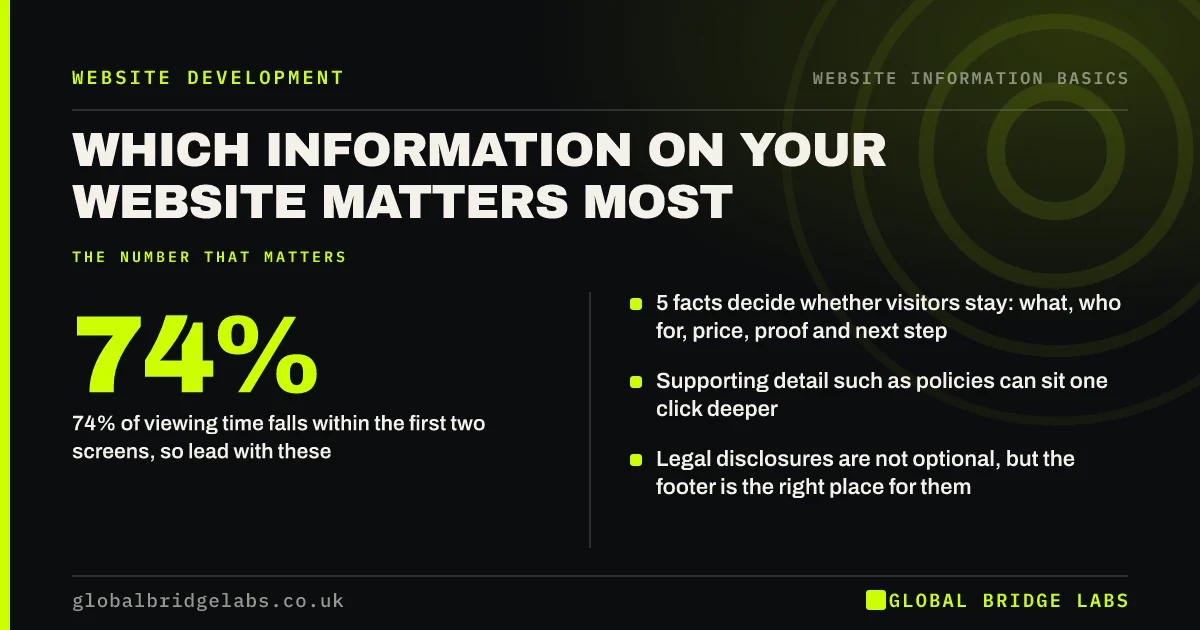
Customers usually look first for what you do, whether you serve their area or need, a rough price, proof that others have used you, and how to get in touch. If those five are visible quickly, they keep reading; if not, most go back to the search results.
Written by

Global Bridge Labs (GBL) is a UK–Sri Lanka partner for social media, websites and BPO. Everything here comes from client delivery, not theory.