On this page
- 01Key takeaways
- 02What website information should change after buying a business?
- 03What should be secured first?
- 04What legal details need updating?
- 05Which claims might no longer be true?
- 06How should customers be told?
- 07When should you leave things unchanged?
- 08What does this look like in practice?
- 09New owner website checklist
- 10Next step
- 11Sources and further reading
- 12Frequently asked questions
Key takeaways
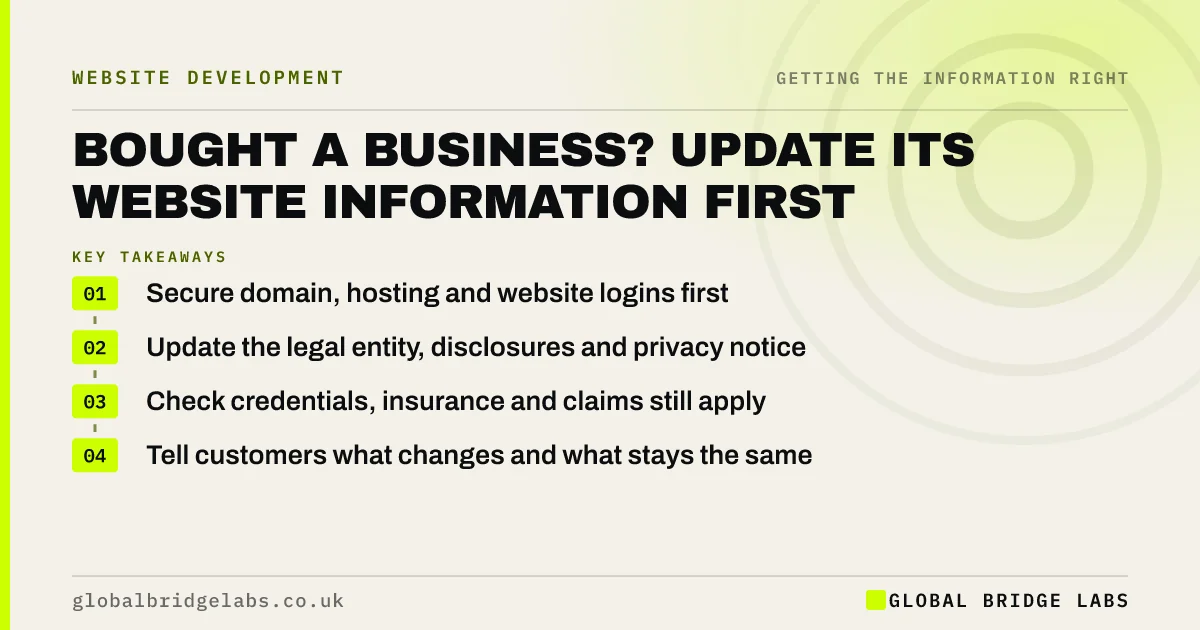
After buying a business, update its website information early: legal entity and disclosures, ownership and team, contact routes, privacy notice and data controller, terms, credentials and insurance, and any claims that depended on the old owner. Secure logins and domain ownership first. Customers and regulators judge you on what the site says.
- Secure domain, hosting and website logins first.
- Update the legal entity, disclosures and privacy notice.
- Check credentials, insurance and claims still apply.
- Tell customers what changes and what stays the same.
Just bought a business? Message us on WhatsApp.
Chat on WhatsApp →What website information should change after buying a business?
Change anything tied to the old owner or entity: company details and disclosures, ownership and team information, contact routes, the privacy notice and data controller, terms, credentials, insurance and claims. Global Bridge Labs (GBL) recommends doing this within the first few weeks, after securing access.
What should be secured first?
Secure the domain registration, hosting, website administrator accounts, Google Business Profile, analytics and email first. Make sure they are in the new owner's name and that former owners or staff no longer have access. Losing the domain is one of the costliest mistakes after a sale.
What legal details need updating?
If the trading entity changes, update the disclosure line, terms and invoices. If personal data passes to a new controller, update the privacy notice to say who now controls it. If the business is regulated, check whether registrations transfer or need new applications.
Which claims might no longer be true?
Check claims that depended on the old owner or team: years of personal experience, named qualifications, awards, accreditations, insurance and client lists. Some transfer with the business; some do not. Remove or reword anything that is no longer accurate.
How should customers be told?
Tell customers plainly what changes and what stays the same: the team, prices, guarantees and how to get support. A short 'new ownership' note on the about page and a customer email build continuity. Honour commitments made under the old ownership where you have taken them on.
When should you leave things unchanged?
Leave the brand, design and content customers value unchanged at first, unless it is inaccurate. Many acquisitions lose goodwill by rebranding too fast. Fix facts and legal details now; consider bigger changes once you know what customers value.
What does this look like in practice?
A pattern we see after acquisitions: the website still shows the seller's photo and 'I personally handle every job', months after they left. Updating the people, ownership and claims, while keeping the trusted brand, maintains trust and avoids misleading customers.
New owner website checklist
- Transfer domain, hosting and logins.
- Remove former owners' access.
- Update disclosures and terms.
- Update the privacy notice and controller.
- Check credentials, insurance and claims.
- Tell customers what changes.
Next step
Before completion, list every website login and account the seller holds. Make their transfer a condition of the handover.
Message us on WhatsApp for a new owner website checklist, with no pitch.
Chat on WhatsApp →Sources and further reading
- Right to be informed (privacy information) · Information Commissioner's Office
- Company, Limited Liability Partnership and Business Names (Trading Disclosures) Regulations 2015 · legislation.gov.uk
- Unfair commercial practices guidance (CMA207) · Competition and Markets Authority
Frequently asked questions
What should I change on a website after buying a business?
Update company details and disclosures, ownership and team information, the privacy notice and data controller, terms, credentials, insurance and any claims tied to the previous owner. Secure all logins and the domain first.
Do I need a new privacy policy after buying a business?
If the organisation controlling customers' personal data changes, the privacy notice must be updated to say who now controls it and how data is used. Review it as part of the handover.
Should I rebrand a business I have just bought?
Usually not straight away. Fix facts and legal details first, then decide on branding once you understand what customers value. Rebranding too quickly can lose the goodwill you paid for.
Written by

Global Bridge Labs (GBL) is a UK–Sri Lanka partner for social media, websites and BPO. Everything here comes from client delivery, not theory.