On this page
- 01Key takeaways
- 02What should warranty information on a website say?
- 03What does the law require of a guarantee?
- 04How does a warranty relate to consumer rights?
- 05Should a guarantee be insurance-backed?
- 06What about manufacturer warranties?
- 07When should you not advertise a guarantee?
- 08What does this look like in practice?
- 09Warranty information checklist
- 10Next step
- 11Sources and further reading
- 12Frequently asked questions
Key takeaways
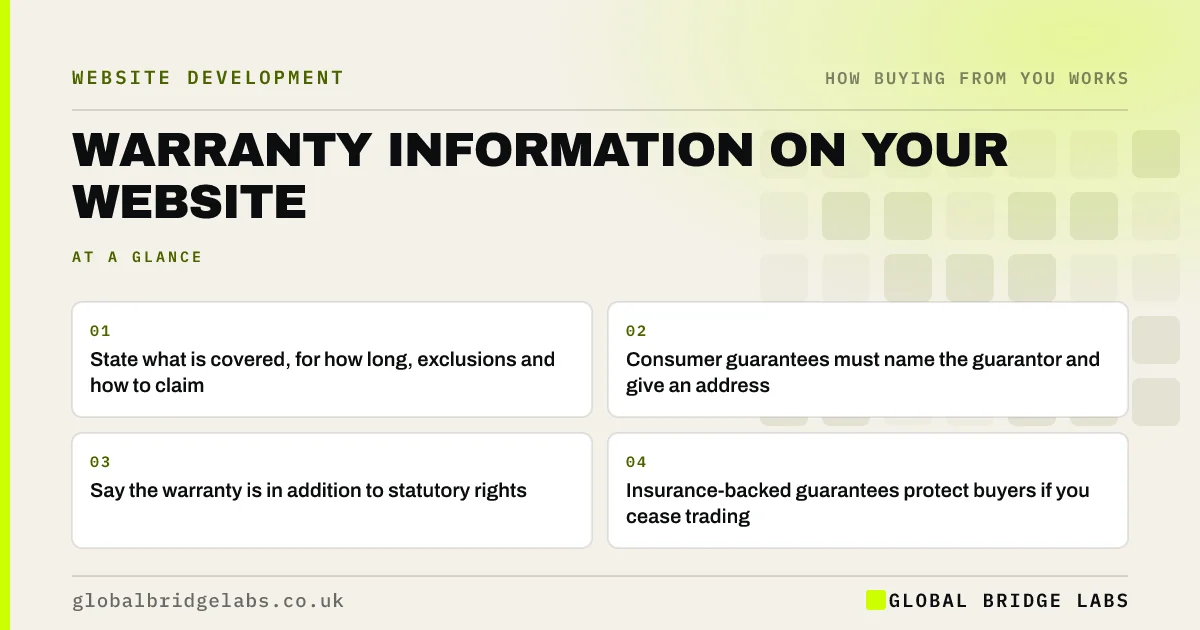
State what your warranty or guarantee covers, for how long, what is excluded, how to claim and who gives it. Under the Consumer Rights Act 2015, a consumer guarantee must be in plain language and include the guarantor's name and address, its duration and the claims procedure. Make clear it is in addition to legal rights.
- State what is covered, for how long, exclusions and how to claim.
- Consumer guarantees must name the guarantor and give an address.
- Say the warranty is in addition to statutory rights.
- Insurance-backed guarantees protect buyers if you cease trading.
Want your warranty wording checked? Message us on WhatsApp.
Chat on WhatsApp →What should warranty information on a website say?
Warranty information should say what is covered, for how long, what is excluded, how to make a claim and who stands behind it. Global Bridge Labs (GBL) treats it as part of item 23 of the inventory. For trades and home improvements, it is often one of the deciding factors between quotes.
What does the law require of a guarantee?
Section 30 of the Consumer Rights Act 2015 requires a consumer guarantee to be written in plain, intelligible language and to set out the guarantor's name and address, the duration and territorial scope, and the claims procedure. It is binding as a contractual term. The consumer can ask for it in writing.
How does a warranty relate to consumer rights?
A warranty adds to consumer rights; it cannot reduce them. Goods must be of satisfactory quality and services carried out with reasonable care and skill whatever your warranty says. Make that clear with a line such as 'This guarantee is in addition to your legal rights'.
Should a guarantee be insurance-backed?
For larger home improvement jobs, an insurance-backed guarantee reassures buyers that the cover will survive if your business does not. Some schemes, such as those linked to TrustMark or trade bodies, include it. If you offer one, name the provider and explain what it covers.
What about manufacturer warranties?
If products you supply or fit carry a manufacturer warranty, say so, give the length and explain any conditions, such as registration or annual servicing. Make clear which warranty comes from the manufacturer and which from you, so buyers know who to contact.
When should you not advertise a guarantee?
Do not advertise a guarantee you cannot afford to honour, or one so hedged with exclusions that it means little. Vague 'satisfaction guaranteed' claims can mislead. A shorter, clear guarantee you honour builds more trust than a long one buyers do not believe.
What does this look like in practice?
A pattern we see in trades: 'fully guaranteed' on the homepage, with no length, scope or claims process anywhere. Replacing it with 'two-year workmanship guarantee, in addition to your legal rights; here is how to claim' gives buyers something concrete to compare and meets the legal requirements for guarantees.
Warranty information checklist
- State coverage and length.
- List exclusions plainly.
- Explain how to claim.
- Name the guarantor and address.
- Say it is in addition to legal rights.
- Separate your guarantee from manufacturer warranties.
Next step
Rewrite your guarantee as five lines: cover, length, exclusions, how to claim and who gives it. Publish it on each service page.
Message us on WhatsApp for help with guarantee wording, with no pitch.
Chat on WhatsApp →Sources and further reading
- Consumer Rights Act 2015 · legislation.gov.uk
- TrustMark: the government endorsed quality scheme for work in and around the home · TrustMark
- Unfair commercial practices guidance (CMA207) · Competition and Markets Authority
Frequently asked questions
What is the difference between a warranty and a guarantee?
In everyday use the terms overlap. A guarantee is usually a free promise to fix or replace, while a warranty may be part of the contract or a paid extension. For consumers, both sit on top of statutory rights and must be described clearly.
Do I have to offer a guarantee on my work?
No. You do not have to offer a guarantee, but consumer law already requires services to be done with reasonable care and skill, and goods to be of satisfactory quality. A guarantee is an extra promise, and if you offer one it is binding.
What should a workmanship guarantee include?
It should include what work is covered, how long the guarantee lasts, exclusions, how to make a claim, and your name and address. Add that it is in addition to legal rights, and mention whether it is insurance-backed.
Written by

Global Bridge Labs (GBL) is a UK–Sri Lanka partner for social media, websites and BPO. Everything here comes from client delivery, not theory.