On this page
- 01Key takeaways
- 02Do you have to disclose AI use on a website?
- 03Should chatbots say they are AI?
- 04What about AI and personal data?
- 05Do you need to label AI-written content?
- 06Where should an AI statement go?
- 07When is disclosure unnecessary?
- 08What does this look like in practice?
- 09AI disclosure checklist
- 10Next step
- 11Sources and further reading
- 12Frequently asked questions
Key takeaways
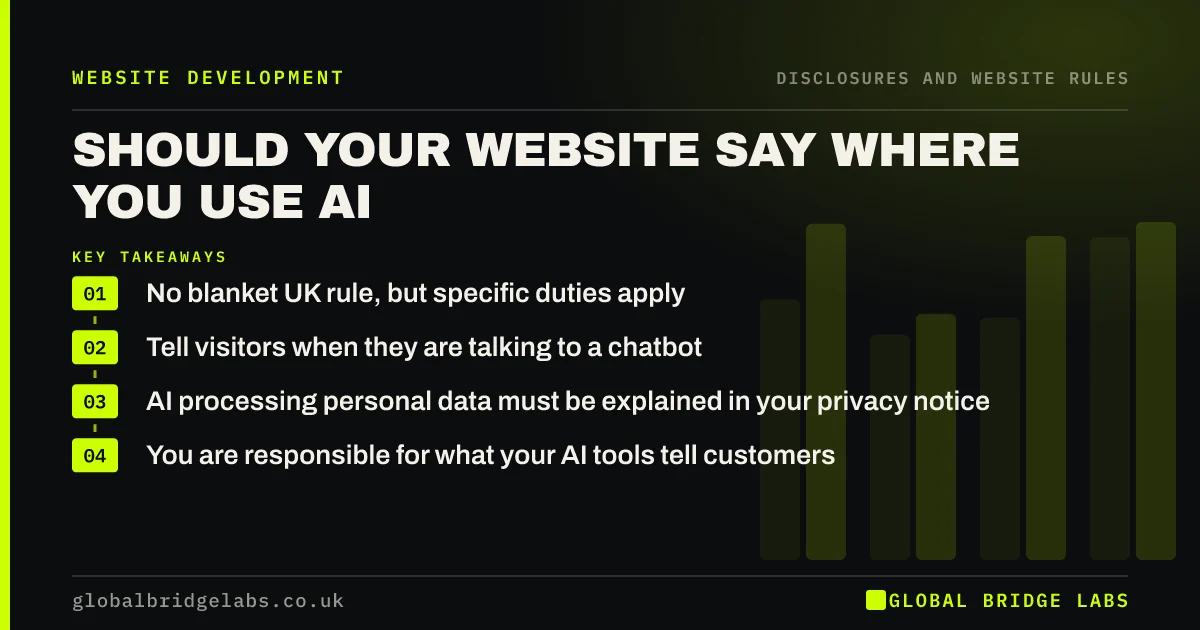
There is no blanket UK rule that every use of AI must be disclosed on a website. But if a chatbot talks to customers, if AI processes personal data or makes decisions about people, or if AI-generated content could mislead, you have duties. Say plainly where AI is used, especially for chatbots, and check what it says.
- No blanket UK rule, but specific duties apply.
- Tell visitors when they are talking to a chatbot.
- AI processing personal data must be explained in your privacy notice.
- You are responsible for what your AI tools tell customers.
Using AI on your website? Message us on WhatsApp.
Chat on WhatsApp →Do you have to disclose AI use on a website?
There is no general UK law requiring every website to disclose AI use. Specific duties apply instead: data protection transparency when AI uses personal data, consumer law against misleading content, and advertising rules. Global Bridge Labs (GBL) recommends plain disclosure wherever a reasonable visitor would want to know.
Should chatbots say they are AI?
Yes. Visitors should know whether they are talking to a person or a bot, and what it can and cannot help with. You remain responsible for its answers: in Moffatt v Air Canada (2024), a Canadian tribunal held the airline liable for its chatbot's incorrect advice. Limit what a chatbot can answer and check it.
What about AI and personal data?
If AI tools process visitors' or customers' personal data, for example to qualify leads or analyse enquiries, your privacy notice must explain it. The ICO's guidance on AI covers transparency and, where decisions about people are automated, extra safeguards. Name the purpose, not every tool.
Do you need to label AI-written content?
Not as a rule. Google's guidance says it rewards helpful content however it is produced, and that it is the quality and accuracy that matter. Label AI content where it would otherwise mislead, such as AI images presented as real projects, or synthetic testimonials, which must never be used.
Where should an AI statement go?
Put chatbot disclosure inside the chat window itself. Cover AI and personal data in the privacy notice. If AI is a big part of how you deliver your service, a short 'how we use AI' section on the about or policies page answers client questions in one place.
When is disclosure unnecessary?
Disclosure is unnecessary for routine internal uses, such as spelling checks or drafting help, where a person reviews and owns the result. The point is to avoid misleading people, not to list every tool in your workflow.
What does this look like in practice?
A pattern we see: a business adds a chat widget with a human name and photo, and visitors assume they are talking to staff. Renaming it as an assistant, saying it is automated and offering a route to a person resets expectations and avoids complaints.
AI disclosure checklist
- List where AI touches visitors or their data.
- Label chatbots as automated.
- Offer a route to a person.
- Update the privacy notice.
- Never use AI-generated testimonials or fake project photos.
- Check what AI tools say about your service.
Next step
List every place AI touches your website visitors or their data. Add a plain disclosure to each one that a visitor would want to know about.
Message us on WhatsApp for help with AI on your website, with no pitch.
Chat on WhatsApp →Sources and further reading
- Artificial intelligence · Information Commissioner's Office
- Google Search's guidance on generative AI content on your website · Google Search Central
- Moffatt v. Air Canada, 2024 BCCRT 149 · Civil Resolution Tribunal of British Columbia
- Digital Markets, Competition and Consumers Act 2024, Schedule 20 (banned practices, including fake reviews) · legislation.gov.uk
Frequently asked questions
Is it a legal requirement to disclose AI-generated content in the UK?
There is no blanket legal requirement, but content must not mislead consumers, and data protection law requires transparency where AI processes personal data. Fake AI reviews or images presented as real work can breach consumer law.
Should my chatbot tell people it is a bot?
Yes. Visitors should know they are talking to an automated tool and how to reach a person. Businesses remain responsible for what their chatbots tell customers, so limit and check its answers.
Does Google penalise AI-written content?
Google's guidance says it focuses on whether content is helpful, reliable and people-first, not on how it was produced. Low-quality content made mainly to manipulate rankings can be treated as spam, however it was created.
Written by

Global Bridge Labs (GBL) is a UK–Sri Lanka partner for social media, websites and BPO. Everything here comes from client delivery, not theory.