On this page
- 01Key takeaways
- 02Which businesses must show regulator details online?
- 03What does the law say about professional details?
- 04How should you word a status statement?
- 05Where should regulator details go?
- 06Should you link to the public register?
- 07When is a voluntary membership not a regulator?
- 08What does this look like in practice?
- 09Regulator details checklist
- 10Next step
- 11Sources and further reading
- 12Frequently asked questions
Key takeaways
If you belong to a regulated profession or a statutory register, your website should state the regulator, your registration number and how to check it. Some rules make this explicit, such as the SRA's badge for law firms. For others, the Electronic Commerce Regulations 2002 require regulator and professional body details where you provide services online.
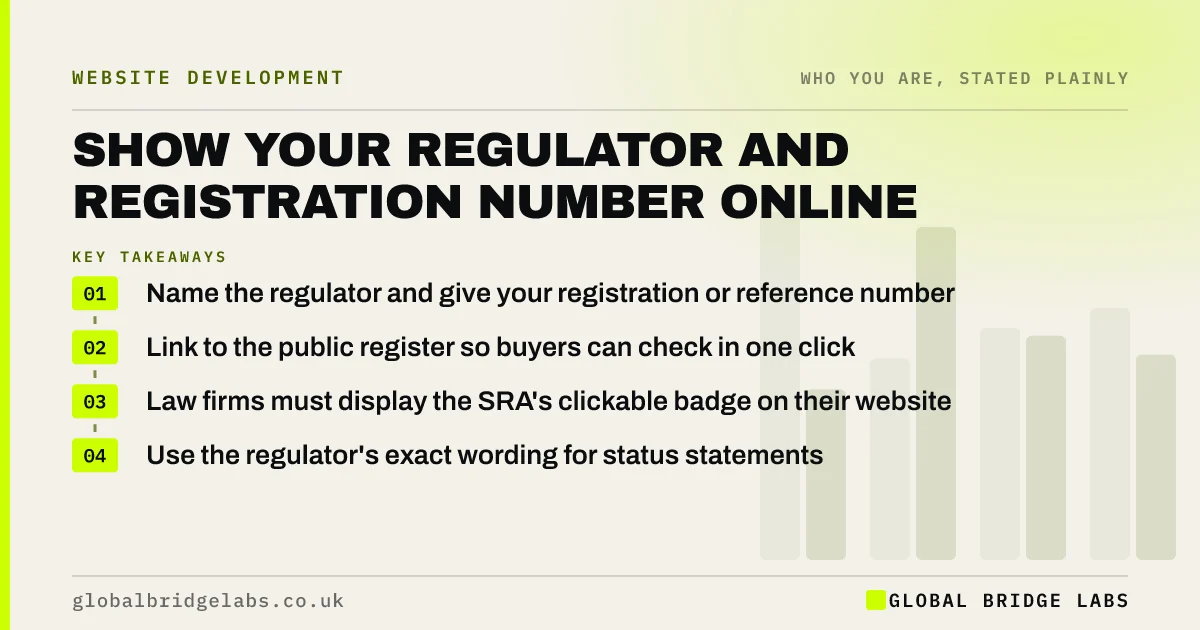
- Name the regulator and give your registration or reference number.
- Link to the public register so buyers can check in one click.
- Law firms must display the SRA's clickable badge on their website.
- Use the regulator's exact wording for status statements.
Unsure what your regulator expects online? Message us on WhatsApp.
Chat on WhatsApp →Which businesses must show regulator details online?
Businesses in regulated professions or on statutory registers should show regulator details online: financial firms authorised by the FCA, law firms regulated by the SRA, care providers registered with CQC, gas engineers on the Gas Safe Register and similar. Global Bridge Labs (GBL) treats these as item 6 of the 30-item inventory.
What does the law say about professional details?
The Electronic Commerce Regulations 2002 require online service providers in a regulated profession to give the professional body, professional title and the state where it was granted, plus a reference to the applicable professional rules. Sector regulators add their own requirements, such as the SRA Transparency Rules for law firms.
How should you word a status statement?
Use your regulator's own wording rather than inventing your own. Financial firms typically state that they are authorised and regulated by the Financial Conduct Authority, with their firm reference number. Copy the exact form from your regulator's guidance, because an inaccurate status statement can itself be misleading.
Where should regulator details go?
Put the status statement and registration number in the footer of every page, so it appears wherever a visitor lands. Add a fuller explanation, with a link to the public register, on the about page. Where a regulator provides a badge or widget, place it where the rules say.
Should you link to the public register?
Yes. Linking directly to your entry on the public register, such as the FCA Register, the SRA's solicitor check or the Gas Safe Register, lets buyers verify you in one click. It also signals you have nothing to hide, which matters to buyers who have been warned about rogue traders.
When is a voluntary membership not a regulator?
Voluntary trade associations and accreditation schemes are not regulators, even when they have codes of conduct. Show them as memberships, not as regulation. Describing a voluntary body as your regulator, or implying statutory approval you do not have, risks misleading buyers.
What does this look like in practice?
A pattern we see: a regulated firm's registration number appears only in a PDF of terms of business. Moving the status line into the footer, with a link to the register entry, takes minutes and puts a key trust and compliance signal on every page.
Regulator details checklist
- Name your regulator or statutory register.
- Give your registration or reference number.
- Use the regulator's exact status wording.
- Put it in the footer of every page.
- Link to your public register entry.
- Show voluntary memberships separately.
Next step
Check your regulator's guidance on website disclosures this week and compare it with your footer, word for word.
Message us on WhatsApp for a regulated website check, with no pitch.
Chat on WhatsApp →Sources and further reading
- Electronic Commerce (EC Directive) Regulations 2002 · legislation.gov.uk
- Transparency rules · Solicitors Regulation Authority
- Financial Services Register · Financial Conduct Authority
- Gas Safe Register · Gas Safe Register
Frequently asked questions
Do I need to show my FCA number on my website?
Firms authorised by the FCA are expected to make their regulatory status clear in communications, and most do this with a footer statement including their firm reference number. Check the FCA's current requirements for your permissions and use their wording.
What is the SRA digital badge?
The SRA digital badge is a clickable logo that law firms regulated by the Solicitors Regulation Authority must display on their website. It shows the firm is regulated and links to its details on the SRA's site, so clients can verify it.
Should I show trade association logos as regulation?
No. Trade association logos show membership, not regulation. Display them as memberships or accreditations, and only where you are a current member. Implying statutory regulation you do not have could mislead buyers.
Written by

Global Bridge Labs (GBL) is a UK–Sri Lanka partner for social media, websites and BPO. Everything here comes from client delivery, not theory.