On this page
- 01Key takeaways
- 02Why list the brands you supply or fit?
- 03What should a brands page say?
- 04Can you use brand names and logos?
- 05What about 'approved' or 'accredited' claims?
- 06Should each brand get its own page?
- 07When should you not list brands?
- 08What does this look like in practice?
- 09Brands page checklist
- 10Next step
- 11Sources and further reading
- 12Frequently asked questions
Key takeaways
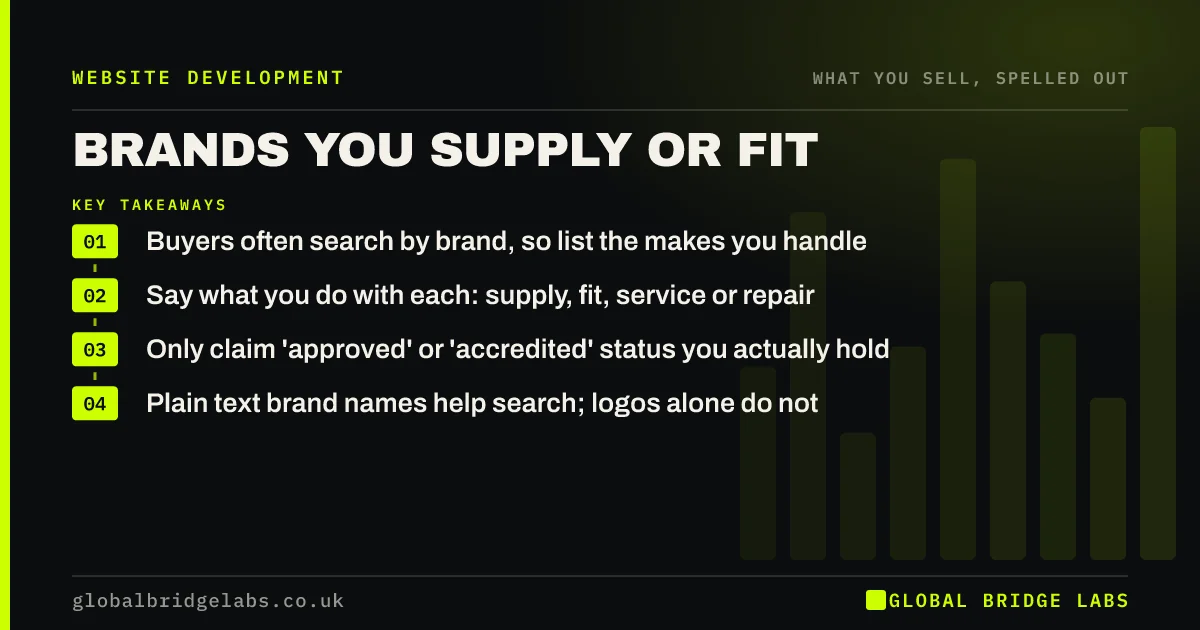
List the brands you supply, install or service on your website, because many buyers search by brand: 'Worcester boiler service' or 'Velux window fitter'. A brands page helps them find you and confirms you handle their make. Describe your relationship accurately, and never imply official approval you do not hold.
- Buyers often search by brand, so list the makes you handle.
- Say what you do with each: supply, fit, service or repair.
- Only claim 'approved' or 'accredited' status you actually hold.
- Plain text brand names help search; logos alone do not.
Want a brands page outline? Message us on WhatsApp.
Chat on WhatsApp →Why list the brands you supply or fit?
List brands because buyers often search by make, and a buyer with a specific boiler, window or machine wants to know you handle it before they call. Global Bridge Labs (GBL) sees brand lists help most for installers, repairers, parts suppliers and stockists, where the brand is part of the buyer's question.
What should a brands page say?
For each brand, say what you do: supply, install, service, repair or stock parts. Add any genuine status, such as an approved installer scheme, and the products or ranges you cover. Write the brand names in text so they can be found in search, with logos as an optional extra.
Can you use brand names and logos?
Using a brand name to say truthfully that you sell or service its products is common practice. Logos are different: many manufacturers have rules for their use, and some reserve them for approved partners. Check each brand's guidelines, and see the UK government's trade mark guidance if unsure.
What about 'approved' or 'accredited' claims?
Only use 'approved', 'accredited' or 'official' if you hold that status with the manufacturer, and keep it current. The CMA's unfair commercial practices guidance treats false claims of approval or endorsement as misleading. Where status brings benefits, such as longer warranties, explain them.
Should each brand get its own page?
Give a brand its own page when you have a lot to say about it, such as an approved installer scheme, extended warranties or many products, and buyers search for it often. Otherwise, a single brands page with short entries is enough. Avoid thin pages that only swap the brand name.
When should you not list brands?
Do not list brands you rarely handle, cannot get parts for, or would prefer not to work on. A long list of every brand in the market looks like padding and raises expectations you cannot meet. List the brands you are good at and willing to take on.
What does this look like in practice?
A pattern we see in servicing trades: buyers phone to ask 'do you work on [brand]?' before anything else. A short, honest brands list on the service page answers it immediately and helps the site appear for brand-plus-service searches in the local area.
Brands page checklist
- List the brands you actively handle.
- Say what you do with each.
- Write names in text, not just logos.
- Check each brand's logo rules.
- Claim approval only where you hold it.
- Remove brands you no longer support.
Next step
List the five brands buyers ask about most often and write one line on what you do with each. Add it to the relevant service page.
Message us on WhatsApp for help with your brands page, with no pitch.
Chat on WhatsApp →Sources and further reading
- Register a trade mark · GOV.UK
- Unfair commercial practices guidance (CMA207) · Competition and Markets Authority
- Creating helpful, reliable, people-first content · Google Search Central
Frequently asked questions
Can I put other companies' logos on my website?
Some manufacturers allow stockists and installers to use their logos and some restrict them to approved partners. Check each brand's guidelines before using a logo. Using the brand name in text to describe what you sell or service is generally safer.
Should I say I am an approved installer?
Only if you hold that status now. Claiming approval you do not have is misleading under consumer protection law and may breach the manufacturer's rules. If you are approved, say what it means for the buyer, such as a longer warranty.
Does listing brands help SEO?
It can, because many buyers search for a brand plus a service, such as a boiler make plus 'service near me'. Write brand names in plain text on relevant pages. Avoid creating near-identical pages for each brand, which add little value.
Written by

Global Bridge Labs (GBL) is a UK–Sri Lanka partner for social media, websites and BPO. Everything here comes from client delivery, not theory.