On this page
- 01Key takeaways
- 02What is an effective business website?
- 03Why do so many UK business websites underperform?
- 041. Is your offer clear within five seconds?
- 052. Does the site load fast on a real phone?
- 063. Where is the proof on each page?
- 074. Is there one obvious next step?
- 085. Can people and AI search engines find it?
- 096. Do you know which enquiries the site produced?
- 10What does an effective website cost in the UK?
- 11When is a new website the wrong answer?
- 12What does this look like in practice?
- 13The effective website checklist
- 14Next step
- 15Sources and further reading
- 16Frequently asked questions
Key takeaways
What makes a business website effective in 2026 is not how it looks. An effective business website turns the right visitors into enquiries, bookings or sales at a cost the business can measure. For UK SMEs that comes down to six things, and most sites fail on at least two of them.
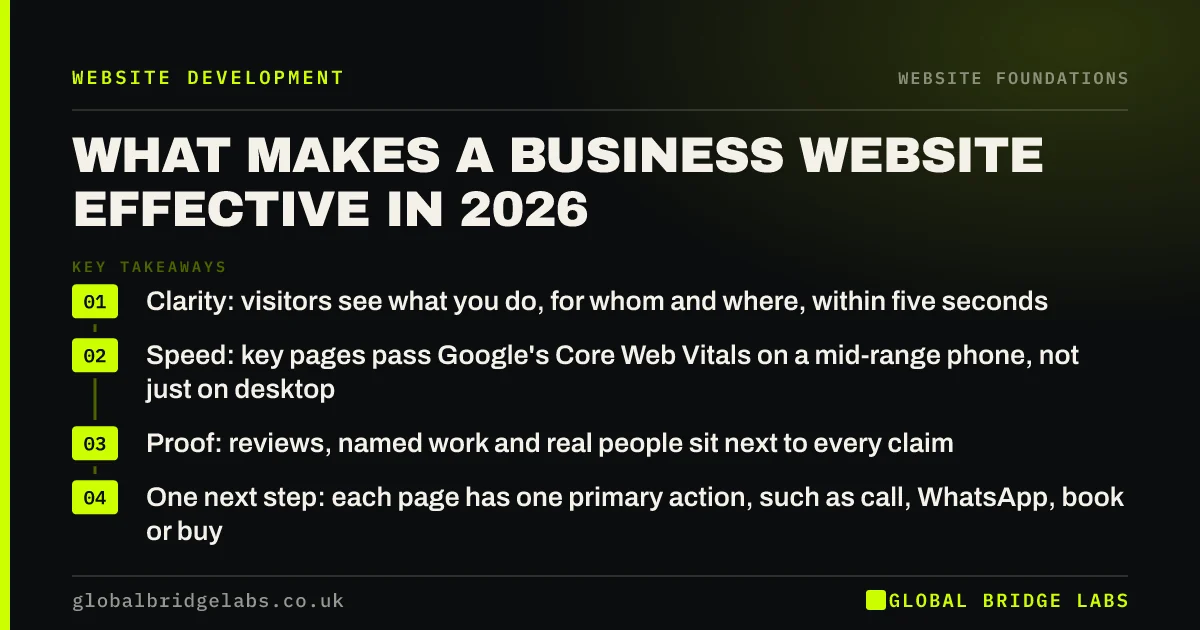
- Clarity: visitors see what you do, for whom and where, within five seconds.
- Speed: key pages pass Google's Core Web Vitals on a mid-range phone, not just on desktop.
- Proof: reviews, named work and real people sit next to every claim that asks for trust.
- One next step: each page has one primary action, such as call, WhatsApp, book or buy.
- Measurement: every enquiry is tracked to its source, so you know what the site earns.
Want your current site scored against these six? Message us on WhatsApp with the URL and we will tell you the two that matter most.
Chat on WhatsApp →What is an effective business website?
An effective business website is a website that reliably converts qualified visitors into a measurable commercial action, such as an enquiry, booking or order, at a cost per result the business is happy to pay.
That definition deliberately leaves out design awards, page counts and traffic. A site with 400 visitors a month and a 5% enquiry rate outperforms one with 4,000 visitors and a 0.3% rate, and it usually costs less to run. Traffic is an input. Enquiries are the output, and the output is what the website is for.
It also means effectiveness is specific to the business. A trades firm needs calls and quote requests from three postcodes. A professional services firm needs a small number of high-value consultations. An e-commerce brand needs orders at a margin. The six principles below apply to all of them, but the numbers you judge them by differ.
Why do so many UK business websites underperform?
Most underperform because they were briefed as a design project rather than a sales tool. The brief listed pages and colours, not the enquiries the site was expected to produce, so nobody can say afterwards whether it worked.
The scale of the problem is large. The Department for Business and Trade counted 5.7 million private sector businesses in the UK at the start of 2025, 99.8% of them small or medium-sized. Most have a website. Very few have one that is measured against a commercial number.
- The homepage talks about the company rather than the customer's problem.
- The site is fast on the office desktop and slow on a phone in a car park.
- Proof sits on a separate testimonials page that nobody visits.
- Five competing buttons on a page, so visitors pick none of them.
- No call, form or WhatsApp tracking, so the site gets credit for nothing.
1. Is your offer clear within five seconds?
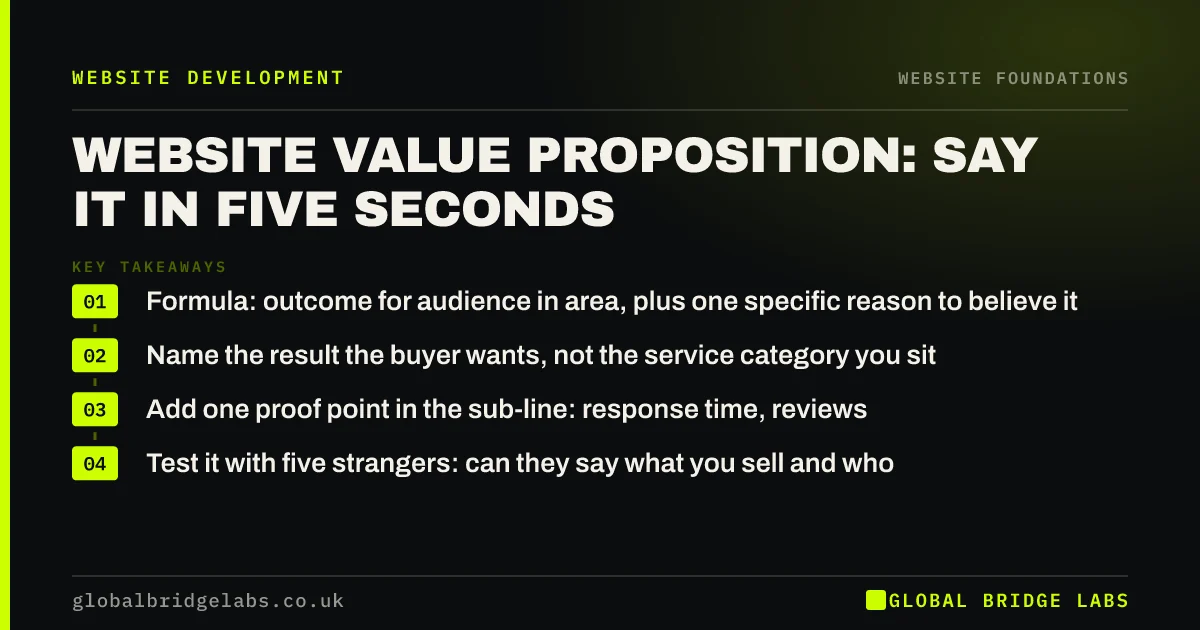
Clarity is the first test because every other improvement depends on it. If a visitor cannot tell what you sell, who it is for and where you work from the first screen, they leave before speed, proof or design have a chance to matter.
The practical standard is a headline that names the outcome, a sub-line that names the audience and area, and a primary button that names the next step. "Emergency plumbing across Leeds, with an engineer at your door in 90 minutes" beats "Quality solutions you can trust" every time, because a stranger can repeat it back.
2. Does the site load fast on a real phone?
Speed is a conversion feature and a ranking signal. Google's Core Web Vitals set three thresholds at the 75th percentile of real visits: Largest Contentful Paint within 2.5 seconds, Interaction to Next Paint within 200 milliseconds, and Cumulative Layout Shift below 0.1.
Google also indexes the mobile version of your site first, so a site that is fast only on desktop is slow as far as search is concerned. The usual culprits on small business sites are uncompressed hero images, page builders loading scripts on every page, and third-party widgets such as chat, reviews and tracking that were added one at a time and never removed.
3. Where is the proof on each page?
Proof belongs next to the claim it supports, not on a page of its own. A visitor reading your service page is deciding whether to trust you at that moment, so the review, the photograph of the finished job or the named client needs to be on that page.
Effective proof is specific. A review that names the job, the town and the outcome does more work than five stars and "great service". Accreditation logos help only when the buyer recognises them. Real photographs of your team and your work beat stock images, which visitors now recognise instantly.
4. Is there one obvious next step?
Every page should have one primary action and at most one secondary action. When a page offers a phone number, a form, a chat widget, a newsletter sign-up, three social icons and a brochure download, the visitor has to make a decision you should have made for them.
Pick the action that matches how your buyers prefer to talk. Urgent, local services convert best on click-to-call and WhatsApp. Considered B2B purchases convert best on a short form or a booked call. Retail converts on add to basket. Then repeat that one action at the top, middle and bottom of every long page.
5. Can people and AI search engines find it?
Visibility in 2026 means ranking in Google and Bing, appearing in the local map pack, and being cited in AI answers from Google AI Overviews, ChatGPT, Perplexity and Copilot. The good news is that the same work serves all of them: clear pages that answer specific questions, consistent business details, and structured data.
Google's own guidance on AI features says there are no special requirements beyond normal SEO best practice. Pages still need to be indexable, useful and clearly written. What changes is the format: short, self-contained answers under question-style headings are far more likely to be quoted than long paragraphs of marketing copy.
6. Do you know which enquiries the site produced?
Measurement closes the loop. Without it, a website is judged on opinion, and redesigns are commissioned because someone is bored of the colours rather than because the numbers dropped.
The minimum set-up for a UK SME is Google Analytics 4 with key events for form submissions, phone clicks and WhatsApp clicks, Google Search Console connected, and a simple monthly view of enquiries by source. That takes a few hours to configure and it changes every later decision about the site.
What does an effective website cost in the UK?
Typical UK market ranges for a small business site are £1,500–£5,000 from a freelancer, £5,000–£20,000 from an agency for a lead generation site, and £10,000–£40,000 or more for e-commerce with integrations. Ongoing hosting, maintenance and improvement usually add £50–£500 a month.
The build price matters less than the cost per enquiry it produces. A £12,000 site that produces 30 qualified enquiries a month is cheaper than a £2,000 site that produces three. Across our client work, we have seen a 2.4x enquiry rate after a website rebuild, and the gain came from clarity, speed and tracking rather than from visual design.
Want a costed plan for your site rather than a rate card? Send us your URL and goals on WhatsApp and we will discuss your requirements.
Chat on WhatsApp →When is a new website the wrong answer?
A rebuild is the wrong answer when the problem is not the website. If enquiries arrive but are answered two days later, a new site will not help. If you have no traffic at all, a better page will convert more of nothing.
It is also the wrong answer when a few focused fixes would do. Rewriting the homepage headline, compressing images, adding proof to service pages and fixing the form often recovers more than a full rebuild, at a fraction of the cost. Audit first, then decide whether you need a redesign, a rebuild or neither.
What does this look like in practice?
A pattern we see often in UK service businesses: a site built four or five years ago, a homepage that opens with "Welcome to our website", a 12-field contact form, and hero images of several megabytes each. The owner believes the site does not work because the market is quiet.
The fixes follow the six principles in order. A headline that names the service and the area. Compressed images and fewer scripts so the phone version loads quickly. Reviews moved onto the service pages. A four-field form plus a WhatsApp button. Call and form tracking so the next month can be compared with the last. None of it is exotic, which is exactly why it gets skipped.
The effective website checklist
Score your site against these ten items. Anything you cannot tick is your priority list, in this order.
- Write a homepage headline that names the outcome, the audience and the area.
- Give every page one primary action and repeat it down long pages.
- Test key pages on a mid-range phone over 4G and in PageSpeed Insights.
- Put a specific review or piece of proof on every service page.
- Show real photographs of your team, premises and work.
- Cut the contact form to the fields you need for a first reply.
- Add click-to-call and WhatsApp for mobile visitors.
- Set up GA4 key events for forms, calls and WhatsApp clicks.
- Connect Google Search Console and check which queries bring visitors.
- Review enquiries by source every month and change one thing at a time.
Next step
If you want to know which of the six your site fails, we will review it with you in 30 minutes: clarity, speed, proof, next step, visibility and tracking, with the two fixes we would make first. No pitch, and you keep the notes.
Message us on WhatsApp for a website effectiveness review, or book a 30-minute consultation.
Chat on WhatsApp →Sources and further reading
- Understanding Core Web Vitals and Google search results · Google Search Central
- AI features and your website · Google Search Central
- Business population estimates for the UK and regions 2025 · Department for Business and Trade
- Mobile-first indexing best practices · Google Search Central
Frequently asked questions
What makes a small business website effective?
An effective small business website makes the offer clear within five seconds, loads quickly on a phone, shows specific proof next to its claims, gives one obvious next step, can be found in search and AI answers, and tracks every enquiry to its source. Looks matter far less than those six things.
How do I know if my website is working?
Measure enquiries, not visits. Set up tracking for forms, calls and WhatsApp clicks, then compare enquiries per month and enquiry rate against the previous quarter. If you cannot say how many enquiries the site produced last month, you do not yet know whether it works.
What is a good conversion rate for a business website?
For UK lead generation sites, 2% to 5% of visits becoming an enquiry is a reasonable working range, and focused landing pages can go higher. Your own previous quarter is a better benchmark than any published average, because traffic quality varies enormously between businesses.
How often should a business website be updated?
Check performance monthly and change one thing at a time. Refresh proof, prices and team details whenever they change, review the whole site against your goals once a year, and plan a rebuild only when the platform itself blocks improvements. Most sites need steady maintenance, not a new build every three years.
Does a website still matter if AI answers questions directly?
Yes. AI answers in Google, ChatGPT and Perplexity cite websites as their sources, and buyers who arrive from them are often further along in their decision. Clear, specific, well-structured pages are more likely to be cited, and your website is still where the enquiry actually happens.
Written by

Global Bridge Labs (GBL) is a UK–Sri Lanka partner for social media, websites and BPO. Everything here comes from client delivery, not theory.