On this page
- 01Key takeaways
- 02Who needs a modern slavery statement?
- 03Where must it appear on the website?
- 04What should the statement cover?
- 05What about smaller businesses?
- 06Should a small firm publish a voluntary statement?
- 07When is a statement not worth publishing?
- 08What does this look like in practice?
- 09Modern slavery statement checklist
- 10Next step
- 11Sources and further reading
- 12Frequently asked questions
Key takeaways
Commercial organisations supplying goods or services in the UK with a total turnover of £36 million or more must publish a modern slavery statement each financial year. If they have a website, the statement must be on it, with a link in a prominent place on the homepage. Smaller firms are not required to publish one, but large customers often ask.
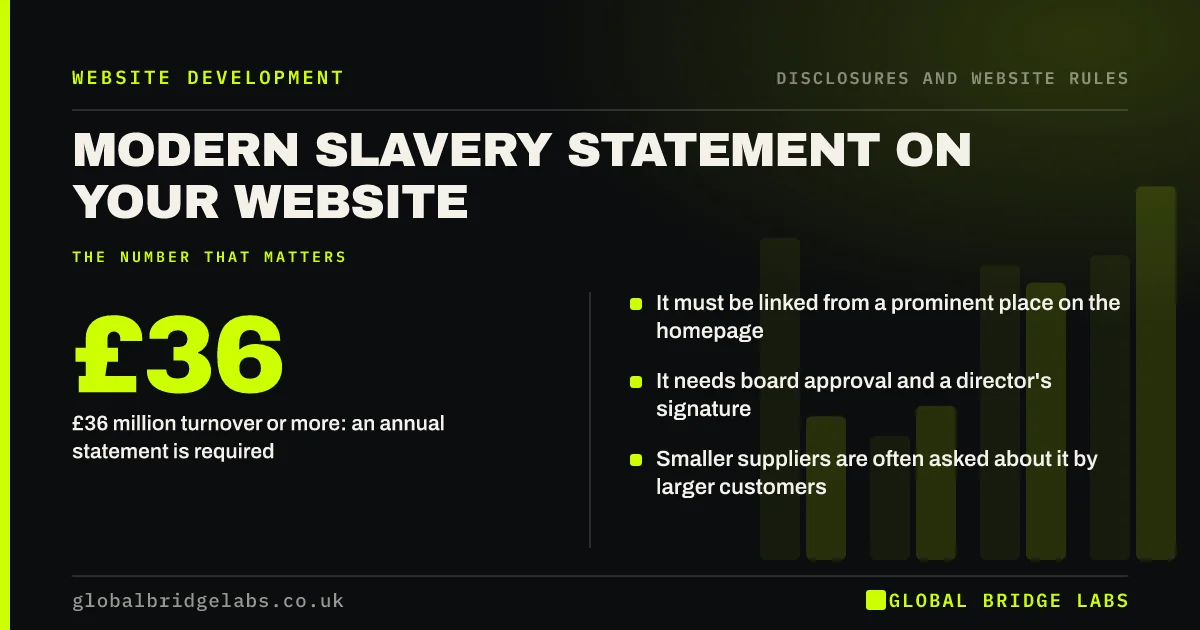
- £36 million turnover or more: an annual statement is required.
- It must be linked from a prominent place on the homepage.
- It needs board approval and a director's signature.
- Smaller suppliers are often asked about it by larger customers.
Asked about modern slavery by a customer? Message us on WhatsApp.
Chat on WhatsApp →Who needs a modern slavery statement?
Under section 54 of the Modern Slavery Act 2015, commercial organisations that supply goods or services and carry on business in the UK, with total turnover of £36 million or more, must publish a slavery and human trafficking statement for each financial year. Global Bridge Labs (GBL) treats it as a threshold-based item in the policies layer.
Where must it appear on the website?
If the organisation has a website, the statement must be published on it, with a link to the statement in a prominent place on the homepage. A footer link labelled 'Modern slavery statement' is the common approach. Keep previous years' statements available too.
What should the statement cover?
Home Office guidance suggests covering your structure and supply chains, policies, due diligence, risk assessment, effectiveness measures and training. The statement must be approved by the board, or equivalent, and signed by a director. It should describe what you actually did that year.
What about smaller businesses?
Smaller businesses are not required to publish a statement, but if they supply large organisations they will often be asked about labour practices, supplier checks and policies. A short voluntary statement or policy on the website can answer those questions once.
Should a small firm publish a voluntary statement?
Publish one if customers ask, if you have overseas supply chains or outsourced operations, or if you bid for public contracts. Keep it honest and proportionate to your size. A short, specific statement beats a long template that promises checks you do not carry out.
When is a statement not worth publishing?
For a small local business with a simple, UK-based supply chain and no corporate customers asking, a published statement adds little. Focus on paying staff correctly and choosing reputable suppliers. Publish when a customer or tender asks.
What does this look like in practice?
A pattern we see with growing suppliers: a corporate customer's onboarding questionnaire asks for a modern slavery statement, and the team scrambles. A short, honest statement on the policies page, reviewed each year, answers that question for every future customer.
Modern slavery statement checklist
- Check whether turnover is £36 million or more.
- Cover structure, policies and due diligence.
- Get board approval and a director's signature.
- Link it prominently from the homepage.
- Keep previous years available.
- Publish voluntarily if customers ask.
Next step
If you are under the threshold but supply larger firms, draft a one-page statement of how you check your own staff and suppliers.
Message us on WhatsApp for help with supplier policies, with no pitch.
Chat on WhatsApp →Sources and further reading
Frequently asked questions
Does my business need a modern slavery statement?
If you are a commercial organisation carrying on business in the UK with total turnover of £36 million or more, yes, each financial year. Below that, it is voluntary, though large customers and public buyers may ask for one.
Where should a modern slavery statement go on a website?
It must be published on the website, with a link in a prominent place on the homepage. Most organisations use a clearly labelled footer link and keep previous years' statements available.
Who must sign a modern slavery statement?
The statement must be approved by the board of directors, or the equivalent for other organisation types, and signed by a director, member or partner. Record the approval date in the statement.
Written by

Global Bridge Labs (GBL) is a UK–Sri Lanka partner for social media, websites and BPO. Everything here comes from client delivery, not theory.