On this page
- 01Key takeaways
- 02What belongs on a Google Business Profile vs a website?
- 03Which details must match exactly?
- 04Do you need a website if you have a profile?
- 05Which page should the profile link to?
- 06How do you keep them in sync?
- 07When is the profile more important than the website?
- 08What does this look like in practice?
- 09Profile and website checklist
- 10Next step
- 11Sources and further reading
- 12Frequently asked questions
Key takeaways
Your Google Business Profile is a summary that appears in Maps and local results; your website is where buyers check detail and decide. Core facts, such as name, address, phone, hours and categories of service, must match exactly. Detail, such as prices, process, policies and proof, belongs on the website, with the profile linking to it.
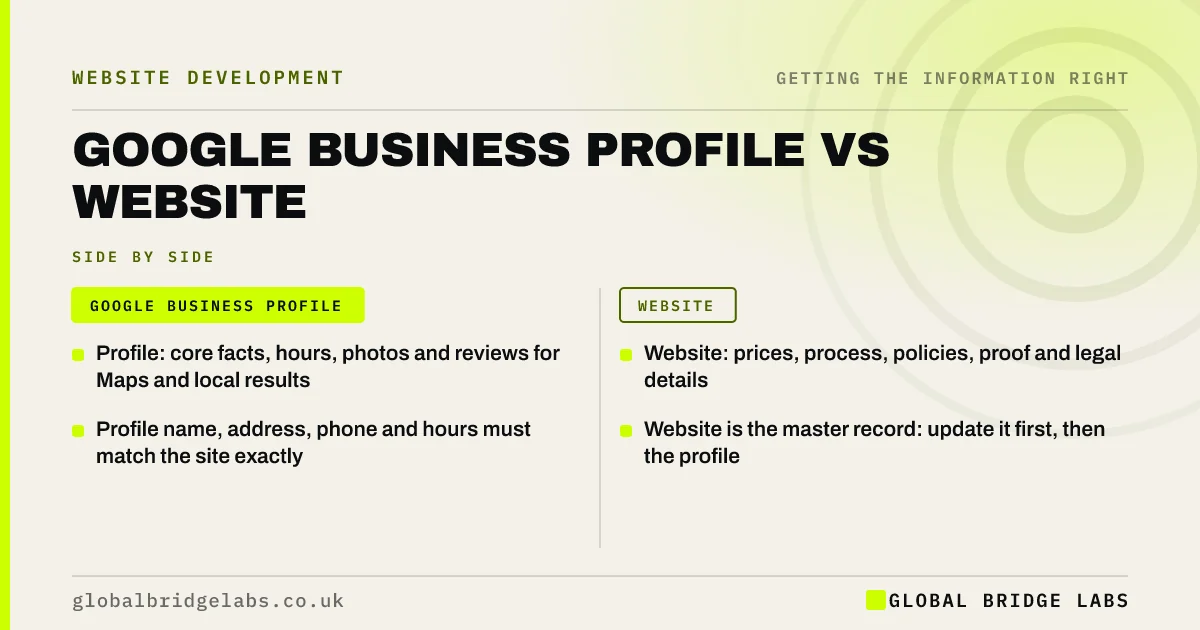
- Profile: core facts, hours, photos and reviews for Maps and local results.
- Website: prices, process, policies, proof and legal details.
- Profile name, address, phone and hours must match the site exactly.
- Website is the master record: update it first, then the profile.
Want your profile and site aligned? Message us on WhatsApp.
Chat on WhatsApp →What belongs on a Google Business Profile vs a website?
The Google Business Profile should carry core facts and a summary: name, address or service area, phone, hours, categories, a short description, photos and reviews. The website should carry everything a buyer needs to decide. Global Bridge Labs (GBL) treats the website as the master record and the profile as its mirror.
Which details must match exactly?
Your business name, address, phone number, hours, website link and service categories must match exactly. Mismatches confuse buyers and make it harder for search engines to trust your details. Use the same formatting too, such as 'Unit 4' rather than '4' on one and 'Unit 4' on the other.
Do you need a website if you have a profile?
A profile alone can bring calls, but it cannot hold prices, process, policies, detailed proof or legal disclosures, and you do not control its layout or future features. Most businesses need both: the profile to be found locally and the website to win the decision.
Which page should the profile link to?
Link the profile to the page that best matches local searchers' needs, usually the homepage for a single-location business or a location page for multi-site firms. The page should repeat the core facts and make the next step obvious.
How do you keep them in sync?
Update both on the same day whenever a core fact changes, starting from your master fact sheet. Set special hours for holidays in advance. Review the profile monthly, because suggested edits from users or Google can change details without you noticing.
When is the profile more important than the website?
For urgent, local, low-consideration services, such as emergency trades or takeaways, many customers act from the profile without visiting the site. Keep the profile especially complete for those businesses, while the website supports bigger or less urgent jobs.
What does this look like in practice?
A pattern we see: the website has new hours and a new phone number, but the Google profile still shows the old ones, so calls go to a disconnected line. A monthly five-minute check of the profile against the website prevents it.
Profile and website checklist
- Match name, address and phone exactly.
- Match hours, including special hours.
- Use the same short description.
- Link to the most relevant page.
- Keep detail on the website.
- Check the profile monthly.
Next step
Open your Google Business Profile and your website contact page side by side. Fix every difference today.
Message us on WhatsApp for a profile and website alignment check, with no pitch.
Chat on WhatsApp →Sources and further reading
- Google Business Profile Help · Google
- Tips to improve your local ranking on Google · Google Business Profile Help
- LocalBusiness type · Schema.org
Frequently asked questions
Do I need a website if I have a Google Business Profile?
Most businesses benefit from both. A profile helps you appear in local results, but a website holds prices, process, policies, proof and legal details, and gives you control. Many buyers check the website before contacting you.
Should my Google Business Profile match my website?
Yes. Name, address, phone, hours and services should match exactly. Mismatches confuse buyers and can weaken search engines' confidence in your details. Update both together whenever anything changes, starting from a single master record of your business facts.
Which page should my Google Business Profile link to?
Usually the homepage for a single-location business, or the relevant location page for multi-site businesses. The linked page should confirm the core details shown on the profile and make the next step, such as calling or booking, obvious.
Written by

Global Bridge Labs (GBL) is a UK–Sri Lanka partner for social media, websites and BPO. Everything here comes from client delivery, not theory.