On this page
- 01Key takeaways
- 02Which information on a website matters most?
- 03Why do the first screens matter so much?
- 04How do you rank the rest of your information?
- 05Does what matters change by sector?
- 06Where do legal details fit in the ranking?
- 07When does this ranking not apply?
- 08What does this look like in practice?
- 09Information priority checklist
- 10Next step
- 11Sources and further reading
- 12Frequently asked questions
Key takeaways
The information that matters most on a business website is what you do, who it is for, roughly what it costs, proof that it works and how to start. These five decide whether a visitor keeps reading. Everything else supports a decision the buyer has already half made, so it can sit one click deeper.
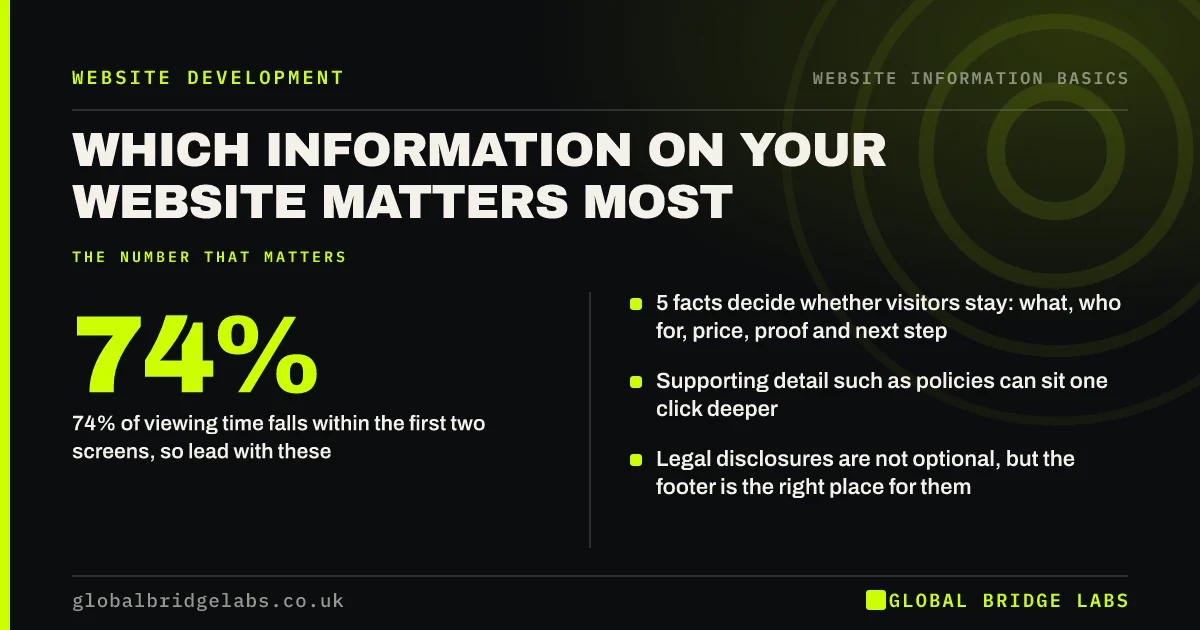
- 5 facts decide whether visitors stay: what, who for, price, proof and next step.
- 74% of viewing time falls within the first two screens, so lead with these.
- Supporting detail such as policies can sit one click deeper.
- Legal disclosures are not optional, but the footer is the right place for them.
Want your top five checked? Message us on WhatsApp.
Chat on WhatsApp →Which information on a website matters most?
Five facts matter most: what you do, who it is for, roughly what it costs, proof that you deliver, and how to take the next step. Global Bridge Labs (GBL) calls these the decision facts, because a buyer uses them to decide whether to shortlist you. If any is missing, the rest of the site rarely gets read.
Why do the first screens matter so much?
Attention is concentrated at the top. Nielsen Norman Group found 74% of viewing time falls within the first two screenfuls of a page. A decision fact placed lower down can still work, but only for visitors already convinced enough to scroll, so the first screens should carry the facts that earn the scroll.
How do you rank the rest of your information?
Rank the rest by how many buyers need it and how early in the decision. Area served and timescales come next for most service firms. Payment terms, cancellation and warranty matter just before buying. Policies, history and team detail matter to fewer people or later. Rank order decides placement, not whether the fact appears.
Does what matters change by sector?
Yes. For urgent trades, response time and area outrank everything. For regulated advice, regulatory status and qualifications rise to the top. For B2B suppliers, capacity, accreditations and policies matter earlier because procurement asks. Ask your last ten customers what they checked first; the answers are usually consistent.
Where do legal details fit in the ranking?
Legal details such as your company number and registered office rank low for buyer attention but are not optional. The footer of every page is the conventional place: visible, consistent and out of the way. Ranking them low means placing them sensibly, not leaving them out.
When does this ranking not apply?
The ranking does not apply when visitors arrive with a specific task, such as existing customers looking for support or candidates looking for jobs. Their most important information is different. Give them a clear route from the header or footer so they do not have to wade through sales content.
What does this look like in practice?
A pattern we see: a homepage opens with the company's history and values, while price guidance and the area served sit on a separate page three clicks away. Swapping the order, so decision facts come first and history moves to the about page, usually leaves the same content on the site but puts it in the order buyers use it.
Information priority checklist
- Write down your five decision facts.
- Check each is on the first two screens.
- Rank the remaining facts by how many buyers need them.
- Place high-ranked facts on service pages.
- Put legal details in the footer.
- Give non-buyers their own route.
Next step
Ask your next five customers what they looked for first on your website. Use their words to check your top five.
Message us on WhatsApp for a review of your decision facts, with no pitch.
Chat on WhatsApp →Sources and further reading
- Scrolling and attention · Nielsen Norman Group
- How users read on the web · Nielsen Norman Group
- Company, Limited Liability Partnership and Business Names (Trading Disclosures) Regulations 2015 · legislation.gov.uk
Frequently asked questions
What do customers look for first on a business website?
Most look first for what you do, whether you serve their need or area, a rough price, proof such as reviews, and how to get in touch. If those are visible on the first screens, visitors keep reading. If they are missing, most go back to the search results.
What information should be on a homepage?
A homepage should carry the decision facts: what you do, who for, price guidance, proof and the next step, plus links to detail. Everything else belongs on deeper pages. Legal disclosures and contact details go in the footer of every page, including the homepage.
Is contact information the most important thing on a website?
Contact details are essential but rarely decisive on their own. Buyers look for them once they have decided you might be right. That is why they belong in the header and footer of every page, while the body of the page answers whether you are the right choice.
Written by

Global Bridge Labs (GBL) is a UK–Sri Lanka partner for social media, websites and BPO. Everything here comes from client delivery, not theory.