On this page
- 01Key takeaways
- 02What should a website say about deposits?
- 03Can a deposit be non-refundable?
- 04How do deposits interact with cancellation rights?
- 05What about payment terms for business customers?
- 06Where should deposit terms appear?
- 07When should you not take a deposit?
- 08What does this look like in practice?
- 09Deposit terms checklist
- 10Next step
- 11Sources and further reading
- 12Frequently asked questions
Key takeaways
Say on your website whether you take a deposit, how much it is, when it is due, what it covers and when it can be refunded, plus when the balance and any staged payments fall. Clear terms prevent disputes. Under UK consumer law, a non-refundable deposit that is out of proportion to your real costs may be unfair and unenforceable.
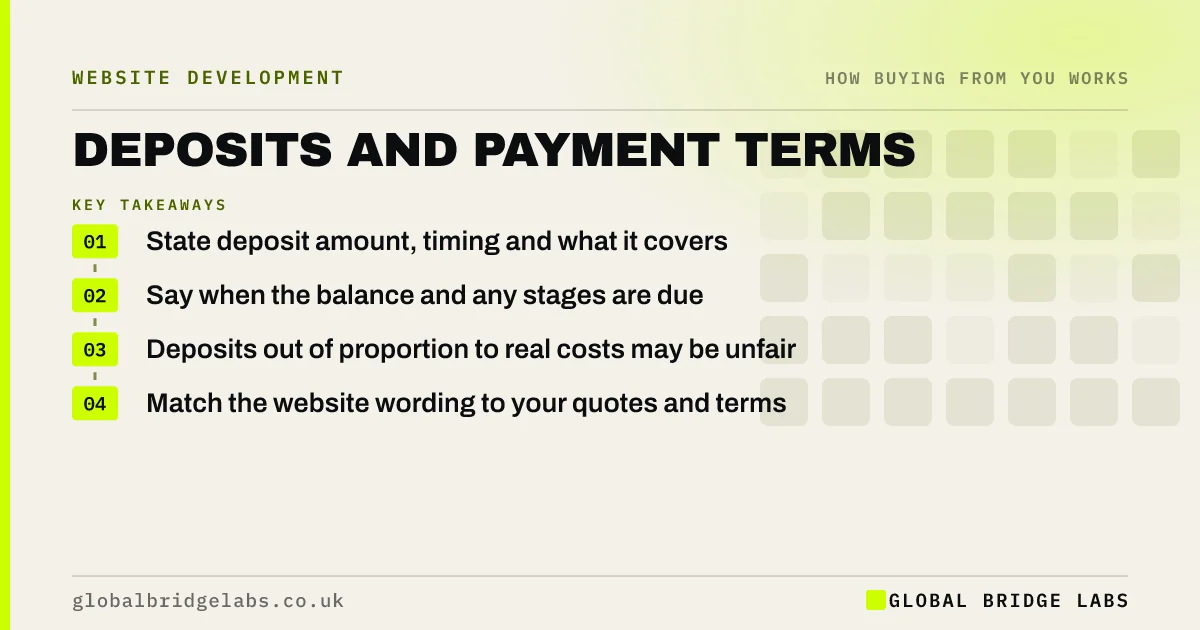
- State deposit amount, timing and what it covers.
- Say when the balance and any stages are due.
- Deposits out of proportion to real costs may be unfair.
- Match the website wording to your quotes and terms.
Want your deposit terms reviewed? Message us on WhatsApp.
Chat on WhatsApp →What should a website say about deposits?
A website should say whether you take a deposit, how much it is (a fixed sum or percentage), when it is due, what it pays for, such as materials or securing a date, and when it is refundable. Global Bridge Labs (GBL) recommends a short paragraph on each service page and the full wording in your terms.
Can a deposit be non-refundable?
A deposit can be partly or wholly non-refundable if it reflects real costs or losses, such as materials ordered or a date you turned others away for. The CMA's unfair contract terms guidance warns that large non-refundable deposits that exceed likely losses may be unfair to consumers and not binding.
How do deposits interact with cancellation rights?
For distance and off-premises consumer contracts, the Consumer Contracts Regulations 2013 give a 14-day cancellation period. A deposit taken in that period is normally refundable if the consumer cancels, unless they asked for work to start and it has, in which case you can keep a proportionate amount.
What about payment terms for business customers?
For business customers, state your standard payment terms, such as 30 days from invoice, and any staged payments. If they pay late, the Late Payment of Commercial Debts (Interest) Act 1998 allows statutory interest and compensation unless your contract says otherwise. Mentioning your terms up front avoids surprises.
Where should deposit terms appear?
Put a summary on service pages and booking pages, near the price guidance, and the full terms on your terms page. Repeat the key points in the quote. Buyers should never learn about a deposit for the first time when an invoice arrives.
When should you not take a deposit?
Skip deposits for low-value or quick jobs where the admin outweighs the risk, and for long-standing customers with a payment record. A deposit is a protection, not a requirement. Where you do take one, make sure it is proportionate and clearly explained.
What does this look like in practice?
A pattern we see in events and bespoke work: a deposit described as 'non-refundable' on the booking page, 'refundable minus costs' in the terms and something else in the quote. Writing one fair, cost-based version and using it everywhere removes a common source of complaints.
Deposit terms checklist
- State amount and timing.
- Say what the deposit covers.
- Explain when it is refundable.
- Keep non-refundable parts proportionate.
- State balance and staged payment dates.
- Match website, quotes and terms.
Next step
Read your deposit wording on the website, the quote template and the terms side by side. Rewrite them as one version.
Message us on WhatsApp for a deposit terms review, with no pitch.
Chat on WhatsApp →Sources and further reading
Frequently asked questions
Is a non-refundable deposit legal in the UK?
It can be, if it reflects your genuine costs or losses, such as materials ordered or a date held. Large non-refundable deposits that exceed likely losses may be unfair under consumer law and unenforceable against consumers. Explain clearly what the deposit covers.
How much deposit should a business ask for?
There is no fixed legal amount. Base it on the costs you commit before the job, such as materials or turning away other bookings. Many trades and services use a figure that covers materials or a modest share of the price.
Should I put payment terms on my website?
Yes. A summary of deposits, staged payments and when the balance is due helps buyers plan and prevents disputes. Put the summary on service or booking pages and the full terms on your terms page.
Written by

Global Bridge Labs (GBL) is a UK–Sri Lanka partner for social media, websites and BPO. Everything here comes from client delivery, not theory.