On this page
- 01Key takeaways
- 02Should you show your insurance cover on your website?
- 03Is showing insurance a legal requirement?
- 04What details should you show?
- 05Does 'fully insured' work?
- 06Where should insurance details go?
- 07When should you not mention insurance?
- 08What does this look like in practice?
- 09Insurance details checklist
- 10Next step
- 11Sources and further reading
- 12Frequently asked questions
Key takeaways
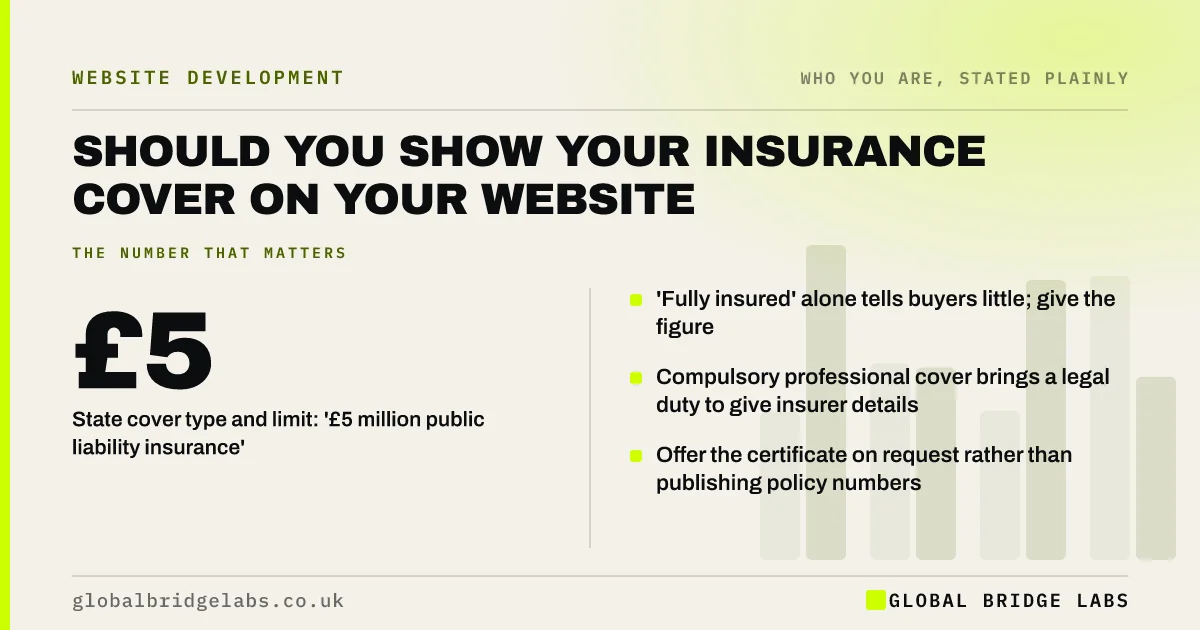
Yes, for most trades and service businesses: state the types and levels of cover, such as '£5 million public liability insurance', because buyers check before letting you work. Where professional indemnity cover is compulsory, the Provision of Services Regulations 2009 require you to give buyers details of the insurer and territorial coverage.
- State cover type and limit: '£5 million public liability insurance'.
- 'Fully insured' alone tells buyers little; give the figure.
- Compulsory professional cover brings a legal duty to give insurer details.
- Offer the certificate on request rather than publishing policy numbers.
Want your trust details reviewed? Message us on WhatsApp.
Chat on WhatsApp →Should you show your insurance cover on your website?
Yes, for most trades and service businesses. Buyers letting someone into their home or relying on professional advice want to know you are covered if something goes wrong. Global Bridge Labs (GBL) recommends stating the type and limit of each relevant policy, for example public liability and professional indemnity, in plain words.
Is showing insurance a legal requirement?
Sometimes. Where you are required to hold professional liability insurance, the Provision of Services Regulations 2009 say you must make information about it available to buyers, including the insurer's contact details and territorial coverage. A website page or terms of business is the usual place. Otherwise, showing cover is voluntary but expected.
What details should you show?
Show the type of cover and the limit, such as '£2 million professional indemnity' or '£10 million public liability', and the insurer's name where required. Do not publish policy numbers or full certificates openly. Offer to send the certificate on request, which large customers and main contractors often ask for anyway.
Does 'fully insured' work?
'Fully insured' is better than nothing but tells buyers little, because it does not say what kind of cover or how much. A specific figure is more credible and easier to compare. If your cover differs by service, list the relevant policy on each service page.
Where should insurance details go?
Insurance details work best near other trust signals: in a credentials strip on the homepage, on the about page and on service pages where risk is highest. Professional firms often include them in a footer or a 'regulatory information' page with their other required disclosures.
When should you not mention insurance?
Do not mention insurance you do not hold or have let lapse, and do not imply it covers things it does not, such as guaranteeing workmanship. For low-risk, low-value products, insurance details add little and can be left to your terms. Keep them current, because an expired claim is a misleading one.
What does this look like in practice?
A pattern we see in trades: the homepage says 'fully insured' but the commercial customer still emails for a certificate before every job. Stating the cover limits on the site and offering the certificate in one click from the contact page shortens that exchange and looks more organised.
Insurance details checklist
- List each relevant policy type.
- State the cover limit for each.
- Add insurer details if cover is compulsory.
- Keep policy numbers private.
- Offer certificates on request.
- Diary the renewal date to update the site.
Next step
Find your current certificates and write one line per policy: type and limit. Add it to your about page this week.
Message us on WhatsApp for a trust details check, with no pitch.
Chat on WhatsApp →Sources and further reading
- Unfair commercial practices guidance (CMA207) · Competition and Markets Authority
- Substantiation: advice on backing up marketing claims · ASA and CAP
Frequently asked questions
Should a tradesperson show public liability insurance on their website?
Yes. Public liability cover reassures homeowners and is often required by commercial clients. Show the limit, such as £5 million, rather than just 'insured', and be ready to send the certificate when asked.
Do I have to tell clients who my insurer is?
If professional liability insurance is compulsory for your profession, the Provision of Services Regulations 2009 require you to give clients information about it, including the insurer's contact details and territorial coverage. Otherwise it is optional, though many clients ask.
Is it safe to put my insurance certificate online?
It is safer to state the type and limit of cover and send the certificate on request. Certificates contain policy numbers and details that are not needed by most visitors. Sending it directly also lets you see who is asking.
Written by

Global Bridge Labs (GBL) is a UK–Sri Lanka partner for social media, websites and BPO. Everything here comes from client delivery, not theory.