On this page
- 01Key takeaways
- 02What should a training provider's website include?
- 03How should course pages be structured?
- 04Which accreditation claims are safe?
- 05How should prices and terms be shown?
- 06What about outcomes and reviews?
- 07When is less better?
- 08What does this look like in practice?
- 09Training provider website checklist
- 10Next step
- 11Sources and further reading
- 12Frequently asked questions
Key takeaways
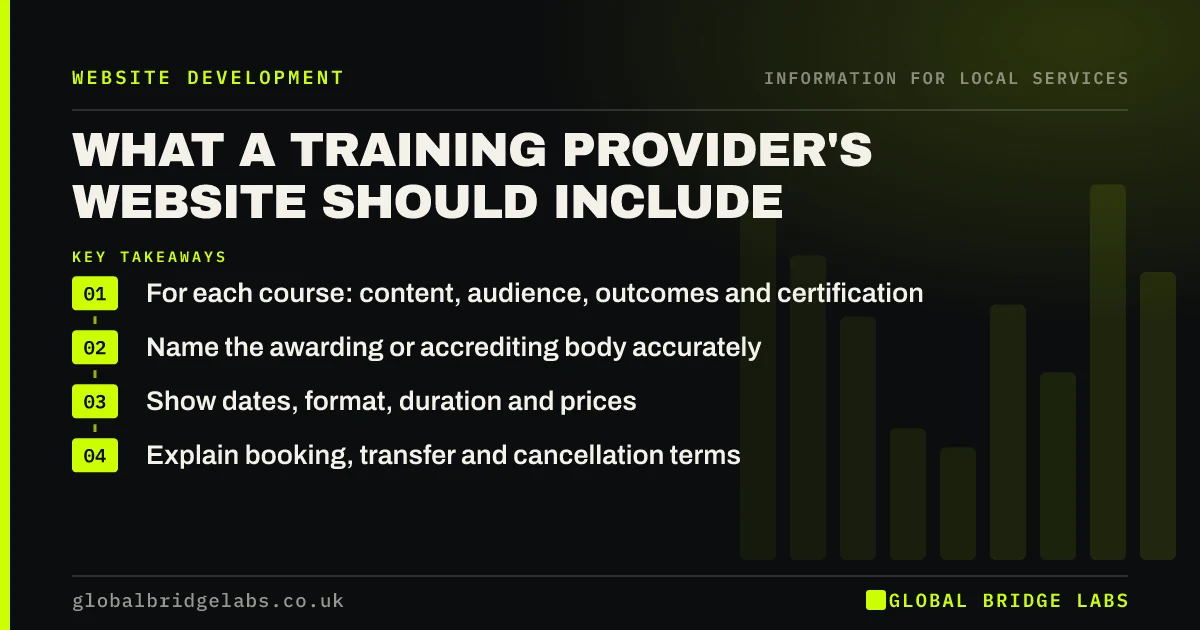
A training provider's website should give, for each course, what is covered, who it is for, outcomes and certification, accreditation or awarding body, dates, duration, delivery format, prices including VAT for individuals, group options, and booking, transfer and cancellation terms. Accreditation claims must be accurate and checkable.
- For each course: content, audience, outcomes and certification.
- Name the awarding or accrediting body accurately.
- Show dates, format, duration and prices.
- Explain booking, transfer and cancellation terms.
Running a training website? Message us on WhatsApp.
Chat on WhatsApp →What should a training provider's website include?
A training provider's website should include, for every course, its content, audience, prerequisites, outcomes, certification, accreditation, dates, duration, format, price and booking terms. Global Bridge Labs (GBL) sees outcomes and accreditation as the items buyers check most closely, especially when employers are paying.
How should course pages be structured?
Give each course its own page with the same structure: who it is for, what it covers, what learners will be able to do afterwards, prerequisites, format, duration, dates, certificate, price and how to book. Consistent pages make courses easy to compare.
Which accreditation claims are safe?
Name the awarding or accrediting body exactly and say what is accredited: the course, the qualification or your organisation. Do not describe an in-house certificate as a recognised qualification. Advertising rules require such claims to be accurate and substantiated.
How should prices and terms be shown?
Show prices including VAT for individuals and clearly labelled ex-VAT prices for businesses, what they include, group and in-house options, and payment terms. Explain transfers, cancellations and refunds. Consumers booking online usually have cancellation rights unless the course starts with their agreement.
What about outcomes and reviews?
Show evidence of outcomes, such as pass rates with dates and numbers, and recent reviews from learners and employers. Describe what learners can do after the course in concrete terms. Results claims must be evidenced.
When is less better?
Less is better in course catalogues that list dozens of courses with thin pages. A smaller set of well-described courses ranks and converts better than many near-empty pages. Combine or retire courses you rarely run.
What does this look like in practice?
A pattern we see: a training provider's course pages show a title, a date and a 'book now' button, with outcomes and accreditation only in a downloadable brochure. Moving them onto the page, in a consistent format, helps both learners and the managers who approve the spend.
Training provider website checklist
- Use one consistent structure per course.
- State outcomes and certification.
- Name accrediting bodies accurately.
- Show dates, format and duration.
- Show prices with VAT labelled.
- Explain transfers and cancellations.
Next step
Pick your best-selling course and rebuild its page in the consistent structure above. Then apply the same structure to the rest.
Message us on WhatsApp for a course page review, with no pitch.
Chat on WhatsApp →Sources and further reading
- Substantiation: advice on backing up marketing claims · ASA and CAP
- Consumer Contracts (Information, Cancellation and Additional Charges) Regulations 2013 · legislation.gov.uk
Frequently asked questions
What should a course information page include?
It should include who the course is for, what it covers, outcomes, prerequisites, format, duration, dates, certification and accreditation, price and booking terms. Using the same structure for every course makes comparison easy.
Can I call my course accredited?
Only if it is accredited by a named body for the thing you describe. Say exactly what is accredited and by whom. Describing an in-house certificate as a recognised qualification can mislead learners.
Do learners have a right to cancel a course booking?
Consumers booking online or by phone usually have a 14-day right to cancel, unless the course starts within that period at their request. Business bookings follow your terms, which should cover transfers and refunds.
Written by

Global Bridge Labs (GBL) is a UK–Sri Lanka partner for social media, websites and BPO. Everything here comes from client delivery, not theory.