On this page
- 01Key takeaways
- 02Why does conflicting information matter?
- 03Where do contradictions come from?
- 04How do you find contradictions?
- 05How do you stop them coming back?
- 06What about contradictions with quotes and invoices?
- 07When is repetition acceptable?
- 08What does this look like in practice?
- 09Contradictions checklist
- 10Next step
- 11Sources and further reading
- 12Frequently asked questions
Key takeaways
Conflicting information, such as two different prices, hours, response times or phone numbers, makes buyers doubt everything and can create legal risk if they rely on the wrong one. It usually comes from the same fact being written in several places at different times. Fix it by giving each fact one home and linking to it.
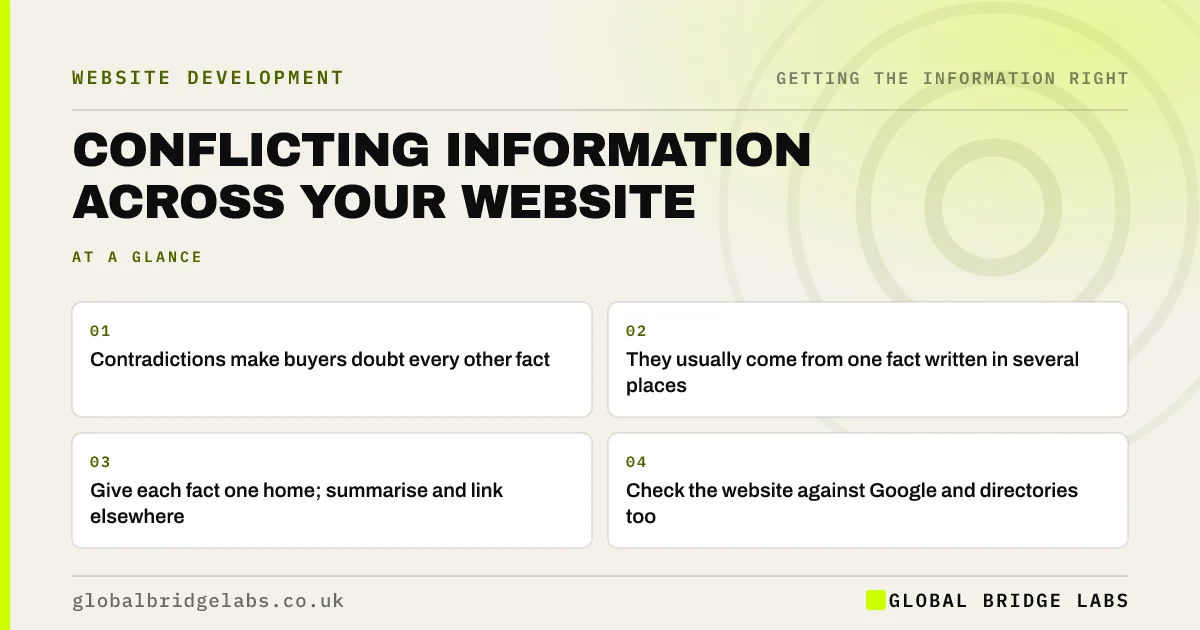
- Contradictions make buyers doubt every other fact.
- They usually come from one fact written in several places.
- Give each fact one home; summarise and link elsewhere.
- Check the website against Google and directories too.
Want a contradiction check? Message us on WhatsApp.
Chat on WhatsApp →Why does conflicting information matter?
Conflicting information matters because buyers cannot tell which version is right, and they start doubting everything else. If they rely on the more favourable version, consumer law may hold you to it. Global Bridge Labs (GBL) finds contradictions in prices, hours and response times on most sites we review.
Where do contradictions come from?
They come from the same fact written in several places at different times: a price on the homepage, service page and FAQ; hours on the contact page, footer and Google; terms on a booking page and in the terms. Updates reach one place and miss the others.
How do you find contradictions?
List your key facts, then search the site for each one, including old values such as previous prices or phone numbers. Check PDFs, image text, structured data and email templates too. Compare the website with your Google Business Profile and the main directories.
How do you stop them coming back?
Give each fact one home page where its full version lives, and use short summaries with links elsewhere. Record every place a fact appears in a master sheet, and update all of them together. Avoid repeating detail, such as full terms, in several places.
What about contradictions with quotes and invoices?
Contradictions between the website and your quotes, terms or invoices are the most likely to cause disputes. Check that payment terms, deposits, cancellation rules and company details match across all of them, and update templates when the website changes.
When is repetition acceptable?
Repetition is fine for facts that rarely change, such as your phone number in the header and footer, as long as they come from one setting in the content management system. It is risky for prices, terms and anything that changes often.
What does this look like in practice?
A pattern we see: three different response time promises on one site, 'same day', 'within 24 hours' and 'within 2 working days', written in three different years. Choosing the one the team actually meets and using it everywhere ends the confusion.
Contradictions checklist
- List your key facts.
- Search for each, including old values.
- Check PDFs and structured data.
- Compare with Google and directories.
- Give each fact one home.
- Match quotes and terms to the site.
Next step
Search your site for every phone number, price and response time it contains. If you find more than one version of any, pick one today.
Message us on WhatsApp for a contradiction check, with no pitch.
Chat on WhatsApp →Sources and further reading
- Consumer Rights Act 2015 · legislation.gov.uk
- Google Business Profile Help · Google
- Maintain consistency and adhere to standards (usability heuristic #4) · Nielsen Norman Group
Frequently asked questions
Why does my website show different prices on different pages?
Usually because the price was written in several places and updated in only some. Give the full price one home, such as the service page, and use short summaries that link to it elsewhere.
Does inconsistent business information affect SEO?
Inconsistent names, addresses and phone numbers across your website and listings can make it harder for search engines to trust your details, particularly for local results. Keep them identical everywhere.
Can a customer hold me to a price on my website?
If a consumer relied on a price or term you published, they may be able to hold you to it, depending on the circumstances. Keeping information consistent and current is the simplest protection.
Written by

Global Bridge Labs (GBL) is a UK–Sri Lanka partner for social media, websites and BPO. Everything here comes from client delivery, not theory.