On this page
- 01Key takeaways
- 02What is a 'what to expect' page?
- 03Why does a 'what to expect' page help?
- 04What should each step include?
- 05Where should the page be linked?
- 06How does it differ from an FAQ page?
- 07When is it not needed?
- 08What does this look like in practice?
- 09'What to expect' page checklist
- 10Next step
- 11Sources and further reading
- 12Frequently asked questions
Key takeaways
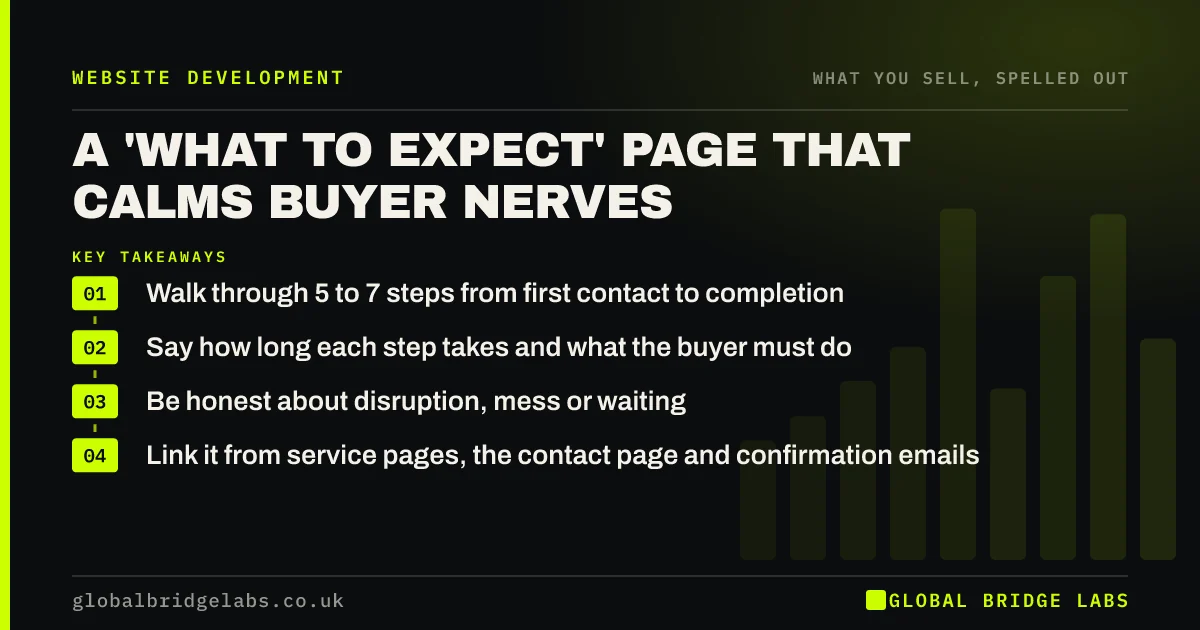
A 'what to expect' page walks buyers through working with you, step by step: first contact, visit or consultation, quote, scheduling, the work itself and completion. It calms nervous buyers by removing the unknown, sets expectations that prevent complaints, and gives your team a single link to send.
- Walk through 5 to 7 steps from first contact to completion.
- Say how long each step takes and what the buyer must do.
- Be honest about disruption, mess or waiting.
- Link it from service pages, the contact page and confirmation emails.
Want a 'what to expect' outline? Message us on WhatsApp.
Chat on WhatsApp →What is a 'what to expect' page?
A 'what to expect' page explains, in order, what happens when someone works with you: how first contact works, what a visit or consultation involves, how quotes and scheduling work, what happens during the job and how it finishes. Global Bridge Labs (GBL) treats it as the fullest answer to item 12 of the inventory: process and timescales.
Why does a 'what to expect' page help?
It helps because uncertainty stops people acting. A buyer who can picture each step, how long it takes and what they need to do feels more in control and is more likely to enquire. It also reduces complaints, because expectations about noise, access or timing were set in writing beforehand.
What should each step include?
Each step should say what happens, who does it, how long it usually takes and what the buyer needs to do or prepare. Use a numbered list. Be honest about the less pleasant parts, such as dust, waiting for parts or a deposit, because buyers find them out anyway.
- 1 Enquiry: how and when you reply.
- 2 Visit or call: what you check and how long it takes.
- 3 Quote: what it includes and how long it is valid.
- 4 Booking: deposit, lead time and scheduling.
- 5 The work: access, disruption and updates.
- 6 Completion: sign-off, payment and aftercare.
Where should the page be linked?
Link it from each service page, the contact page and the main menu if many buyers are first-timers. Send it in enquiry replies and booking confirmations. One clear page that everyone links to beats the same steps written slightly differently in five places.
How does it differ from an FAQ page?
A 'what to expect' page tells the story in order, while an FAQ page answers questions in any order. Buyers who want to understand the whole journey read the first; buyers with one specific question use the second. Many businesses need both, cross-linked.
When is it not needed?
It is not needed for simple purchases where the process is obvious, such as buying a product online with standard delivery. Delivery and returns information covers that. It earns its place for services, appointments, events and anything involving a visit to the buyer's home or premises.
What does this look like in practice?
A pattern we see in clinics and home services: first-time customers phone to ask what will happen, how long it will take and whether they need to be there. A single 'what to expect' page, sent with every booking, answers all three and makes the first appointment run more smoothly.
'What to expect' page checklist
- List every step from enquiry to completion.
- Add timing to each step.
- Say what the buyer must do.
- Be honest about disruption.
- Link it from service and contact pages.
- Send it with booking confirmations.
Next step
Write down the steps of your last completed job, from first call to final invoice. That list is the skeleton of your 'what to expect' page.
Message us on WhatsApp for help writing your process page, with no pitch.
Chat on WhatsApp →Sources and further reading
- How users read on the web · Nielsen Norman Group
- Writing to GOV.UK standards: writing guidelines · GOV.UK
- UK Customer Satisfaction Index · Institute of Customer Service
Frequently asked questions
What should a 'what to expect' page include?
It should include each step from enquiry to completion, how long each takes, what the customer needs to do, any deposits or payments, and what happens afterwards. Use a numbered list and be honest about disruption or waiting.
Is a 'what to expect' page the same as an FAQ?
No. A 'what to expect' page explains the whole process in order, while an FAQ answers individual questions. They work well together: the process page gives the big picture, and the FAQ handles specific concerns.
Where should I link my 'what to expect' page?
Link it from service pages, the contact page and booking confirmations. If most of your buyers are new to the service, add it to the main menu. Sending the same link everywhere keeps the process description consistent.
Written by

Global Bridge Labs (GBL) is a UK–Sri Lanka partner for social media, websites and BPO. Everything here comes from client delivery, not theory.