On this page
- 01Key takeaways
- 02What are the five questions every homepage must answer?
- 03What belongs in the first screen?
- 04How do you answer 'why should I trust you?' quickly?
- 05How do you answer 'what should I do next?'
- 06When do visitors need different questions answered?
- 07What does this look like in practice?
- 08Five questions checklist
- 09Next step
- 10Sources and further reading
- 11Frequently asked questions
Key takeaways
There are five questions a homepage must answer, roughly in this order: what do you do, is it for someone like me, do you cover where I am, why should I trust you, and what do I do next. The first three belong in the first screen. If a visitor has to scroll or click to answer them, many will leave instead.
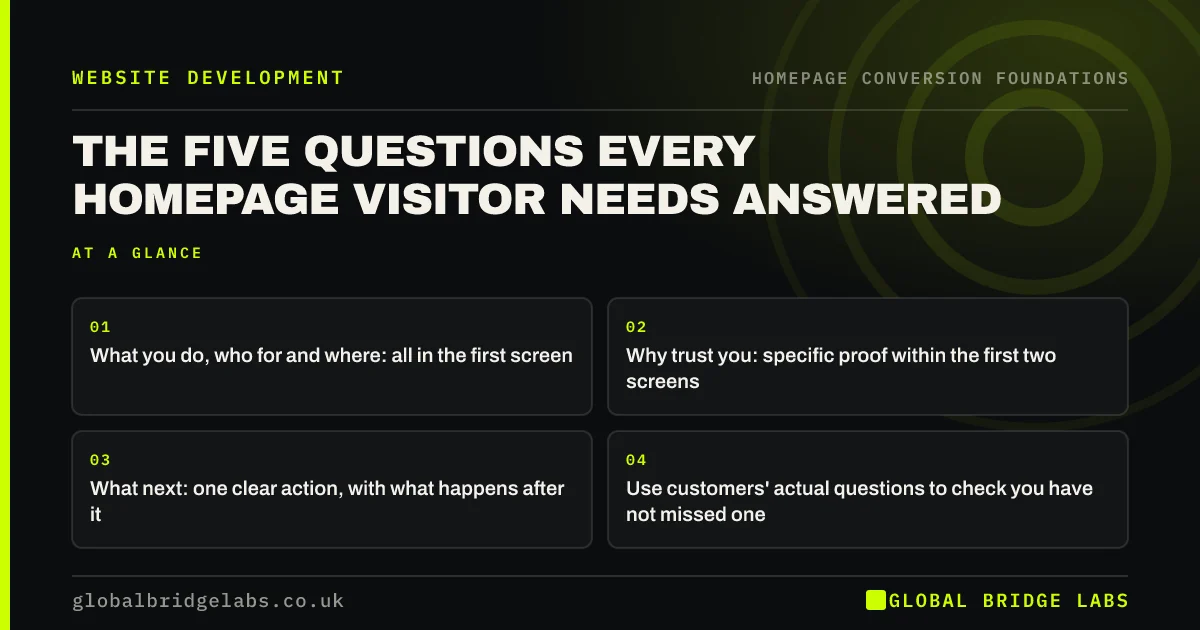
- What you do, who for and where: all in the first screen.
- Why trust you: specific proof within the first two screens.
- What next: one clear action, with what happens after it.
- Use customers' actual questions to check you have not missed one.
Want to know which of the five your homepage misses? Message us on WhatsApp.
Chat on WhatsApp →What are the five questions every homepage must answer?
Every homepage must answer: what do you do; is it for someone like me; do you work where I am; why should I believe you; and what should I do next. Visitors ask these in roughly that order, and each answer earns the right to ask the next. They map directly onto the rungs of the GBL Homepage Ladder.
What belongs in the first screen?
The first three answers belong before any scrolling: a headline that names what you do, a subheadline that says who it is for and the result they get, and a clear service area or delivery promise. 'Boiler installation and repair across Leeds, usually within 48 hours' answers all three in one line; 'Quality heating solutions' answers none.
How do you answer 'why should I trust you?' quickly?
Answer it with specific proof rather than adjectives: a review score with a count, a named accreditation that buyers recognise, two or three real projects and a short description of how the service works. Put a compact version straight under the hero and fuller examples lower down.
How do you answer 'what should I do next?'
Give one main action with a verb and an outcome, such as 'Get a fixed quote', and tell people what happens after they click: who replies, how and when. Uncertainty about the next step is a common reason people do not enquire, even when they are ready.
When do visitors need different questions answered?
Returning customers, job seekers and suppliers have different questions, and price-led buyers may ask 'how much?' before 'why you?'. Do not rebuild the homepage around them; give them clear, small routes such as a login link, a careers link in the footer or a 'prices from' line if prices suit your business.
What does this look like in practice?
A pattern we see: a homepage that answers 'why us' at length, with values, history and awards, but never says which towns the firm covers. Visitors outside the area waste the firm's time and visitors inside it are not sure. One line under the headline fixes both.
Five questions checklist
- What you do: named plainly in the headline.
- Who for: stated in the subheadline.
- Where: service area or delivery promise in the first screen.
- Why trust you: specific proof within two screens.
- What next: one action and what happens after it.
Next step
Show your first screen to three people outside the business and ask them the first three questions. Write down their exact answers.
Message us on WhatsApp for the five-question test sheet, or book a 30-minute consultation.
Chat on WhatsApp →Sources and further reading
- How long do users stay on web pages? · Nielsen Norman Group
- Scrolling and attention · Nielsen Norman Group
- Information scent: how users decide where to go next · Nielsen Norman Group
Frequently asked questions
What should a homepage tell visitors first?
What you do, who it is for and where you do it. These three answers belong in the headline, subheadline and first screen. Without them, visitors cannot judge whether the rest of the page is relevant and many will leave within seconds.
What do customers look for on a business homepage?
Most look for a clear description of the service, proof the business is real and good at the work, whether it covers their area, rough price or availability, and an easy way to get in touch. Anything that delays those answers costs enquiries.
How do I find out what questions my homepage misses?
Keep a tally of the questions customers ask by phone, email and message for two weeks. Then check whether your homepage answers each one clearly in the first two screens. The most common unanswered questions are your priority fixes.
Written by

Global Bridge Labs (GBL) is a UK–Sri Lanka partner for social media, websites and BPO. Everything here comes from client delivery, not theory.