On this page
- 01Key takeaways
- 02Should your own name be on your business website?
- 03Why do named people build trust?
- 04How much should you share about yourself?
- 05Where should the owner's name appear?
- 06When should you not put your name on the site?
- 07What does this look like in practice?
- 08Owner name checklist
- 09Next step
- 10Sources and further reading
- 11Frequently asked questions
Key takeaways
For most small businesses, yes: put the owner's or founders' names on the website, with a photo and a line on their role. Buyers trust a business they can attach to a person, and some disclosure rules already expect a name. You choose how much else to share, such as background, but the name itself should not be hidden.
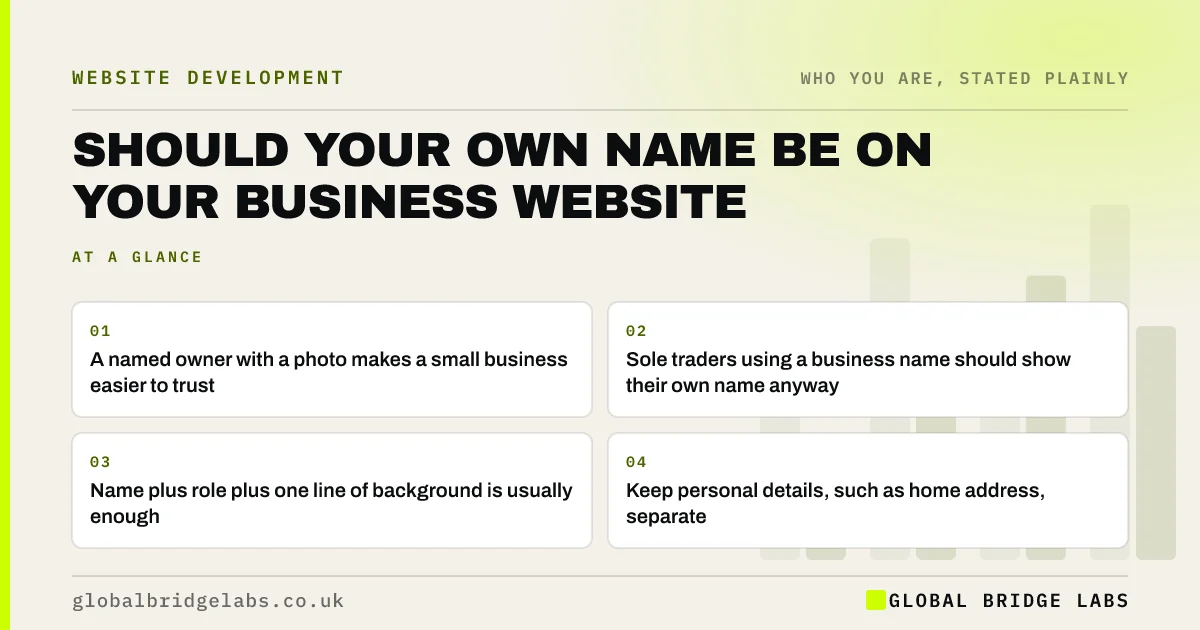
- A named owner with a photo makes a small business easier to trust.
- Sole traders using a business name should show their own name anyway.
- Name plus role plus one line of background is usually enough.
- Keep personal details, such as home address, separate.
Want your about content reviewed? Message us on WhatsApp.
Chat on WhatsApp →Should your own name be on your business website?
Yes, for most small businesses. Showing who runs the business, by name, role and photo, tells buyers a real person stands behind the work. Global Bridge Labs (GBL) sees named owners most clearly help in trades, advice and local services, where buyers are choosing someone to trust with their home, money or problem.
Why do named people build trust?
Named people build trust because they make claims checkable and accountable. In Fogg and colleagues' 2003 Stanford study of 2,684 people, credibility comments often referred to signs that real people and a real organisation stood behind a site. A name, photo and role are the simplest version of that signal.
How much should you share about yourself?
Share your name, role, a photo and one or two lines on relevant experience, such as years in the trade or qualifications. Personal details, such as family, home address or date of birth, are unnecessary. Write the background in terms of what it means for the buyer, not as a biography.
Where should the owner's name appear?
The owner's name usually belongs on the about page, in a short homepage about section and, for sole traders and very small firms, near the contact details. If the owner personally replies to enquiries, saying so on the contact page sets expectations and makes the enquiry feel safer.
When should you not put your name on the site?
Leave names off when there is a real safety or harassment risk, when the business is deliberately built around a brand rather than people, or when staff change so often that names go stale. In those cases, show credentials and real proof instead, and keep the legal disclosures correct.
What does this look like in practice?
A pattern we see: a firm's website says 'we' throughout but never names anyone, even though the owner does every site visit. Adding the owner's name, photo and a line such as 'I will be the one who quotes and does the work' turns a generic page into a personal recommendation.
Owner name checklist
- Show the owner's or founders' names.
- Add a recent, natural photo.
- State role and relevant experience in one line.
- Say who replies to enquiries.
- Keep home address and personal details off the site.
- Update the page when people change.
Next step
Write one line that starts with your name and says what you personally do for customers. Put it on your about page and near your contact details.
Message us on WhatsApp for help writing your about content, with no pitch.
Chat on WhatsApp →Sources and further reading
- How do users evaluate the credibility of web sites? A study with over 2,500 participants · ACM (Fogg et al., 2003)
- 'About Us' information on corporate websites · Nielsen Norman Group
Frequently asked questions
Is it professional to use my name on my business website?
Yes. Many professional services firms and trades put the owner or partners front and centre. A named, photographed owner signals accountability. It is less common for brands built around products, where the brand itself is what buyers recognise.
Should I use a photo of myself on my website?
A recent, natural photo of you is usually better than none and much better than a stock image. It should look like the person the customer will meet. Keep it consistent with your LinkedIn and Google profile photos so buyers recognise you.
What should a business owner bio include?
A short owner bio should include your name, role, relevant experience or qualifications, and what that means for the customer. Two or three sentences are enough on most pages. Skip unrelated personal history unless it explains why you started the business.
Written by

Global Bridge Labs (GBL) is a UK–Sri Lanka partner for social media, websites and BPO. Everything here comes from client delivery, not theory.