On this page
- 01Key takeaways
- 02Who should check the legal information on a website?
- 03What can you check yourself?
- 04When should you pay a solicitor?
- 05Are templates good enough?
- 06How often should legal pages be reviewed?
- 07When is a legal review not worth paying for?
- 08What does this look like in practice?
- 09Legal information review checklist
- 10Next step
- 11Sources and further reading
- 12Frequently asked questions
Key takeaways
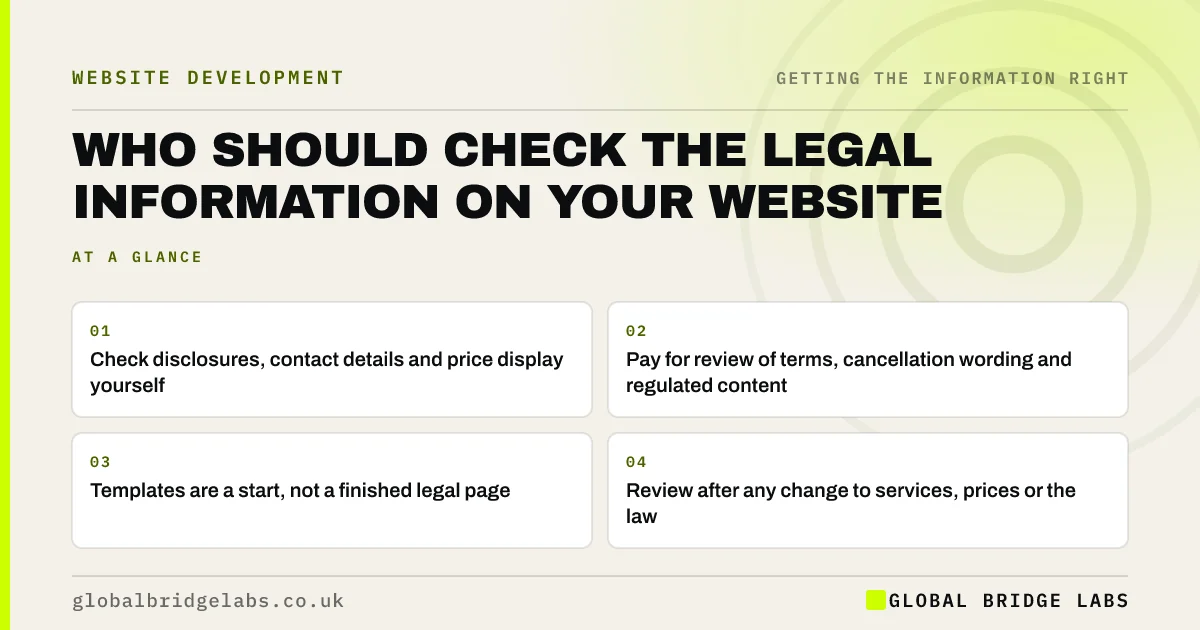
You can check the basic legal information on your website yourself: trading disclosures, contact details, privacy notice coverage and price display. Pay a solicitor to review terms and conditions, cancellation and refund wording, regulated-sector disclosures and anything unusual, such as subscriptions or finance. Review again whenever the business or the law changes.
- Check disclosures, contact details and price display yourself.
- Pay for review of terms, cancellation wording and regulated content.
- Templates are a start, not a finished legal page.
- Review after any change to services, prices or the law.
Want a plain-English check before a legal review? Message us on WhatsApp.
Chat on WhatsApp →Who should check the legal information on a website?
The business owner, or whoever owns the business fact sheet, can check the factual legal items: company details, contact information, privacy notice coverage and price labelling. A solicitor should review terms, consumer rights wording and regulated disclosures. Global Bridge Labs (GBL) builds and writes websites but does not give legal advice, so we say the same to clients.
What can you check yourself?
You can check that your company name, number and registered office match Companies House, that contact details work, that prices for consumers include VAT and fees, that your privacy notice mentions every form and tool collecting data, and that cookie consent works. These are factual checks against clear rules.
When should you pay a solicitor?
Pay for review when drafting or changing terms and conditions, cancellation and refund policies, subscription terms, guarantees, finance wording or anything in a regulated sector. A one-off review is often cheaper than a dispute. Check a solicitor's status on the SRA's register before instructing them.
Are templates good enough?
Templates are a reasonable starting point but rarely fit a business exactly. Common problems include copied periods shorter than the law allows, references to old EU rules, and terms for services you do not offer. Use a template as a draft, edit it to fit, then have the important pages reviewed.
How often should legal pages be reviewed?
Review legal pages at least once a year and whenever your services, prices, data use or the law change. The DMCC Act 2024 has changed consumer law significantly, with more changes being phased in, so pages written before 2025 deserve a fresh look.
When is a legal review not worth paying for?
For a simple brochure site with no online sales, a careful self-check against official guidance is usually enough. Spend on review when you take payments online, sell to consumers at a distance, or work in a regulated field.
What does this look like in practice?
A pattern we see: a business pays for a full redesign but keeps terms copied years ago from a competitor's site. The new site looks modern; its legal pages describe someone else's business. A short review alongside the redesign fixes the mismatch.
Legal information review checklist
- Check disclosures against Companies House.
- Check price labelling and fees.
- Check the privacy notice covers every form and tool.
- Have terms and consumer rights wording reviewed.
- Remove outdated EU references.
- Diary an annual review.
Next step
List your legal pages and the date each was last reviewed. Anything older than a year, or written before April 2025, goes on the review list.
Message us on WhatsApp for a plain-English pre-review check, with no pitch.
Chat on WhatsApp →Sources and further reading
- Check a solicitor's record · Solicitors Regulation Authority
- Digital Markets, Competition and Consumers Act 2024 · legislation.gov.uk
- Company, Limited Liability Partnership and Business Names (Trading Disclosures) Regulations 2015 · legislation.gov.uk
Frequently asked questions
Do I need a solicitor to write website terms and conditions?
Not always, but it is wise if you sell online to consumers, offer subscriptions, finance or guarantees, or work in a regulated sector. A one-off review of a well-prepared draft is usually affordable and reduces the risk of disputes.
Can I copy terms and conditions from another website?
Copying risks infringing copyright and, more importantly, publishing terms that do not match your business or the current law. Use templates as a starting point, adapt them carefully and have key pages reviewed.
How often should website legal pages be updated?
Review them at least once a year and whenever your services, prices, data use or the law change. Consumer law changed significantly with the DMCC Act 2024, so older pages deserve a fresh look.
Written by

Global Bridge Labs (GBL) is a UK–Sri Lanka partner for social media, websites and BPO. Everything here comes from client delivery, not theory.