On this page
- 01Key takeaways
- 02What is website information architecture?
- 03How should a small business group its pages?
- 04How deep should a small business website be?
- 05How do you label sections and pages?
- 06How do you plan IA around the customer journey?
- 07What about search engines and accessibility?
- 08When should you leave the structure alone?
- 09What does this look like in practice?
- 10Information architecture checklist
- 11Next step
- 12Sources and further reading
- 13Frequently asked questions
Key takeaways
Information architecture (IA) is how a website's content is grouped, labelled and connected so visitors can find what they need. For a small business, good IA means a shallow structure, groups that match how customers think about their problems, labels in customers' words and links that follow the journey. Test it with a card sort and a tree test before anyone designs a page.
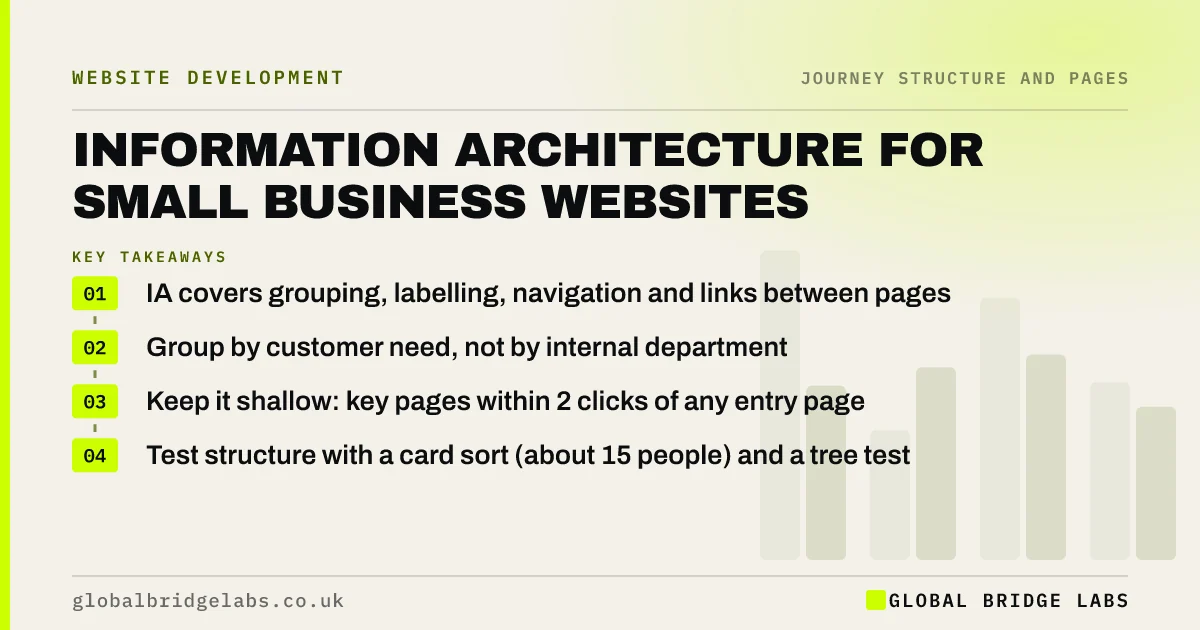
- IA covers grouping, labelling, navigation and links between pages.
- Group by customer need, not by internal department.
- Keep it shallow: key pages within 2 clicks of any entry page.
- Test structure with a card sort (about 15 people) and a tree test.
Want your site structure reviewed against your customer journey? Message us on WhatsApp.
Chat on WhatsApp →What is website information architecture?
Website information architecture is the structure of a site's content: how pages are grouped, what the groups and pages are called, how they are arranged in menus and how they link to each other. It is the skeleton the design sits on. Good IA lets a visitor predict where something will be; poor IA makes them search, guess or give up.
IA is distinct from visual design and from navigation menus, although it shapes both. Navigation is how the structure is presented; IA is the structure itself.
How should a small business group its pages?
Group pages the way customers group their problems, which is often not how the business is organised. A building firm may be organised by trade, while customers think in projects: extensions, loft conversions, kitchens. An accountant may be organised by department, while customers think by situation: sole trader, limited company, landlord. A card sort with customers shows the grouping that makes sense to them.
How deep should a small business website be?
Keep a small business site shallow. Most should have one level of main sections and one level of pages beneath, so any key page is within two clicks of an entry page. Depth is not the main problem, though: clear labels and good links matter more than click counts. A deep page with a clear trail is easier to reach than a shallow one behind a vague label.
- Main sections: 5 to 7 in the top menu.
- One level of pages beneath each section.
- Service pages reachable from every relevant article.
- Pricing, proof and contact reachable from every service page.
How do you label sections and pages?
Label sections and pages with the words customers use, tested rather than assumed. 'Services' is vague; 'Boiler repair' is clear. Avoid internal names, clever wordplay and jargon. Nielsen Norman Group's work on information scent shows that people choose links based on how well the label predicts what they will find, so specific labels carry visitors further.
How do you plan IA around the customer journey?
Plan IA by starting from the journey map. List the questions buyers ask at each stage and the pages that answer them, then group those pages into sections customers would recognise. Make sure every stage is covered: find, orient, compare, commit and return. Then draw the links between pages that follow the journey, not only the menu.
- List every question from the journey map.
- Assign each to an existing or new page.
- Group pages into sections, tested with a card sort.
- Check every stage has pages, including return.
- Draw the journey links between pages.
- Test findability with a tree test.
- Customer journey mapping for small businesses in one day
- Map your website content to the customer journey
- Tree testing: check visitors can find things before you build
Want a site map drawn from your customer journey? Message us on WhatsApp.
Chat on WhatsApp →What about search engines and accessibility?
Clear IA helps both. Google's SEO starter guide recommends a logical site structure and descriptive link text, and a well-grouped site makes topics easier to understand. WCAG 2.2 success criterion 2.4.5, Multiple Ways, asks that pages can be found in more than one way, such as navigation plus search or a sitemap, except where a page is a step in a process.
When should you leave the structure alone?
Leave the structure alone when visitors find things easily and the problems lie elsewhere, such as weak content or slow replies. Restructuring a site has costs: new URLs need redirects, and rankings can wobble. Test findability before restructuring; if people find what they need, improve the pages instead.
What does this look like in practice?
A pattern we see in service businesses that have grown: new services were added as pages under 'Services' one at a time, so the menu now lists fourteen items in the order they were launched. Customers looking for a specific job scan the whole list and still miss it, because two items use internal names.
Regrouping into four customer-named sections, tested with a card sort, makes the same pages findable. Across our client work we have seen a 2.4x enquiry rate from conversion changes of this kind. Global Bridge Labs (GBL) tests structure before designing pages.
Information architecture checklist
- Start from the journey map's questions.
- Group by customer need, tested with a card sort.
- Use customers' words for labels.
- Keep 5 to 7 main sections and a shallow structure.
- Cover every stage, including return.
- Tree-test findability before building.
Next step
Structure is cheaper to fix on paper than after a build. We will review your site's IA against your customer journey and test it with real buyers.
Message us on WhatsApp for an information architecture review, or book a 30-minute consultation.
Chat on WhatsApp →Sources and further reading
- Card sorting: uncover users' mental models · Nielsen Norman Group
- Information scent: how users decide where to go next · Nielsen Norman Group
- Understanding WCAG 2.2 success criterion 2.4.5: Multiple Ways · W3C
- SEO Starter Guide · Google Search Central
Frequently asked questions
What is information architecture in web design?
It is how a website's content is grouped, labelled, arranged and linked so visitors can find what they need. It is the structure beneath the design and navigation. Good information architecture lets visitors predict where something will be.
How do I plan the structure of a small business website?
Start from your customer journey: list the questions buyers ask at each stage, assign each to a page, group pages into sections customers recognise using a card sort, label them in customers' words and test findability with a tree test before building.
How many menu items should a small business website have?
Five to seven main items suits most small business sites, with one level of pages beneath each. Fewer, clearer choices are easier to scan than long lists. The right number depends on how customers group your services, which a card sort can show.
Written by

Global Bridge Labs (GBL) is a UK–Sri Lanka partner for social media, websites and BPO. Everything here comes from client delivery, not theory.