On this page
- 01Key takeaways
- 02What is a website information inventory?
- 03Which items are in the identity and offer layers?
- 04Which items are in the proof and practicalities layers?
- 05Which items are in the contact and compliance layer?
- 06How do you score the inventory?
- 07Which gaps should you fix first?
- 08When is the inventory not the right tool?
- 09What does this look like in practice?
- 10Website information inventory checklist
- 11Next step
- 12Sources and further reading
- 13Frequently asked questions
Key takeaways
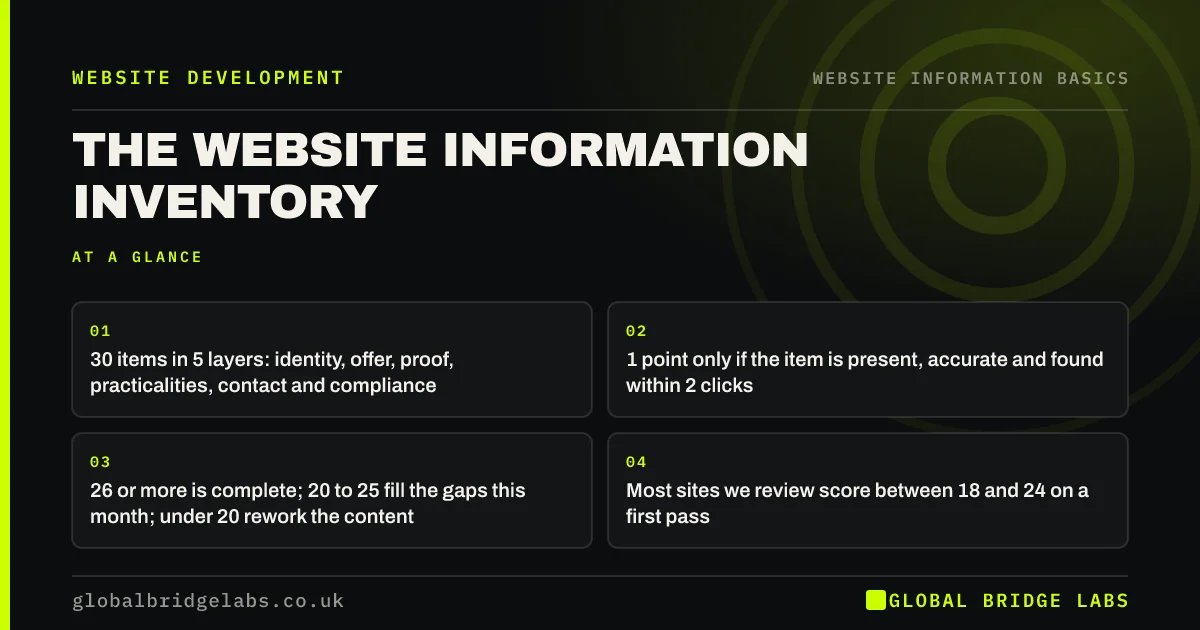
The GBL Website Information Inventory is a 30-item check of the facts a business website should carry, six in each of five layers. Score a point when an item is present, accurate and found within two clicks. 26 or more is complete; 20 to 25 means fill the gaps this month; under 20 means buyers are being under-informed.
- 30 items in 5 layers: identity, offer, proof, practicalities, contact and compliance.
- 1 point only if the item is present, accurate and found within 2 clicks.
- 26 or more is complete; 20 to 25 fill the gaps this month; under 20 rework the content.
- Most sites we review score between 18 and 24 on a first pass.
Want the inventory as a scoring sheet? Message us on WhatsApp.
Chat on WhatsApp →What is a website information inventory?
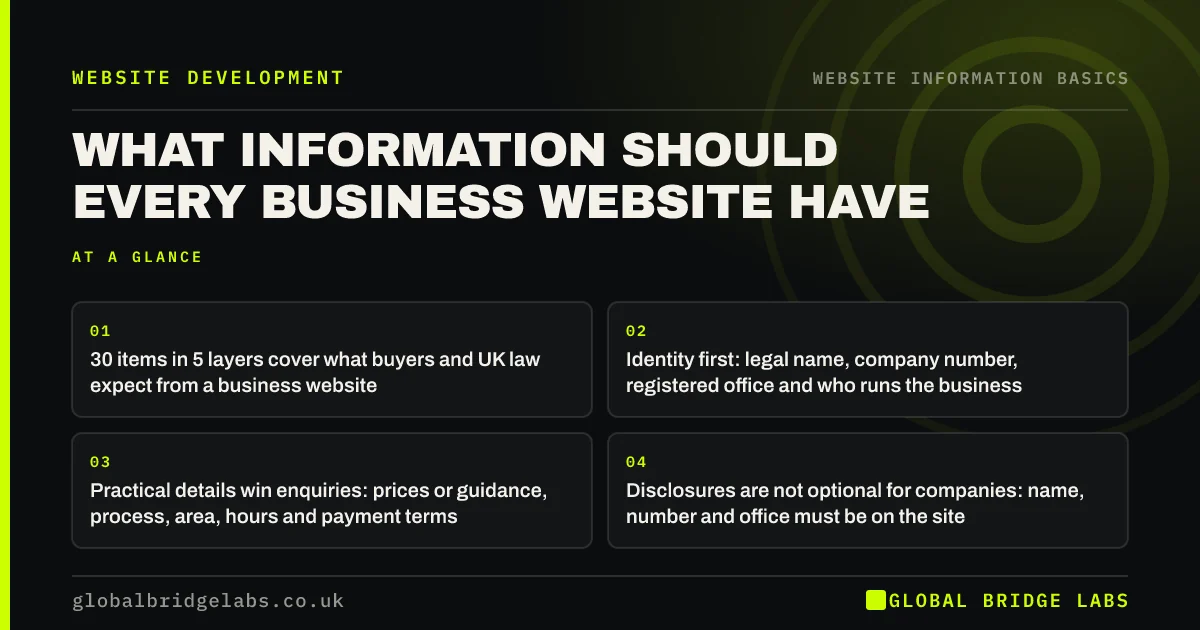
A website information inventory is a list of every fact a buyer or regulator needs from your site, checked one by one for presence, accuracy and findability. Global Bridge Labs (GBL) uses 30 items in five layers. It complements a design review, which asks how the site looks and works, by asking only what it says.
Which items are in the identity and offer layers?
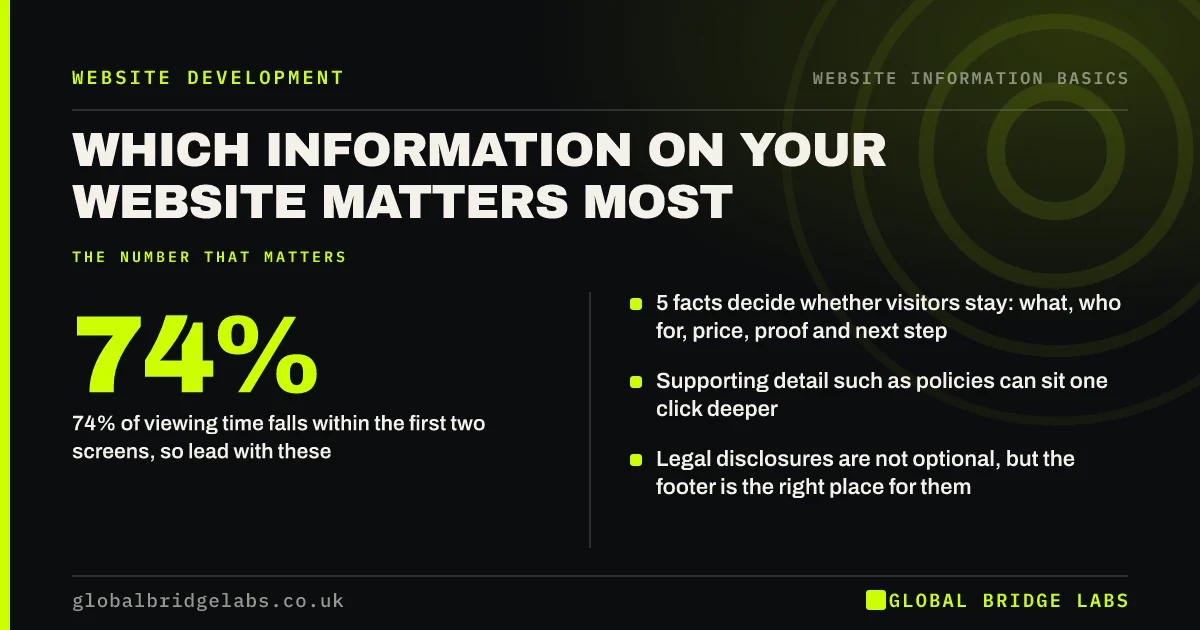
The identity layer checks that buyers can tell exactly who you are. The offer layer checks that they can tell exactly what you sell, to whom and on what terms. Together they answer the first questions every visitor has, and they are where most homepages are thinnest.
- 1 Trading name and, if different, legal name.
- 2 Company number, registered office and VAT number where relevant.
- 3 A one-sentence description of what you do.
- 4 The named people who run the business.
- 5 Where you are based, with real premises or service base.
- 6 Regulator, registration or licence details.
- 7 A complete list of services or products.
- 8 Who each service is for, and who it is not for.
- 9 What is included and excluded.
- 10 Prices or a price guide.
- 11 Area served or delivery coverage.
- 12 Process and typical timescales.
Which items are in the proof and practicalities layers?
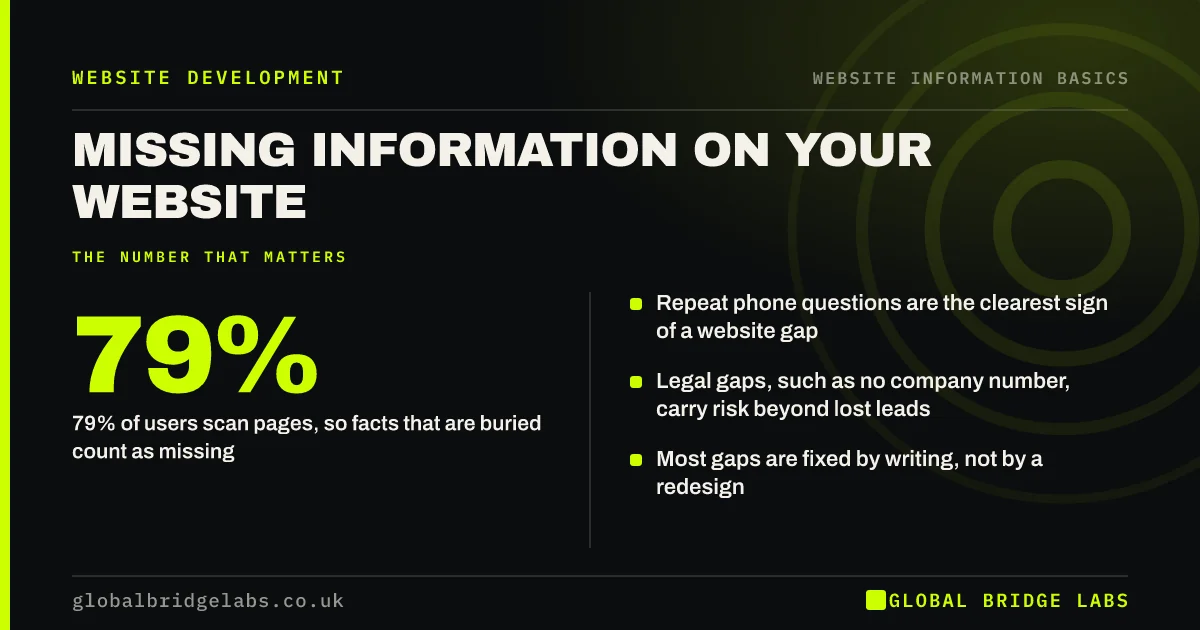
The proof layer checks that a sceptical buyer can verify your claims. The practicalities layer checks that a ready buyer knows how the transaction works before committing. Missing practicalities are the most common reason for repeat phone questions, and several are legal requirements for consumer sales.
- 13 Reviews or testimonials with names or sources.
- 14 Examples of real work or case studies.
- 15 Qualifications, accreditations and memberships.
- 16 Insurance cover where buyers expect it.
- 17 Track record: clients, years trading or volumes.
- 18 Relevant policies such as safety, data and equality.
- 19 Opening or response hours, including holidays.
- 20 Payment methods, deposits and terms.
- 21 Cancellation, returns or refund policy.
- 22 Delivery or booking information.
- 23 Guarantee, warranty or aftercare.
- 24 Complaints procedure.
Which items are in the contact and compliance layer?
The contact and compliance layer checks that people can reach the right person and that the site meets UK disclosure rules. For a limited company, item 29 is a legal requirement under the Trading Disclosures Regulations 2015, and item 27 is required wherever you collect personal data.
- 25 Phone, email and address that match your other listings.
- 26 What happens after someone enquires, and how fast.
- 27 Privacy policy and cookie notice.
- 28 Terms and conditions.
- 29 Trading disclosures in the footer.
- 30 Sector notices such as FCA status or CQC rating.
How do you score the inventory?
Give one point per item only when all three tests pass: the fact is on the site, it is correct today, and a first-time visitor finds it within two clicks of the homepage. Items that do not apply to your business count as passed. Score honestly; a fact hidden in a PDF or a footer link labelled 'Info' fails findability.
- 26 to 30: complete. Recheck each quarter.
- 20 to 25: fill the gaps within a month, starting with offer and practicalities.
- Under 20: buyers are guessing. Plan a content project before any redesign.
Which gaps should you fix first?
Fix legal gaps first, because they carry risk, then the offer and practicalities layers, because they cost the most enquiries. Proof comes next. As a GBL rule of thumb, the five items most often missing are price guidance, area served, process and timescales, payment terms and what happens after an enquiry.
When is the inventory not the right tool?
The inventory is not the right tool when your problem is traffic or design. A site can score 30 and still get no visitors, or score well but be slow and hard to use on a phone. Use it alongside a speed check and a usability review, not instead of them.
What does this look like in practice?
A pattern we see on first passes: identity and contact score well, while offer and practicalities lose six or seven points between them. The business knows its prices, process and terms, but they live in staff heads and quote emails. Writing them down once, then publishing them, closes most of the gap. Across our client work, sites rebuilt around buyer questions have reached a 2.4× enquiry rate.
Website information inventory checklist
- Print the 30 items.
- Open your homepage on a phone.
- Score each item on presence, accuracy and two-click findability.
- Mark items that do not apply as passed.
- Total the score and band it.
- List the zero items in order: legal, offer, practicalities, proof.
- Book the fixes into the next month.
Next step
Score your site today, then send us the list of zero items. We will tell you which three to fix first.
Message us on WhatsApp for the inventory scoring sheet, with no pitch.
Chat on WhatsApp →Sources and further reading
- Company, Limited Liability Partnership and Business Names (Trading Disclosures) Regulations 2015 · legislation.gov.uk
- Right to be informed (privacy information) · Information Commissioner's Office
- How users read on the web · Nielsen Norman Group
- Consumer Contracts (Information, Cancellation and Additional Charges) Regulations 2013 · legislation.gov.uk
Frequently asked questions
How do I audit the information on my website?
List the facts buyers and the law need, then check each against your site for presence, accuracy and findability. The GBL inventory does this with 30 items in five layers. Score one point per item that passes all three tests, then fix the gaps in priority order.
What is the most commonly missing information on business websites?
In our reviews, price guidance, area served, process and timescales, payment terms and what happens after an enquiry are missing most often. Legal disclosures such as the company number and registered office are also frequently absent from limited company websites.
How long does a website information audit take?
For a typical small business site of 10 to 30 pages, a first pass with the 30-item inventory takes one to two hours. Fixing the gaps takes longer, mostly because facts such as process steps or payment terms have to be agreed internally before they can be written.
Written by

Global Bridge Labs (GBL) is a UK–Sri Lanka partner for social media, websites and BPO. Everything here comes from client delivery, not theory.