On this page
- 01Key takeaways
- 02When do affiliate links need disclosing?
- 03How should affiliate links be labelled?
- 04What about sponsored content and partnerships?
- 05Does this apply to referral partners?
- 06Does disclosure hurt trust?
- 07When is disclosure not needed?
- 08What does this look like in practice?
- 09Affiliate disclosure checklist
- 10Next step
- 11Sources and further reading
- 12Frequently asked questions
Key takeaways
If you earn commission from links on your website, or publish sponsored content, UK advertising rules require it to be obviously identifiable as marketing. The ASA's affiliate guidance expects clear labelling near the link or at the start of content, not a disclaimer buried in a footer.
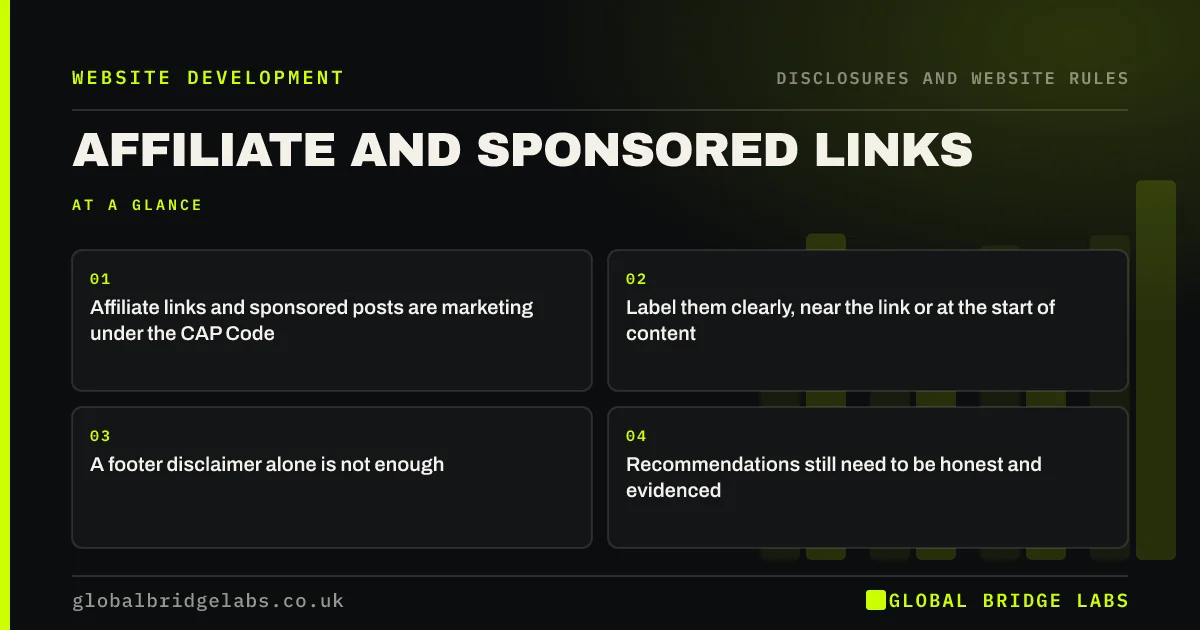
- Affiliate links and sponsored posts are marketing under the CAP Code.
- Label them clearly, near the link or at the start of content.
- A footer disclaimer alone is not enough.
- Recommendations still need to be honest and evidenced.
Unsure how to label sponsored content? Message us on WhatsApp.
Chat on WhatsApp →When do affiliate links need disclosing?
Affiliate links need disclosing whenever you earn commission or another benefit when visitors click or buy. Under the CAP Code, marketing must be obviously identifiable, and the ASA treats affiliate content as marketing. Global Bridge Labs (GBL) sees this most on business blogs that recommend tools or suppliers.
How should affiliate links be labelled?
Label them clearly and prominently, before or beside the link, in words people understand: 'We earn a commission if you buy through these links' or '(affiliate link)'. The ASA's guidance says labels should be upfront, not hidden in small print or only in a footer.
What about sponsored content and partnerships?
If a supplier pays you, or gives you free products, for an article, review or mention, label the content as sponsored or as an advert at the start. Reviews must reflect your genuine experience. Presenting paid content as independent opinion can breach both advertising and consumer law.
Does this apply to referral partners?
Yes, if you receive a fee or benefit for recommending a partner. A line such as 'We may receive a referral fee from partners listed on this page' is a simple way to stay transparent. Regulated firms, such as financial and legal services, may have stricter rules on referral fees.
Does disclosure hurt trust?
Usually not. Readers increasingly expect affiliate links and trust honest disclosure more than they distrust the commission. Hidden commercial relationships that come to light do far more damage. Choosing what to recommend on merit protects you either way.
When is disclosure not needed?
It is not needed for ordinary links to suppliers or resources you gain nothing from. Linking to a supplier you use, without payment or benefit, is just information. If that changes, for example when you join their referral scheme, add the label straight away.
What does this look like in practice?
A pattern we see on business blogs: tool recommendation posts full of affiliate links, with a single disclaimer on the privacy page. Adding one clear line at the top of each post and beside key links meets the rules and costs nothing in clicks.
Affiliate disclosure checklist
- List pages with affiliate or paid links.
- Add a clear label near the links.
- Label sponsored content at the start.
- Disclose referral fees.
- Keep reviews genuine.
- Check sector rules on referral fees.
Next step
Search your site for affiliate links or paid mentions. Add a clear label at the top of every page that has them.
Message us on WhatsApp for a content compliance check, with no pitch.
Chat on WhatsApp →Sources and further reading
Frequently asked questions
Do I need to disclose affiliate links in the UK?
Yes. Affiliate content is marketing under the CAP Code and must be obviously identifiable. Label links clearly near where they appear, rather than relying on a disclaimer in the footer or privacy policy.
How do I write an affiliate disclosure?
Use plain words near the link or at the start of the content, such as 'We earn a commission if you buy through these links'. Avoid jargon and small print. The aim is that readers know before they click.
Does a business blog need an affiliate disclosure?
Only if it earns commission or another benefit from links or mentions. Ordinary links to tools or suppliers you gain nothing from need no disclosure. If you start earning from them, add a label.
Written by

Global Bridge Labs (GBL) is a UK–Sri Lanka partner for social media, websites and BPO. Everything here comes from client delivery, not theory.