On this page
- 01Key takeaways
- 02Why do AI tools get business facts wrong?
- 03Can you correct what an AI says about your business?
- 04How should facts be written so AI reads them correctly?
- 05Which old sources keep wrong facts alive?
- 06When is a wrong AI answer not worth chasing?
- 07What does this look like in practice?
- 08AI business facts checklist
- 09Next step
- 10Sources and further reading
- 11Frequently asked questions
Key takeaways
AI assistants get business facts wrong when the sources they read are missing, out of date or contradict each other. You cannot edit an AI's answer directly. You can fix the sources: state each fact clearly on your website, match it on your Google Business Profile and listings, and remove old versions.
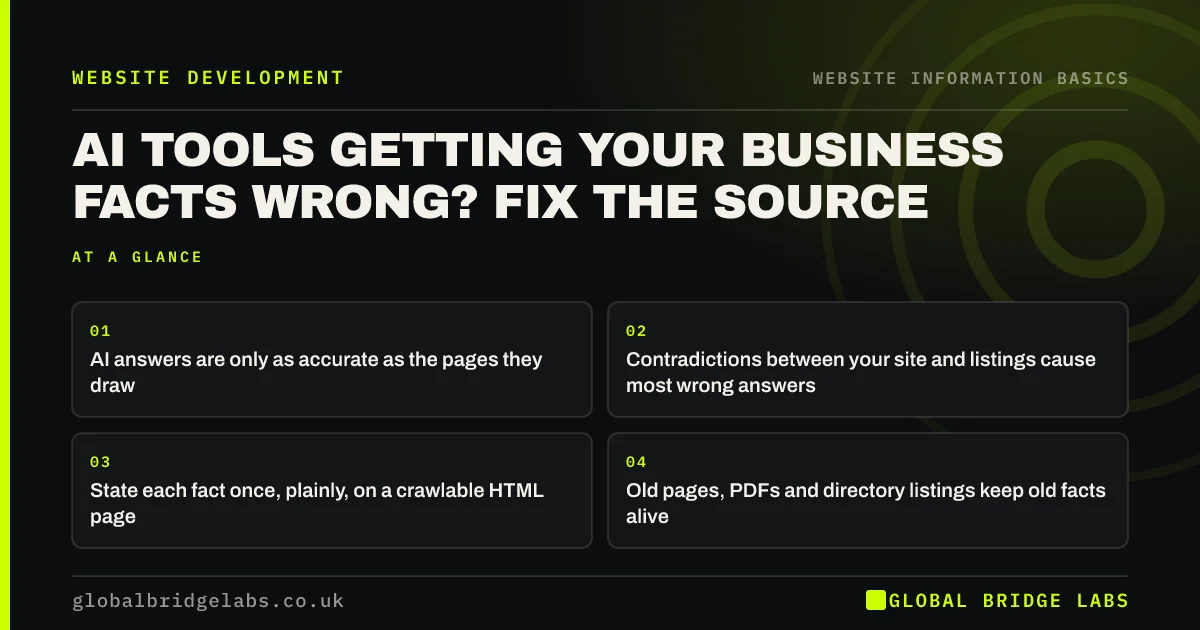
- AI answers are only as accurate as the pages they draw on.
- Contradictions between your site and listings cause most wrong answers.
- State each fact once, plainly, on a crawlable HTML page.
- Old pages, PDFs and directory listings keep old facts alive.
Seeing wrong AI answers about your business? Message us on WhatsApp.
Chat on WhatsApp →Why do AI tools get business facts wrong?
AI tools get business facts wrong because they summarise what they can find, and what they find is often incomplete, outdated or contradictory. An old directory listing, a forgotten PDF price list or a vague service page can all feed a confident but wrong answer. Global Bridge Labs (GBL) sees this most with prices, areas and opening hours.
Can you correct what an AI says about your business?
You cannot edit an AI assistant's answer directly, and feedback buttons rarely change much on their own. What you can do is make the correct fact easy to find and hard to misread: one clear statement on your website, matched on your Google Business Profile and major listings, with outdated versions removed.
How should facts be written so AI reads them correctly?
Write each fact as a plain sentence in HTML text, not inside an image or a PDF. 'We cover Leeds, Bradford and Wakefield' is unambiguous; 'serving the region' is not. Google's guidance on AI features says the same practices that help Search, such as clear text and crawlable pages, apply to AI features too.
Which old sources keep wrong facts alive?
Old facts survive in out-of-date pages left live, PDFs of old brochures or price lists, directory and review site profiles, previous social media bios and press articles. Remove or update what you control, redirect retired pages, and ask the larger directories to correct their listings.
When is a wrong AI answer not worth chasing?
A wrong answer is not worth chasing when it is about a trivial detail, comes from a third-party opinion you cannot change, or appears only for an obscure prompt. Focus on facts that affect buying decisions: what you sell, where, roughly what it costs, and how to reach you.
What does this look like in practice?
A pattern we see: an AI assistant quotes a price that a business stopped charging two years earlier. The source turns out to be a PDF price list still linked from an old blog post. Removing the PDF, redirecting its address and stating current price guidance on the service page addresses the source.
AI business facts checklist
- Ask three AI assistants about your business.
- Note every wrong fact.
- Find where each wrong fact could come from.
- State the correct fact once on your website.
- Match it on your Business Profile and listings.
- Remove or redirect old pages and PDFs.
Next step
Ask ChatGPT, Gemini and Copilot what your business does, where and for roughly how much. Write down every error and trace its source.
Message us on WhatsApp for help tracing wrong AI answers to their source, with no pitch.
Chat on WhatsApp →Sources and further reading
- AI features and your website · Google Search Central
- Organization structured data · Google Search Central
- Google Business Profile Help · Google
- Creating helpful, reliable, people-first content · Google Search Central
Frequently asked questions
Why does ChatGPT have wrong information about my business?
AI assistants summarise information they find or were trained on, which may be outdated or contradictory. Old directory listings, PDFs and vague website copy are common causes. Make the correct facts clear on your website and consistent everywhere else, then check again over the following months.
How do I get AI to show correct business information?
Publish each key fact clearly in text on your website, keep your Google Business Profile and major listings identical, add Organization structured data, and remove outdated pages and documents. There is no direct edit button, so consistency across sources is the main lever.
Does structured data help AI tools?
Structured data makes your business facts easier for machines to read, and Google uses it for its own features. It is not a guarantee for any AI tool. Clear visible text that matches the markup and your other listings matters more.
Written by

Global Bridge Labs (GBL) is a UK–Sri Lanka partner for social media, websites and BPO. Everything here comes from client delivery, not theory.