On this page
- 01Key takeaways
- 02What is the minimum information a business website needs?
- 03Which of the 12 are legal requirements?
- 04Can a one-page website carry all of it?
- 05What can safely wait?
- 06When is the minimum not enough?
- 07What does this look like in practice?
- 08Minimum website information checklist
- 09Next step
- 10Sources and further reading
- 11Frequently asked questions
Key takeaways
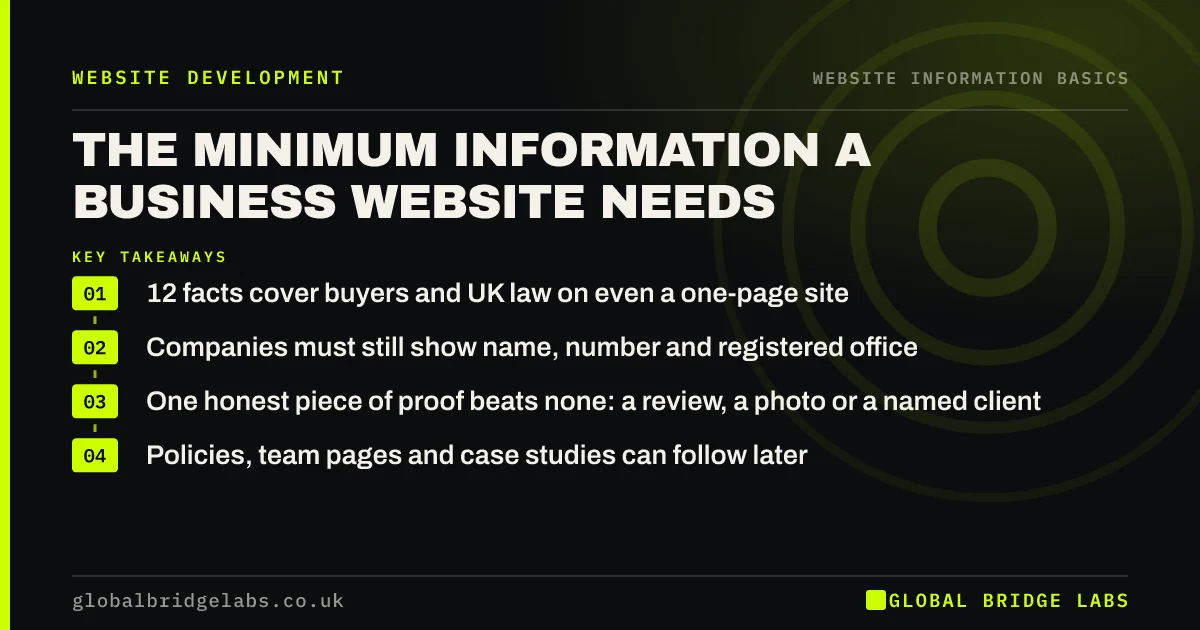
The minimum a business website needs is 12 facts: who you are, legal details, what you do, who for, area, price guidance, one piece of proof, how to buy, contact details, what happens next, a privacy notice and terms if you sell online. That covers buyers and UK law. Everything else can be added as the business grows.
- 12 facts cover buyers and UK law on even a one-page site.
- Companies must still show name, number and registered office.
- One honest piece of proof beats none: a review, a photo or a named client.
- Policies, team pages and case studies can follow later.
Building a first site? Message us on WhatsApp for the 12-fact list.
Chat on WhatsApp →What is the minimum information a business website needs?
A minimum business website needs 12 facts: business name and legal details, what you do, who it is for, where you work, price guidance, one piece of proof, how buying works, phone and email, what happens after enquiring, a privacy notice and terms where you sell online. Global Bridge Labs (GBL) treats these as the floor, not the goal.
Which of the 12 are legal requirements?
For companies and LLPs, the registered name, number, place of registration and registered office are required by the Trading Disclosures Regulations 2015. A privacy notice is required where you collect personal data, including through a contact form. If you sell to consumers online, pre-contract information and cancellation rights are also required.
Can a one-page website carry all of it?
Yes. A one-page site can carry all 12 facts in short sections, with the legal details in the footer and the privacy notice on its own linked page. The constraint is length. Each fact needs one or two sentences, not a section, so the page stays scannable on a phone.
What can safely wait?
Detailed case studies, a team page, a blog, policy pages for tenders, and separate pages per service can wait until you have the material and the demand. Do not publish empty sections or 'coming soon' pages for them. A short, complete site looks more credible than a long one with gaps.
When is the minimum not enough?
The minimum is not enough for regulated firms, higher-value services and businesses selling online at volume. Regulated firms need their status statements. High-value buyers need more proof and process. Online shops need delivery, returns and full pre-contract information on top of the 12.
What does this look like in practice?
A pattern with new businesses: the first site launches with a logo, a tagline and a contact form, and nothing else, because the owner plans to 'fill it in later'. Writing the 12 facts takes an afternoon and turns a placeholder into a working site. The facts usually already exist in the owner's quotes and emails.
Minimum website information checklist
- Business name, plus legal details if a company.
- What you do, in one sentence.
- Who it is for, and the area you cover.
- Price guidance or a typical range.
- One real piece of proof.
- How buying works, in three steps.
- Phone, email and what happens next.
- Privacy notice and, if selling online, terms.
Next step
Write the 12 facts in a document before you open a website builder. The site then takes hours, not weeks.
Message us on WhatsApp for the 12-fact template, with no pitch.
Chat on WhatsApp →Sources and further reading
- Company, Limited Liability Partnership and Business Names (Trading Disclosures) Regulations 2015 · legislation.gov.uk
- Right to be informed (privacy information) · Information Commissioner's Office
- Consumer Contracts (Information, Cancellation and Additional Charges) Regulations 2013 · legislation.gov.uk
- Electronic Commerce (EC Directive) Regulations 2002 · legislation.gov.uk
Frequently asked questions
What should a simple business website include?
A simple business website should include what you do, who for, where, price guidance, one piece of proof, how to buy, contact details, what happens next and the legal basics. That is 12 facts, which fit on a single page with a linked privacy notice.
Does a sole trader website need legal information?
A sole trader is not covered by the company trading disclosure rules, but if you use a business name you should make your own name and an address for documents easy to find. Selling online brings Electronic Commerce Regulations duties, and collecting data needs a privacy notice.
Is a one-page website enough for a small business?
A one-page website is enough when you offer one or two services to one type of buyer. Once you have several services, areas or audiences, separate pages help both visitors and search engines, because each page can answer one set of questions properly.
Written by

Global Bridge Labs (GBL) is a UK–Sri Lanka partner for social media, websites and BPO. Everything here comes from client delivery, not theory.