On this page
- 01Key takeaways
- 02What must a sole trader show on a website?
- 03Do the business names rules apply to websites?
- 04What extra applies if you sell online?
- 05Do you have to show your home address?
- 06What else helps a sole trader site look established?
- 07When does a sole trader need more?
- 08What does this look like in practice?
- 09Sole trader website checklist
- 10Next step
- 11Sources and further reading
- 12Frequently asked questions
Key takeaways
A sole trader website should show your own name if you trade under a business name, a contact email and an address where you can receive post. If you sell online, the Electronic Commerce Regulations 2002 require your name, geographic address and email, plus your VAT number if registered. A privacy notice is needed if your site collects personal data.
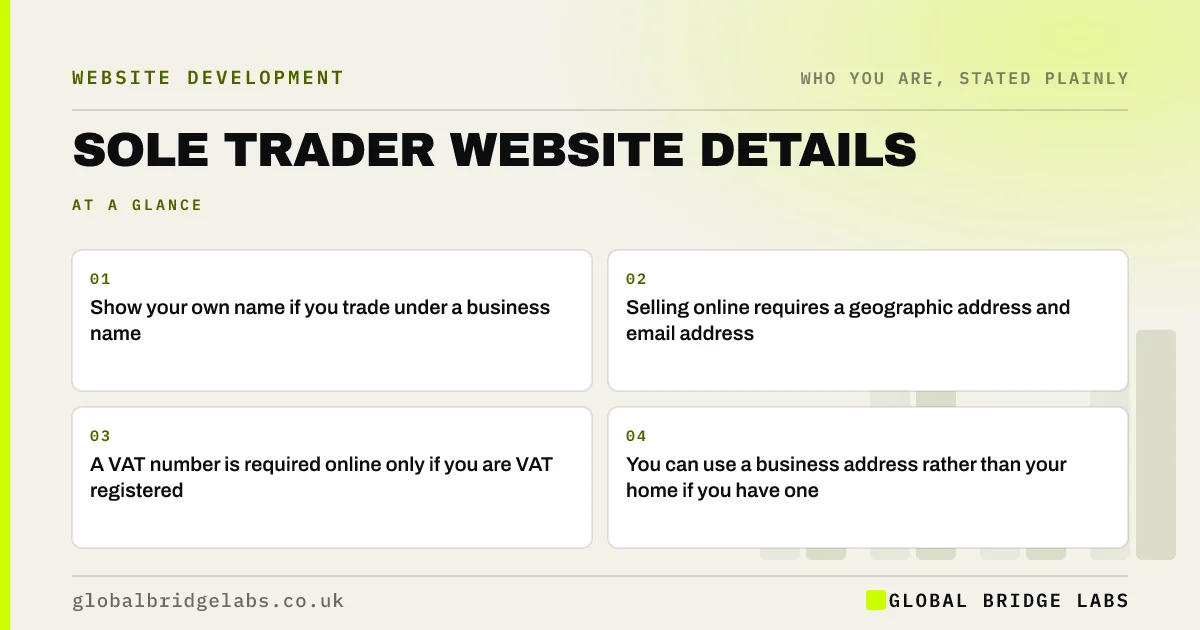
- Show your own name if you trade under a business name.
- Selling online requires a geographic address and email address.
- A VAT number is required online only if you are VAT registered.
- You can use a business address rather than your home if you have one.
Sole trader with a site to check? Message us on WhatsApp.
Chat on WhatsApp →What must a sole trader show on a website?
A sole trader should show their own name where they trade under a business name, a working email address, an address where post reaches them and, if VAT registered and selling online, a VAT number. Global Bridge Labs (GBL) also recommends a privacy notice, because almost every site with a contact form collects personal data.
Do the business names rules apply to websites?
The business names rules require a sole trader using a business name to show their own name and an address on business documents such as invoices, letters and receipts. They do not name websites directly, but a website that hides the owner's name looks less trustworthy and conflicts with your invoices. Show both names.
What extra applies if you sell online?
If you sell or take orders online, the Electronic Commerce Regulations 2002 require your name, a geographic address, an email address, any trade register details and your VAT number if registered. Selling to consumers also brings the Consumer Contracts Regulations 2013, including information about cancellation rights.
Do you have to show your home address?
Not if you have another address where post reliably reaches you, such as a workshop, office or a properly run business address service. The law asks for a geographic address, not a home address. If you work from home with no alternative, weigh the privacy risk and consider a business address service.
What else helps a sole trader site look established?
Beyond the legal details, a sole trader site gains trust from a real photo of you, a short plain-English description of what you do and where, proof of work, insurance details and any registration such as Gas Safe or a trade body. Small businesses look established when they look specific.
When does a sole trader need more?
A sole trader needs more when they work in a regulated field, such as gas work, financial advice or childcare, where the regulator sets its own disclosure rules. Selling online to consumers at volume also brings delivery, returns and pre-contract information duties. Check your sector's rules before launch.
What does this look like in practice?
A pattern we see: a sole trader's site uses a business name, a mobile number and a contact form, with no surname, address or privacy notice anywhere. Adding the owner's name and photo, a postal address and a short privacy notice takes under an hour, and the site immediately reads as a real person's business.
Sole trader website checklist
- Your own name, alongside any business name.
- An email address that works.
- A geographic address for post.
- VAT number if registered and selling online.
- A privacy notice linked from every page.
- Any registration or licence your trade needs.
Next step
Check your site for your own name, a postal address and a privacy notice. If any is missing, add it this week.
Message us on WhatsApp for a sole trader website check, with no pitch.
Chat on WhatsApp →Sources and further reading
- Electronic Commerce (EC Directive) Regulations 2002 · legislation.gov.uk
- Consumer Contracts (Information, Cancellation and Additional Charges) Regulations 2013 · legislation.gov.uk
- Right to be informed (privacy information) · Information Commissioner's Office
Frequently asked questions
Does a sole trader need a privacy policy on their website?
If the website collects personal data, for example through a contact form, enquiry email or analytics cookies, you need to tell people how you use it. That means a privacy notice. Almost every business website collects some personal data, so most sole traders need one.
Can a sole trader use a business name on a website?
Yes. Sole traders can trade under a business name, but they cannot use 'Limited' or 'Ltd', and some words need approval. Your own name and an address must appear on business documents, and showing them on the website keeps things consistent.
Does a sole trader have to show an address online?
If you sell or take orders online, the Electronic Commerce Regulations require a geographic address. It does not have to be your home if you have another address where post reliably reaches you, such as business premises or a business address service.
Written by

Global Bridge Labs (GBL) is a UK–Sri Lanka partner for social media, websites and BPO. Everything here comes from client delivery, not theory.