On this page
- 01Key takeaways
- 02What is an accessibility statement?
- 03Who must publish one?
- 04Why might a private business publish one?
- 05What should the statement include?
- 06Can a statement make things worse?
- 07When is a statement not a priority?
- 08What does this look like in practice?
- 09Accessibility statement checklist
- 10Next step
- 11Sources and further reading
- 12Frequently asked questions
Key takeaways
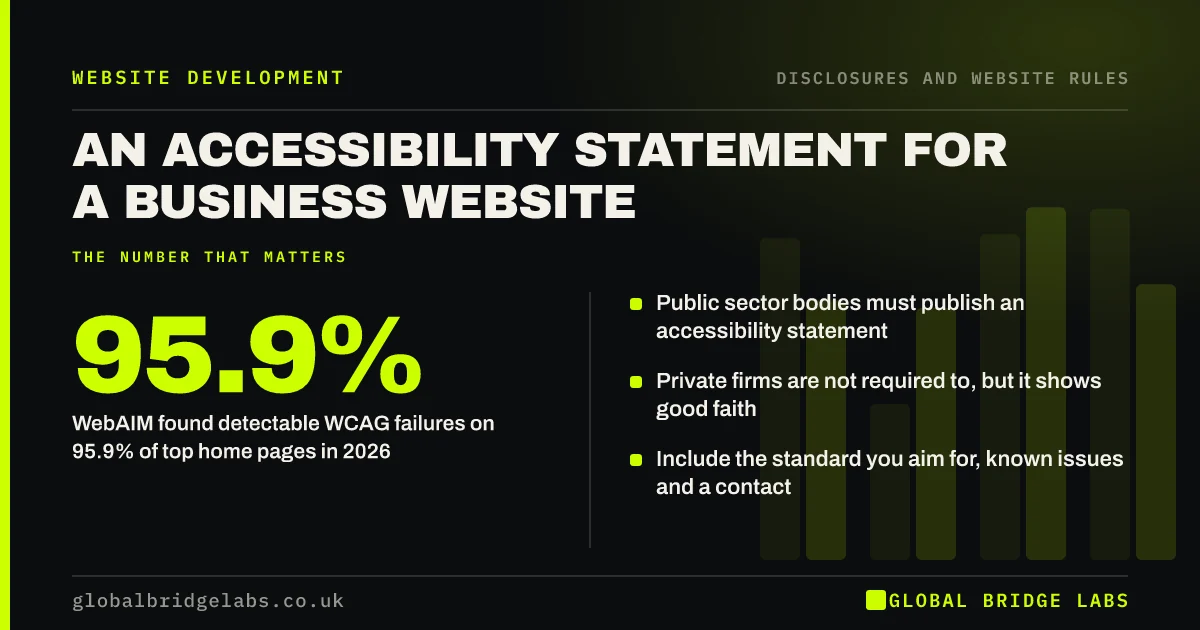
Public sector bodies must publish an accessibility statement for their websites. Private businesses are not required to, but the Equality Act 2010 still expects reasonable adjustments, and a short statement shows disabled visitors you have tested the site, lists known problems and gives a route for help. Only publish what is true.
- Public sector bodies must publish an accessibility statement.
- Private firms are not required to, but it shows good faith.
- WebAIM found detectable WCAG failures on 95.9% of top home pages in 2026.
- Include the standard you aim for, known issues and a contact.
Want your site's accessibility checked? Message us on WhatsApp.
Chat on WhatsApp →What is an accessibility statement?
An accessibility statement explains how accessible your website is, which standard you aim to meet, any known problems and how disabled visitors can get help or information in another format. Global Bridge Labs (GBL) treats it as a sector notice for public bodies and an optional trust item for private businesses.
Who must publish one?
Public sector bodies must publish an accessibility statement under the Public Sector Bodies Accessibility Regulations 2018, in a set format. Private businesses are not covered by those regulations. They are, however, covered by the Equality Act 2010 duty to make reasonable adjustments for disabled people.
Why might a private business publish one?
A statement shows good faith, gives disabled visitors a route for help and sets expectations about known issues. Accessibility problems are common: WebAIM's 2026 analysis of the top one million home pages found detectable WCAG failures on 95.9% of them. Saying what you have fixed, and what you have not, is honest.
What should the statement include?
Include the standard you aim for, usually WCAG 2.2 level AA, when the site was last tested and how, known issues and plans to fix them, how to request information in another format and how to report a problem. Date it, and review it when the site changes.
Can a statement make things worse?
Yes, if it claims compliance you have not tested, or relies on an overlay widget as proof of accessibility. Overstated claims can mislead disabled users. Test with real checks first, then write what you found.
When is a statement not a priority?
For a private business, fixing the site's biggest barriers, such as missing form labels or poor contrast, matters more than writing a statement. If you can only do one, fix the barriers. Then publish a short statement describing the work and the contact route.
What does this look like in practice?
A pattern we see: a business copies an accessibility statement template claiming full WCAG compliance, without any testing. A quick check finds unlabelled forms and low-contrast text. Replacing the claim with tested facts and a fix plan is both more honest and more useful.
Accessibility statement checklist
- Test the site against WCAG 2.2 AA.
- State the standard and test date.
- List known issues and fix plans.
- Offer alternative formats.
- Give a contact for problems.
- Review it after site changes.
Next step
Run a free automated accessibility check on your homepage and contact form. Fix the errors it finds before you write a statement.
Message us on WhatsApp for an accessibility review, with no pitch.
Chat on WhatsApp →Sources and further reading
Frequently asked questions
Does a private business need an accessibility statement?
No, the accessibility statement requirement applies to public sector bodies. Private businesses are still covered by the Equality Act 2010 duty to make reasonable adjustments, so many publish a statement voluntarily to show good faith and offer help.
What should an accessibility statement include?
It should include the standard you aim for, usually WCAG 2.2 AA, how and when you tested, known issues and plans, how to get information in other formats and how to report a problem. Date it and keep it current.
Can I say my website is fully accessible?
Only if you have tested it properly against a recognised standard. Most websites have some issues. Describing what you tested, what you found and what you are fixing is more honest and more useful to disabled visitors.
Written by

Global Bridge Labs (GBL) is a UK–Sri Lanka partner for social media, websites and BPO. Everything here comes from client delivery, not theory.